Chapter 12 — Runbooks, Automation, and the Muscle Memory of Operations
Summary
This chapter treats runbooks as executable operational contracts that convert tribal knowledge into shared, auditable capability usable by both human engineers and AI agents. It defines the anatomy of a production-quality runbook, including trigger conditions, pre-conditions, sovereign zone decision branches, rollback steps and escalation paths, and presents a four-rung automation maturity ladder from fully manual execution through to bounded autonomous operation. Architects will find detailed guidance on Ansible and IBM Ansible Automation Platform as the bridge between human-readable procedures and machine-executable playbooks, the safe-to-automate test for evaluating which steps merit automation, and the agent apprentice model in which Concert and watsonx Orchestrate progressively learn from human decisions. The chapter also covers the design of sovereignty-aware guardrails for automated remediation, the audit trail requirements of DORA and ITIL 4, and the organisational habits needed to keep runbooks aligned with evolving systems.
12.1 When tribal knowledge isn’t enough
In most long‑lived organisations, there is at least one person everyone calls when things go wrong at 2 a.m. They know which process to restart “in the right order,” which feature flag to flip, which database index to rebuild, which firewall rule to toggle. None of this is written down in a way a new joiner could safely follow. It lives in a handful of heads and in half‑remembered chat threads.
In a small, single‑cloud environment, this kind of tribal knowledge is uncomfortable but survivable. In a sovereign, multi‑cloud, agentic estate, it is a structural risk. If common incidents can only be resolved by a few individuals, then your resilience, sovereignty posture and ability to use automation or agents are all hostage to their availability and memory. The Google SRE Workbook is direct on this point: it treats undocumented, person‑dependent response knowledge as a reliability anti-pattern, and positions runbooks as the primary mechanism for converting individual expertise into shared operational capability [1].
The structural danger compounds as estates grow. A single sovereign zone operating in one jurisdiction with a stable team is already risky when knowledge is tribal. Introduce a second zone in a different regulatory jurisdiction, a third cloud provider with its own operational idioms, and a set of AI-driven operational agents that need machine-readable procedures to act on—and the risk multiplies. At that point, the knowledge that lives in a few people’s heads is not merely a bus-factor problem. It is an architectural constraint that prevents the organisation from realising the value of its investments in automation and agentic operations. An agent cannot act on knowledge it cannot access, and it cannot be constrained to act within sovereignty obligations it cannot read.
There is also an accountability dimension that is frequently underestimated. Regulators inspecting an organisation’s incident response capability—under DORA, NIS2, or sector-specific supervisory expectations—will ask not just whether incidents were resolved, but how they were resolved and whether the resolution was consistent with the organisation’s documented procedures and policy commitments. An organisation whose response to this question is “our most experienced operators handled it” is exposed. One whose response is “this incident triggered Runbook P4, which was executed by the automation platform with these specific steps, these policy checks, and this outcome” is in a fundamentally stronger position. The operational record is the compliance record.
The operational world has been moving away from tribal dependence for some time. Site Reliability Engineering and incident‑management practices emphasise documented playbooks or runbooks that describe how to respond to specific classes of incidents, and automation that executes standard steps reliably and repeatably. Beyer et al.’s foundational Site Reliability Engineering text argues that any manual, repetitive operational task is a form of toil that erodes engineering capacity and, left unchecked, scales linearly with system complexity rather than being amortised by it [2]. Humble and Farley, in Continuous Delivery, extend the same logic to deployment and release operations: the goal is to make the entire release process scripted, repeatable and auditable—removing dependence on individual recall and institutional memory [3]. Runbook automation platforms, from both tooling vendors and cloud providers, increasingly realise this ambition by encoding incident response knowledge into predefined workflows triggered by alerts [4].
In a sovereign, agentic architecture, runbooks and automation are how you turn muscle memory into shared capability. They make it possible for humans and agents to act consistently, under pressure, without improvising their way into policy violations. This chapter works through what that capability looks like in practice: how good runbooks are structured, how they are progressively automated, how agents interact with them, and how the whole system is kept alive as the environment around it evolves.
12.2 What a good runbook actually looks like
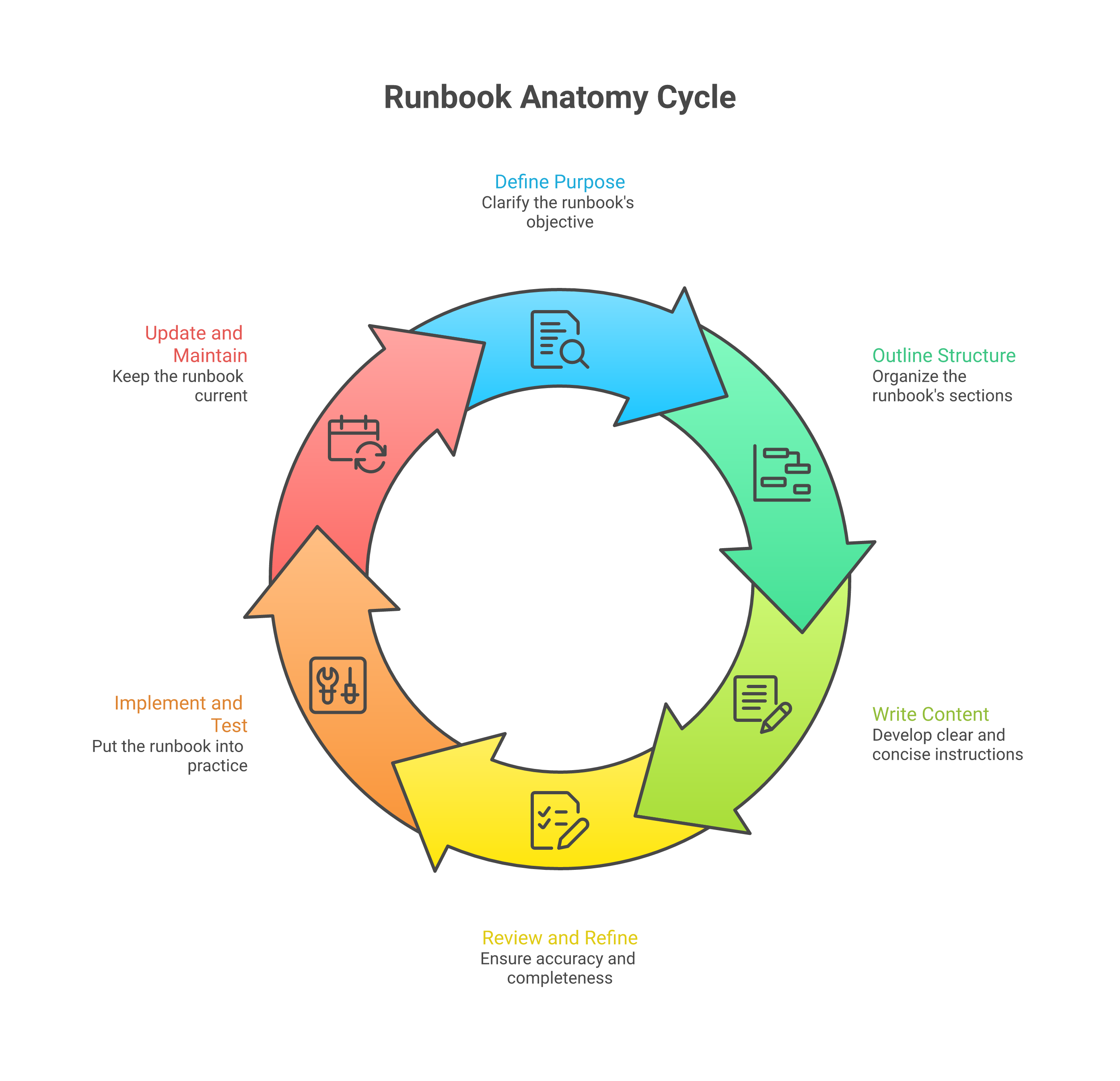
The word “runbook” is sometimes used to describe anything from a one‑line wiki entry (“restart service X”) to a 40‑page PDF written for auditors. Neither extreme is helpful at 2 a.m. The challenge is to define a form that is specific enough to be followed without ambiguity, concise enough to be used under pressure, and structured enough to support automation and agent execution.
Practitioners who specialise in incident response and SRE tend to converge on a well-defined anatomy for effective runbooks. Atlassian’s Incident Management Handbook describes a mature runbook as a structured document whose first concern is precision of scope: it must open with unambiguous trigger conditions that tell the reader exactly which alert, symptom, or operational signal caused it to be invoked [5]. This is not a cosmetic formality. A runbook invoked for the wrong situation is worse than no runbook at all: it wastes time and may apply remediation actions that are inappropriate or actively harmful. The trigger section should reference specific alerting rule names, thresholds, or symptom patterns, so that an operator facing a wall of monitoring data can quickly confirm they are reading the right document.
Following the trigger conditions, a production-quality runbook specifies pre-conditions: the checks that must be satisfied before any action is taken. Is the monitoring system itself behaving correctly? Is a maintenance window currently active? Are there any known platform-level issues that would make this alert a downstream symptom of something else? Pre-conditions prevent wasted effort and, in regulated environments, prevent automation from proceeding when the broader context invalidates the standard response.
The step-by-step procedure is the core of the runbook, and its quality determines whether the document is genuinely useful or merely aspirational. Each step should specify the exact command to run, the exact dashboard or data source to consult, and the exact output or state that should be observed. Vague instructions such as “check whether the database is healthy” are not actionable under incident pressure. Concrete instructions such as “navigate to the Instana infrastructure view, filter by the payments-db tag, and confirm that the connections_active metric is below 200” leave no room for interpretation. The Google SRE Workbook reinforces this point, noting that runbooks must be operable by any competent engineer on the team, not just the person who wrote them [1]. That standard is the right one: if the author is unavailable, the runbook must still work.
Decision points deserve special attention. A runbook that presents a single linear sequence of steps is implicitly asserting that every instance of a given incident is identical. In practice, they rarely are. Well-designed runbooks contain explicit branching logic: “If the error rate remains above 40% after completing step 5, proceed to the degraded-mode path in section 12.3; if it has fallen below 10%, continue to section 12.4 and close the incident.” These decision points are also where sovereign constraints belong. A runbook for a cross-zone connectivity failure might include a branch that reads: “If the affected workload carries the sovereign-zone: regulated tag, do not invoke the failover procedure in section 12.6; instead follow the degraded-service path in Annex B and notify the compliance team immediately.” Embedding these constraints in the procedure itself—rather than relying on operators to remember them—is what makes runbooks compatible with sovereignty obligations.
Rollback steps are an element that many runbooks omit and later regret. Every remediation action that modifies state—restarts, configuration changes, feature flag adjustments, database operations—should have an associated rollback or undo path. The rollback steps do not need to be long, but they must exist, so that if a remediation action makes things worse, the operator has an equally clear path back to the previous state without needing to improvise. Kim et al., in The Phoenix Project, illustrate through narrative how the absence of well-defined rollback procedures transforms straightforward incidents into multi-hour crises [6].
The escalation path and the owner complete the anatomy. The escalation path specifies who to contact, and through which channels, if the procedure does not resolve the incident or if conditions arise that are not covered by the runbook. The owner is the named individual or team responsible for keeping the runbook current and reviewing it after incidents.
A useful heuristic drawn from incident response practice is what might be called the five-minute rule: a runbook that cannot be meaningfully engaged with by a competent engineer within five minutes of arriving at an incident is too complex for operational use [5]. This does not mean that the runbook must be completable in five minutes—some recovery procedures genuinely take longer. It means that within five minutes, an engineer should be able to read the trigger conditions, confirm they apply, understand what the runbook asks them to do first, and begin doing it. If a runbook fails this test, it should be split into a shorter primary procedure and one or more linked reference appendices.
Runbook testing is as essential as runbook authorship, and is practised far less often. A runbook that has never been executed in a controlled environment before the incident it is meant to address is, at best, a hypothesis. Executing runbooks in staging environments—against realistic data and service configurations—reveals gaps, incorrect commands, and invalid assumptions before they cause harm in production. The ITIL 4 Framework’s practices for service management stress the importance of testing service continuity plans and operational procedures as part of normal service management activity, not only after failures [7]. Runbook testing should be a scheduled activity, not an afterthought: quarterly execution exercises, reviewed by the owning team, with gaps documented and addressed before the next scheduled test.
Post-incident retrospectives are the second testing mechanism. After any incident in which a runbook was used—successfully or not—the retrospective should explicitly address how the runbook performed. Was it found quickly? Were the trigger conditions accurate? Did the steps work as described? Were any steps missing? Were any constraints correctly observed? The answers to these questions drive updates. This is not bureaucratic compliance; it is the operational feedback loop that keeps runbooks aligned with reality as systems evolve.
All of this makes sense only if runbooks are version-controlled in Git. A runbook managed in a wiki or a shared document has no reliable change history, no review mechanism, and no rollback path. A runbook stored in Git alongside the infrastructure and application code it supports has all three. Pull requests for runbook changes can require review by the owning team and by representatives of any sovereign zone affected. Change history is preserved automatically. And, crucially, the relationship between runbooks and the automation that implements them is made explicit: the runbook is the human-readable specification, and the Orchestrate workflow or Ansible playbook is the machine-executable implementation derived from it. Changes to one should prompt review of the other.
12.3 From human‑only runbooks to partial automation
Once a runbook has been used a few times, patterns emerge. Certain steps are always performed the same way: fetch these logs, run that health check, flip this feature flag, restart that deployment. These are prime candidates for automation. The question is not whether to automate them, but how to automate them safely, in what sequence, and with what level of human oversight preserved at each stage.
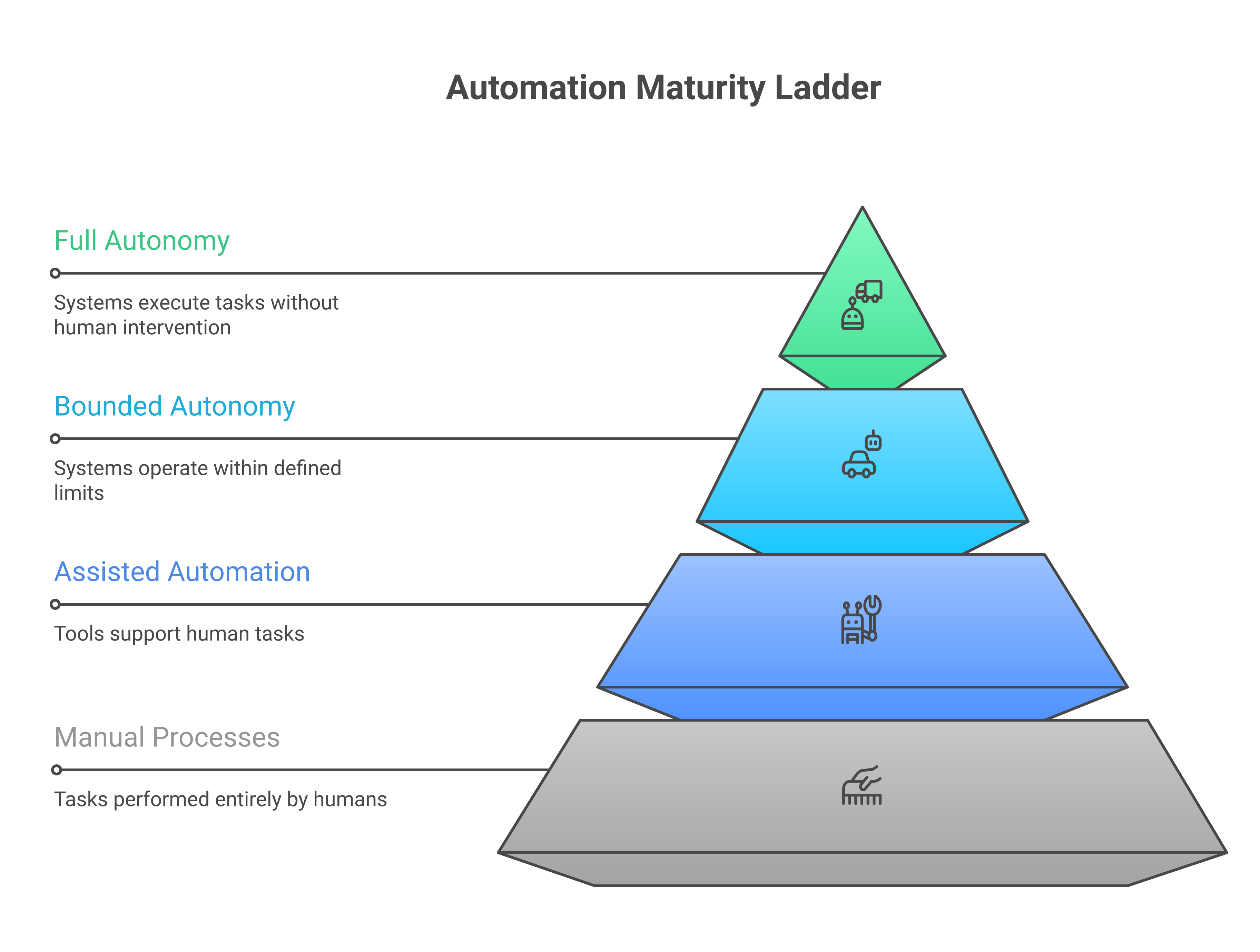
The most useful way to think about this progression is as a maturity ladder, with four distinct rungs that an organisation climbs over time as confidence, tooling and governance capability develop.
At the bottom rung, the operation is fully manual. An engineer reads a runbook, opens a terminal, and types commands. Every action is subject to individual judgement about sequencing and correctness. This is where most organisations begin, and it is not inherently wrong; it is simply the starting point. The risk is pure: human error, recall failure, and inconsistency between operators.
The second rung is tool-assisted. Engineers still invoke procedures manually, but individual steps have been wrapped in scripts or helper utilities that reduce the scope for error. A bash script fetches the relevant logs from the correct cluster and formats them for review. A Python utility queries three monitoring sources and presents a consolidated health report. These tools reduce toil and mechanical error without removing human control over sequencing and decisions. They also serve as a useful forcing function: building them requires the runbook author to be precise about what “fetch the relevant logs” actually means in concrete terms.
The third rung is partially automated. Scripts and utilities are composed into orchestrated workflows, using tools such as Ansible, Rundeck, or IBM Ansible Automation Platform, with branching logic, error handling, and structured logging. A partially automated workflow might automatically execute the diagnostic section of a runbook—gathering logs, querying health endpoints, inspecting recent changes—and then pause to present findings to a human operator before proceeding to remediation. PagerDuty’s guidance on runbook automation describes this model as particularly valuable for high-frequency, well-understood incident types, where the diagnostic work is deterministic but the remediation decision may depend on context that only a human can evaluate [8]. Atlassian similarly describes partial automation as the practical balance between speed and safety for most operational procedures [5].
The fourth rung is fully automated within bounds. Certain well-understood, thoroughly tested, clearly reversible procedures can run end-to-end without human involvement, subject to policy guardrails that constrain their scope. This is not the same as unconstrained automation; it is automation whose blast radius has been deliberately limited, whose conditions for invocation have been precisely specified, and whose every execution is recorded and reviewed.
Ansible is the most widely deployed technology for the second and third rungs of this ladder. Its agentless architecture, human-readable YAML playbook syntax, and extensive module library make it the natural bridge between human-readable runbook steps and machine-executable automation. A runbook step that reads “restart the payment-gateway deployment in the zone-A cluster” translates directly into an Ansible task invoking the kubernetes.core.k8s module with the appropriate parameters. The playbook preserves the structure and logic of the runbook—its pre-conditions, decision points, and rollback steps—while eliminating the manual execution of individual commands.
IBM Ansible Automation Platform extends Ansible’s capabilities with the infrastructure required for enterprise operational use [9]. Execution environments provide reproducible, containerised runtimes for playbooks, ensuring that the Python libraries, collections, and Ansible versions used during a playbook’s authorship and testing are precisely the same as those used when it runs in production. This matters more than it might appear: a playbook that behaves correctly against one version of the kubernetes.core collection may behave differently against another, and in an operational context those differences can be consequential. Credentials management within Automation Platform separates secrets from playbooks: rather than embedding API keys, service account tokens or SSH keys in playbook code—where they are visible in version control and log output—credentials are managed centrally, injected at runtime into the execution environment, and never exposed to the playbook author or operator invoking the workflow. The platform’s audit trail records every playbook execution: who or what triggered it, when, with which inventory and credentials, and what the outcome of every task was. This trail is the operational audit record required by frameworks such as ITIL 4 [7] and regulatory instruments such as DORA, which requires that ICT risk management frameworks include documented evidence of how operational procedures are executed and reviewed.
Before any runbook step is automated, it should be evaluated against a safe-to-automate test. This is a structured assessment with four dimensions. The first is reversibility: can the action be undone if it produces an undesired outcome? Restarting a deployment is reversible; deleting data or revoking a certificate mid-use is not. Irreversible actions require stronger human oversight, even when they are well understood. The second dimension is blast radius: what is the scope of potential harm if the action executes incorrectly? A health-check query against a single service has a minimal blast radius; a network routing change affecting an entire sovereign zone does not. The third is frequency: how often is this step executed? High-frequency, low-complexity steps benefit most from automation, both in toil reduction and in reliability improvement. The fourth is false positive risk: what are the consequences if the triggering condition is incorrectly identified, and the automated action is applied when it should not be? A diagnostic action with no side effects can be triggered liberally; a remediation action with significant side effects must have a tightly specified trigger condition.
Graduated rollout of automation mirrors the practices of good software deployment. New automated procedures begin in development and staging environments, where they are tested under realistic conditions. They are then applied in production non-regulated zones, initially with human approval gates retained for the remediation steps. Only once confidence is established—measured by successful execution rate, absence of unintended side effects, and positive assessment in post-incident retrospectives—are approval gates relaxed and the procedure allowed to run further autonomously. Sovereign zone constraints are applied throughout: a procedure that passes the safe-to-automate test in a non-regulated zone may not pass it in a regulated zone, where the regulatory consequences of an incorrect action are significantly higher.
12.4 Designing automation with sovereignty and guardrails
Automation has a way of spreading. Once a workflow exists, there is always another system it could be pointed at, another region it could touch, another data set it could operate on. In regulated environments, unchecked spread is dangerous. The efficiency gains that make runbook automation appealing—fewer manual steps, faster response, reduced toil—are also what make it capable of causing harm at speed and scale if not properly bounded.
Guidance on automation in regulated industries stresses that traditional “gated” processes—where humans review every change manually—do not scale, and argues instead for systemic trust: automation grounded in policy, telemetry and auditable behaviour. Similarly, emerging best practices for AI and automation talk about guardrails: specialised controls that enforce safety, compliance and ethical boundaries without blocking legitimate innovation [10]. The key insight in both bodies of thought is the same: the goal is not to eliminate automation in high-risk contexts, but to ensure that automation in those contexts is constrained, observable and reversible.
Applied to runbook automation in sovereign operations, this translates into a small number of design principles that must be applied consistently across all automated procedures.
Workflows must be zone‑aware. They should read metadata and tags on resources, clusters and accounts to determine which sovereign zone they are operating in, and adapt or refuse to act accordingly. This is not a last-resort guard rail; it is the first check a workflow should perform. A workflow that would fail over a workload to a different region must first determine whether that workload’s sovereign zone classification permits cross-region failover; if it does not, the workflow must take the degraded-service path instead and surface this decision clearly in its execution log. Zone-awareness must be implemented in the automation engine itself, not in the runbook text alone: a playbook that relies on an operator reading a note that says “check zone constraints before running step 3” has already failed the design standard. Zone constraints must be evaluated programmatically, with the result determining which path the automation takes.
Dangerous actions—moving data, changing network paths, invoking AI models on sensitive datasets—must consult policy services before executing, and log both the request and the decision. This is not merely good practice; in environments subject to DORA or sector-specific supervisory expectations, it is the difference between a defensible operational record and a gap that regulators can challenge. A policy service, in this context, is not necessarily a complex dedicated system; it may be as straightforward as an OPA (Open Policy Agent) rule evaluated by the automation platform before proceeding. The important characteristics are that the policy evaluation happens at execution time, using the actual parameters of the intended action—not at authorship time based on what the author expected those parameters would be—and that both the query and the result are logged durably.
Autonomy levels should vary by context. Some runbooks may auto-remediate in non-regulated environments but only propose actions for humans to approve in regulated zones. This asymmetry is intentional and should be explicitly documented in the runbook and in the workflow configuration, so that operators understand that the same named procedure behaves differently in different zones and why. The documentation of this asymmetry matters: if operators believe that a runbook always executes automatically and in fact it pauses for approval in regulated zones, they may fail to attend to approval requests promptly, or may not realise that their approval is what is preventing the automation from completing.
Runbook-automation platforms integrated with Ansible, for example, emphasise access control, logging and audit trails to make self-service automation safe, even when less technical users invoke powerful playbooks [9]. Those same features are what make runbooks compatible with sovereignty: every invocation is scoped, recorded and subject to role-based access and policy checks. The IBM Ansible Automation Platform’s role-based access control model allows organisations to specify not only who can view and invoke a given playbook, but which inventory hosts—and therefore which sovereign zones—that invocation may target. A playbook author in one zone cannot inadvertently make their automation available to operators in another zone without explicit configuration.
The final design principle is separation of escalation from failure. When automated runbook execution encounters a situation it cannot handle—a policy check that fails, a pre-condition that is not satisfied, an action that returns an unexpected error—the workflow should not simply halt and leave the incident unaddressed. It should transition to a defined escalation path: creating or updating an incident ticket with the full execution context, notifying the appropriate on-call team, and preserving all state information so that a human engineer can take over without needing to repeat the diagnostic work the automation has already done. A workflow that fails silently is more dangerous than one that fails noisily; one that fails with a well-structured handover to a human is the appropriate design target.
12.5 Agents as apprentices, not magicians
Agents do not render runbooks obsolete; they change how runbooks are used and maintained. The most useful mental model for this relationship is the apprentice model: the agent begins by observing human activity, progresses to proposing actions for human review, then advances to executing approved actions within clearly bounded contexts, and eventually—for the narrowest and most thoroughly validated categories of action—operates autonomously within defined limits. At no stage does the agent transcend its operational bounds without explicit extension of those bounds by a human with appropriate authority.
In practice, an agent responding to an incident might begin by reading alerts and observability data to build a coherent narrative: “Since 03:12 UTC, success rates on payment authorisations in zone A have dropped from 98% to 40%, while order placement remains normal.” This is the observation phase—the agent assembles context from multiple telemetry sources, correlates signals across time, and produces a human-readable summary that gives the on-call operator immediate situational awareness rather than a wall of undifferentiated metric graphs.
The agent then matches the narrative against existing runbooks: “This pattern aligns with Runbook P4: Payment gateway degradation.” This matching function is where IBM Concert’s recommendation engine plays a central role [11]. Concert builds a continuously updated topology model of the environment—services, their dependencies, their observed behaviours—and uses this model to score the relevance of candidate runbooks against observed incident patterns. Crucially, Concert learns from human accept and override decisions over time. When an operator accepts a recommended runbook, that acceptance reinforces the match signal for similar future incidents. When an operator overrides the recommendation—selecting a different runbook, or modifying the suggested approach—that override is recorded as a learning signal. Over many incidents, the recommendation engine becomes progressively better calibrated to the specific characteristics of the organisation’s environment, its workloads, and its operational culture. This is the mechanism by which the apprentice model improves: the agent learns not by autonomously experimenting but by observing and internalising human expert judgement applied to real situations.
Once a runbook is selected, the agent executes the diagnostic section automatically as a set of bounded, audited tool calls. In the watsonx Orchestrate architecture, each tool call is a discrete, scoped action: a query against an observability API, a read from a configuration store, an invocation of a log-aggregation endpoint. Each call is authorised against the agent’s identity and scope at execution time, recorded in the audit trail, and surfaced to the operator in the incident context. The agent gathers relevant logs, queries event streams, inspects recent deployment and configuration changes, and attaches findings to the incident ticket—not as a single opaque response, but as a structured set of evidence items with provenance. The operator reviewing this evidence knows exactly what the agent queried, when, and what it found. This transparency is what distinguishes an agentic apprentice from an opaque magic box: the human retains full visibility into the basis for the agent’s conclusions.
The agent then presents recommended remediation options, annotated with policy considerations drawn from the sovereign zone context: “Option 1: switch to backup gateway within zone A (available, compliant with zone constraints); Option 2: degrade certain features to reduce gateway load (available, no policy restrictions); Option 3: fail over to region B (not available in this sovereign zone—zone-crossing failover is blocked by the zone-A policy set).” The annotation of options with their policy status is essential: it prevents operators under pressure from inadvertently selecting an option whose sovereign zone implications they have not had time to evaluate, and it makes the policy compliance of the eventual decision explicit and auditable.
Escalation design deserves particular attention. When an agent encounters a condition not covered by any existing runbook—an incident pattern that matches no established template, or a runbook whose logic reaches a branch for which no action is defined—it must not proceed speculatively. The correct behaviour is to escalate, immediately and with maximum context assembled. The agent should surface everything it has gathered: the narrative it constructed, the runbooks it considered and why it rejected them, the diagnostic evidence it collected, and its assessment of what is uncertain. An agent that escalates with well-assembled context is far more valuable than one that either halts with a bare error or, worse, attempts to improvise a response. The escalation path should be defined in the runbook itself—specifying which team, which channel, and which severity classification applies—so that the agent’s escalation is directed to the right people without requiring further human triage.
Over time, agents can help evolve runbooks by analysing incident histories. By examining the steps taken in resolved incidents, they can identify procedure steps that are always executed identically (strong candidates for fuller automation), branches that are never taken (potentially obsolete decision paths), and points where operators routinely deviate from the documented procedure (possible misalignment between the runbook and operational reality). This analysis is surfaced as recommendations in post-incident retrospectives, not applied automatically: the runbook owner reviews the agent’s observations and decides which changes to make. In this way, the continuous learning loop between incidents, agent observations, human decisions, and runbook updates keeps the operational muscle memory alive and accurate even as systems change rapidly beneath it.
In a sovereign architecture, agents must also respect AI guardrails: they should not propose or execute remediations that cross data or jurisdiction boundaries, or that invoke AI models outside approved contexts. The same identity-first and policy-driven patterns used for AI safety apply to operational agents. The bounds within which an agent may act are not general-purpose; they are zone-specific, role-specific, and runbook-specific—and they are defined by humans, encoded in policy, and enforced at the level of the tool call authorisation mechanism, not merely by instructions in a system prompt.
12.6 Runbooks, automation and the audit trail
When auditors or regulators ask how an organisation handles incidents, they increasingly expect more than a static document. They want to see how incidents are actually handled: how quickly they are detected, how responses are initiated, how decisions are made under pressure, and how lessons are captured. In a sovereign, multi-cloud environment, they may also ask specifically whether responses stayed within the bounds of the organisation’s sovereignty commitments—whether data was processed only in approved jurisdictions, whether AI-assisted decisions were made with appropriate human oversight, whether cross-zone actions were explicitly authorised before they occurred.
Runbook and automation platforms can contribute significantly to this evidence by recording each execution—who or what triggered a runbook, when, with which parameters, and in which environment [8]. Every step and its outcome should be logged, including calls to external systems, policy checks and approvals. Integration with incident-management tools ensures that timelines and actions are linked to specific incidents, creating a coherent narrative from first alert to resolution [1]. This linkage matters because auditors evaluating an incident after the fact need to be able to reconstruct the decision-making sequence: what information was available at each step, what action was taken, who authorised it, and what the consequence was. Logs that record individual actions without linking them to the incident context are less useful than logs that preserve the full causal chain.
The specifics of what must be recorded vary by regulatory regime, but several elements are common across DORA, NIS2, and equivalent frameworks. First, the identity of every actor—human or automated—that performed a materially significant action must be recorded. For human actors, this means the authenticated identity of the operator, not merely the system account under which they acted. For automated actors—Ansible playbooks, Orchestrate agents, or other workflow engines—it means the service identity of the automation, the human identity that invoked it, and the approval chain if one was required. Second, the scope of each action must be recorded: which resources were affected, in which sovereign zone, under which policy context. Third, the outcome must be recorded: success or failure, and in the case of failure, the error condition and the subsequent escalation path followed.
SolarWinds and comparable platforms stress that automated runbooks, when designed well, not only improve incident resolution efficiency but also provide consistency and accuracy, reducing variance between incidents and making responses more auditable [12]. Vendors like PagerDuty emphasise that runbook automation with strong access control and logging can make automation safe for wider audiences, which is critical in regulated environments [8]. Both observations point to the same conclusion: the audit trail is not a secondary output of automation, it is one of its primary deliverables. Designing automation without considering what it needs to log—and verifying that those logs are structured, queryable, and retained for the required period—is designing it incompletely.
For sovereign operations, this data can show not just that incidents were handled, but that they were handled within constraints. For example: logs can demonstrate that during a cross-zone outage, automation chose to degrade functionality locally rather than failing over to a non-compliant region; or that certain remediation options were blocked by policy and alternatives used instead [13]. This kind of evidence—machine-generated, time-stamped, and linked to the specific policy rule that was applied—is qualitatively stronger than a written procedure that says policy constraints will be observed. It demonstrates that they were, in this specific incident, at this specific time, with these specific resources involved. That is the standard of evidence that mature regulatory supervision increasingly demands, and it is a standard that well-designed runbook automation can meet consistently where improvised, person-dependent response cannot.
12.7 Keeping operational muscle memory alive
Runbooks and automation are sometimes treated as one‑off deliverables: something written during a transformation or after a painful outage and then left to gather dust. Everyone knows how that story ends: the next big incident reveals that the runbook is out of date, the scripts don’t quite work, and people fall back on improvisation.
Best-practice guidance is clear on the antidote: runbooks and automation must be treated as living artefacts [14]. The ITIL 4 Framework, in its practices for service management, identifies continual improvement as a core principle that applies equally to operational procedures as to service components [7]. A runbook that is not being updated is a runbook that is silently diverging from the system it describes.
Key habits include:
Post-incident review and update: after an incident, teams review not only what went wrong technically but how the runbooks and automation performed. Were they helpful, confusing, or missing? The results feed into updates with clear owners and deadlines. This is not optional—it is the primary mechanism by which operational knowledge is kept aligned with operational reality. Teams that consistently skip runbook review in retrospectives accumulate a debt of outdated procedures that becomes painfully apparent at the worst possible moment.
Regular exercises: game days and chaos experiments that explicitly include running and testing runbooks—both manually and via agents—help keep procedures realistic and tools sharp. The SRE Workbook describes DiRT (Disaster Recovery Testing) exercises at Google as a mechanism for surfacing exactly this kind of procedural debt before incidents do [1]. The discipline of treating runbooks as executable artefacts to be tested, not merely readable documents to be filed, is the cultural shift that separates organisations with genuine operational resilience from those with the appearance of it.
Version control: storing runbooks and their automation definitions in Git means changes are reviewed, history is preserved and rollbacks are possible [14]. Every runbook update should be a pull request, reviewed by the owning team and by any affected sovereign zone representatives. The commit message should reference the incident or exercise that prompted the change, creating a traceable link between operational experience and procedural evolution.
Discoverability: ensuring operators and agents can easily find the right runbook for a given signal or alert, rather than starting from scratch each time, requires intentional taxonomy and tooling [4]. Runbooks should be tagged with the alert names and symptom patterns that trigger them, so that both search interfaces and agent recommendation engines can surface the right document quickly. A runbook that exists but cannot be found in the first five minutes of an incident might as well not exist.
In a sovereign, agentic estate, these habits are not optional hygiene; they are central to maintaining control. As systems, regulations and AI capabilities evolve, your operational muscle memory must evolve with them. Keeping it codified, tested and visible is how you ensure that when things go wrong, you respond not just quickly, but in ways that are consistent with your obligations and your own sense of how the system should behave.
Bridge to Chapter 13 — Secrets, Identity, and Access
This chapter has established that runbooks are not administrative documents but executable operational contracts: structured procedures that encode expert knowledge in a form followable by any competent engineer, and increasingly by agents, under the pressure of real incidents. The anatomy of a production-quality runbook—trigger conditions, pre-conditions, step-by-step procedure, decision points with sovereign zone branches, rollback steps, escalation path, and owner—provides the template. The automation maturity ladder—from fully manual through tool-assisted and partially automated to bounded autonomous execution—provides the progression model. Ansible and IBM Ansible Automation Platform provide the bridge between human-readable specification and machine-executable implementation, with the audit trail and credential isolation that regulated environments require. The agent apprentice model extends this further: agents that observe, propose, execute with approval, and eventually operate autonomously within carefully defined bounds, learning from human decisions and escalating gracefully when conditions exceed their scope.
These capabilities are only as trustworthy as the identity and access controls underpinning them. An Ansible playbook executing in a sovereign zone must authenticate with appropriate credentials, scoped to precisely the resources it is permitted to modify. An Orchestrate agent proposing remediation actions must carry an identity whose authorisations have been deliberately defined and regularly reviewed. A Concert recommendation engine whose learning signals are based on human expert decisions must be able to demonstrate that those decisions were made by authorised, authenticated individuals. Chapter 13 takes up this foundation: the secrets, identity and access architecture that makes every automated and agentic action in a sovereign multi-cloud estate attributable, auditable, and appropriately constrained.
Key Takeaways
- A production-quality runbook is not a document but an operational contract: it must specify trigger conditions, pre-conditions, procedural steps, decision points with sovereign zone branches, rollback steps, escalation path, and an owner—everything required for a competent engineer to act correctly under incident pressure without improvisation.
- The five-minute rule is a practical quality standard: if a runbook cannot be meaningfully engaged with within five minutes of arriving at an incident, it is too complex and must be restructured.
- The automation maturity ladder—fully manual, tool-assisted, partially automated, fully automated within bounds—provides a principled progression; each rung requires demonstrating safety at the previous rung before ascending, and sovereign zone constraints apply at every level.
- Ansible and IBM Ansible Automation Platform translate human-readable runbook steps into machine-executable playbooks with enterprise-grade credential management, execution environments, role-based access control, and audit trails—making runbook automation compatible with the evidence requirements of DORA, ITIL 4, and comparable regulatory frameworks.
- The agent apprentice model—observe, propose, execute with approval, execute autonomously within bounds—is the correct posture for operational agents; agents must escalate with fully assembled context when they encounter conditions outside their defined scope, rather than proceeding speculatively.
- IBM Concert’s recommendation engine learns from human accept and override decisions, progressively calibrating runbook recommendations to the specific operational environment without requiring the agent to experiment autonomously on production systems.
- Runbooks stored in Git, tested in staging and against realistic game-day exercises, reviewed in post-incident retrospectives, and updated with traceable commit history are living operational artefacts; those treated as one-off deliverables silently diverge from reality and fail at the worst possible moment.
References
[1] B. Beyer, N. R. Murphy, D. K. Rensin, K. Kawahara, and S. Thorne, Eds., The Site Reliability Workbook: Practical Ways to Implement SRE. Sebastopol, CA: O’Reilly Media, 2018. [Online]. Available: https://sre.google/workbook/table-of-contents/
[2] B. Beyer, C. Jones, J. Petoff, and N. R. Murphy, Eds., Site Reliability Engineering: How Google Runs Production Systems. Sebastopol, CA: O’Reilly Media, 2016. [Online]. Available: https://sre.google/sre-book/table-of-contents/
[3] J. Humble and D. Farley, Continuous Delivery: Reliable Software Releases through Build, Test, and Deployment Automation. Upper Saddle River, NJ: Addison-Wesley, 2010.
[4] Harness, “Runbook Automation Overview,” Harness Developer Documentation, 2024. [Online]. Available: https://developer.harness.io/docs/ai-sre/runbooks/
[5] Atlassian, Incident Management Handbook. Sydney: Atlassian, 2023. [Online]. Available: https://www.atlassian.com/incident-management/handbook
[6] G. Kim, K. Behr, and G. Spafford, The Phoenix Project: A Novel about IT, DevOps, and Helping Your Business Win. Portland, OR: IT Revolution Press, 2013.
[7] Axelos, ITIL 4 Foundation: ITIL 4 Edition. London: TSO (The Stationery Office), 2019.
[8] PagerDuty, “Beyond Playbooks: Unleashing Enterprise-Wide Automation with Ansible and PagerDuty Runbook Automation,” PagerDuty Blog, 2023. [Online]. Available: https://www.pagerduty.com/blog/automation/beyond-playbooks-unleashing-enterprise-wide-automation-with-ansible-pagerduty-runbook-automation/
[9] IBM, “Ansible Automations,” IBM Netcool Operations Insight Documentation, version 1.6.x. Armonk, NY: IBM Corporation, 2023. [Online]. Available: https://www.ibm.com/docs/en/noi/1.6.14?topic=automations-ansible
[10] Institute of Project Management, “Automation in Regulated Environments: Replacing Gated Delivery with Systemic Trust,” IPM Blog, 2024. [Online]. Available: https://instituteprojectmanagement.com/ae/blog/automation-in-regulated-environments-replacing-gated-delivery-with-systemic-trust/
[11] IBM, IBM Concert: Product Documentation and Architecture Overview. Armonk, NY: IBM Corporation, 2024. [Online]. Available: https://www.ibm.com/products/concert
[12] SolarWinds, “Runbook Best Practices and Automation Benefits,” SolarWinds SRE Best Practices, 2023. [Online]. Available: https://www.solarwinds.com/sre-best-practices/runbook-automation
[13] Cutover, “Incident Management Automation With Intelligent Runbooks,” Cutover Blog, 2023. [Online]. Available: https://www.cutover.com/blog/intelligent-runbooks-automation-transform-incident-management
[14] Octopus Deploy, “Configuration as Code for Runbooks,” Octopus Deploy Blog, 2023. [Online]. Available: https://octopus.com/blog/introducing-config-as-code-runbooks
Sovereign Cloud Operations: AI-Driven Management of Sovereign Estates
© 2026 by Alan Hamilton
is licensed under CC BY-SA 4.0


