Chapter 17 — IBM watsonx Orchestrate: The Conversational Operations Interface
Summary
This chapter explains how IBM watsonx Orchestrate bridges the gap between Concert’s prioritised recommendations and the multi-tool actions required to execute them, providing a single conversational interface that translates natural-language operator intent into authenticated, logged tool calls. It covers Orchestrate’s five-layer architecture—language model, tool registry, workflow engine, memory, and governance integration—and examines the tool-calling model, zone-scoped registries, and short-lived scoped credentials that enforce sovereign-zone boundaries. The chapter details how YAML-defined workflows handle multi-step operations with approval gates, how Orchestrate functions as the planner agent in multi-agent architectures, and how governance controls at the prompt, output, and model-monitoring levels satisfy regulatory obligations including the EU AI Act. Architects will find practical guidance on deployment models, conversational UX design principles, and the systematic refinement of tool descriptions and workflow definitions that builds operator trust over time.
There is a gap that sits between knowing and doing. IBM watsonx Concert, described in Chapter 16, excels at the knowing side: it ingests telemetry, maps application topology, evaluates risk posture and surfaces prioritised recommendations. An operator looking at the Concert dashboard can see, with reasonable confidence, that a certificate is approaching expiry in a regulated zone, that a vulnerability has been scored critical, or that a capacity anomaly has been detected in a production workload. What Concert cannot do, by design, is act. It observes; it recommends; it stops.
Crossing from recommendation to action has historically meant opening a second browser tab, then a third. The operator consults a runbook, raises a ServiceNow change request, logs into an Ansible controller, approves a Terraform plan, monitors a Kubernetes rollout, and then—if everything goes well—closes the ticket and adds a comment. Each of those steps is a context switch, a place where intent can be misread and where the chain of evidence can be broken. Audit logs exist in four systems, none of which fully agrees with the others.
IBM watsonx Orchestrate is the layer that closes that gap. It is a conversational and workflow engine that accepts natural-language operator intent and translates it into sequences of authenticated, logged tool calls. The conversation itself becomes the audit trail. The operator stays in one interface; the actions flow out behind the scenes, properly credentialled and recorded, returning results in language the operator can read and confirm before anything further happens.
This chapter explains how Orchestrate works, from its internal architecture through its tool-calling model, its workflow engine, and its governance controls, to the moment an operator types a question and watches a multi-step operation unfold in response.
17.1 From recommendation to conversation
The problem Concert solves is one of signal quality: in an estate with hundreds of services, thousands of configuration items and millions of log events per day, finding the things that matter is genuinely hard. Concert’s contribution is to reduce that noise to a ranked list of actionable recommendations, each backed by the topology, telemetry and risk context that justifies its priority.
The problem that Orchestrate solves is different. It is not a problem of signal; it is a problem of friction. Once an operator has a recommendation—”renew the TLS certificate for api.payments.example.internal before it expires in eleven days”—the work of executing that recommendation requires navigating a sequence of systems that were built at different times, by different teams, with different interfaces and different authentication models. The operator must remember which Ansible playbook handles certificate renewal, which inventory group covers the payments zone, how to pass the correct variables, and how to ensure that the change request in ServiceNow is linked to the Concert finding before the playbook runs. None of that is technically difficult; all of it is time-consuming, error-prone, and invisible to any single logging system.
Orchestrate approaches this friction by introducing a single conversational interface in front of the entire tool estate. The operator does not need to know which tool handles certificate renewal; they describe what they want in ordinary language, and Orchestrate determines which tools to call, in what order, with what parameters, based on its understanding of the operator’s intent and its registry of available tools.
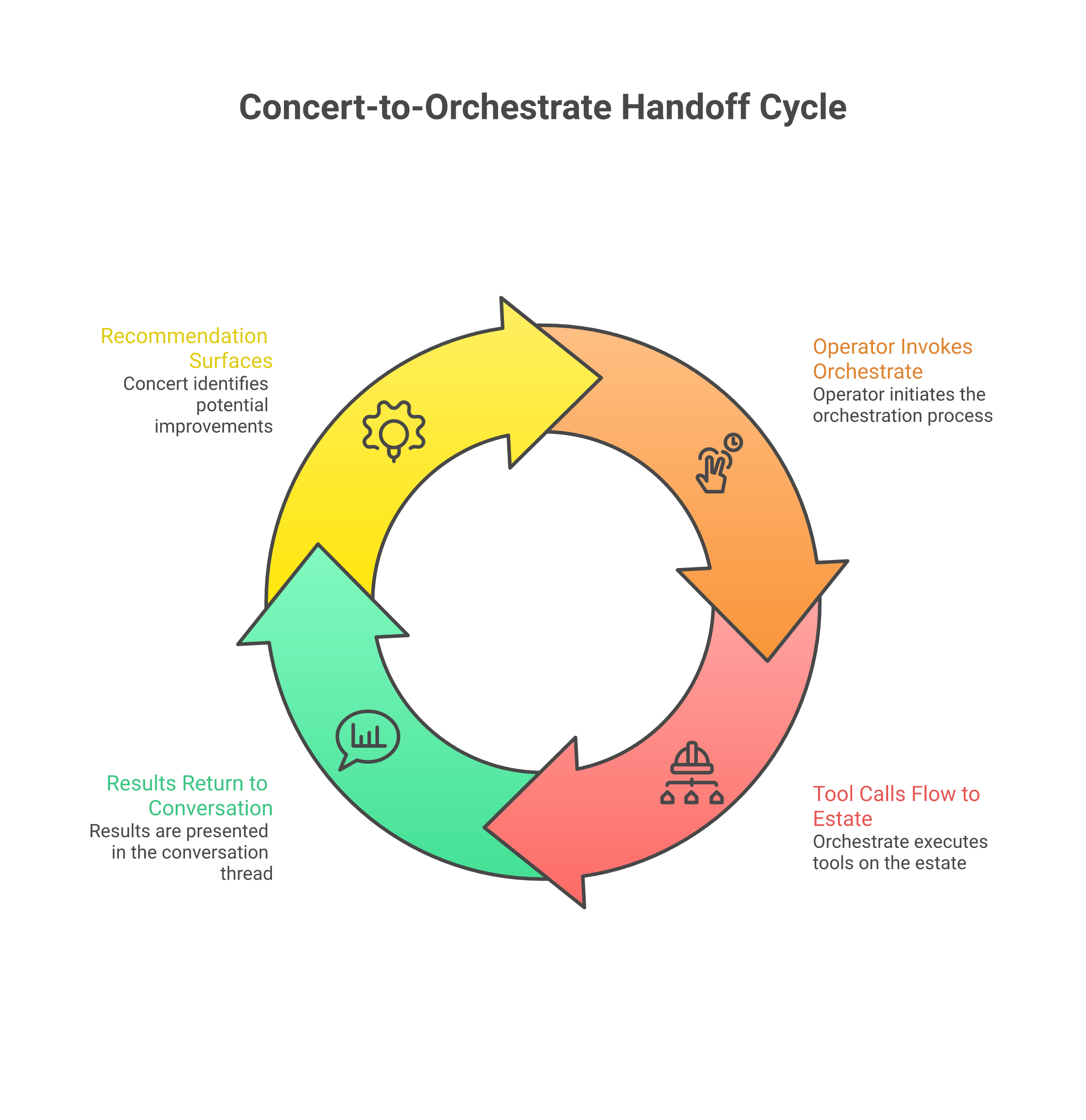
The conversation as audit trail deserves emphasis because it is not merely a convenience feature; it is a compliance mechanism. Every turn in a conversation with Orchestrate is timestamped, associated with the authenticated identity of the operator, and linked to the tool calls that were made on their behalf. When a regulator or an internal auditor asks “who authorised the certificate renewal on 14 February, and what exactly happened,” the answer is retrievable from the conversation log without reconstructing it from four separate systems [1]. The conversation is not a paraphrase of what happened; it is what happened, in a form that both humans and automated audit tools can read.
This matters particularly in sovereign-zone operations, where the obligation to demonstrate control is explicit and ongoing. A conversational interface that produces a structured, tamper-evident log of every operator action—linked to the Concert finding that motivated it, the tool calls that executed it, and the approvals that authorised it—provides a form of operational evidence that no collection of separate system logs can easily replicate.
17.2 Orchestrate architecture
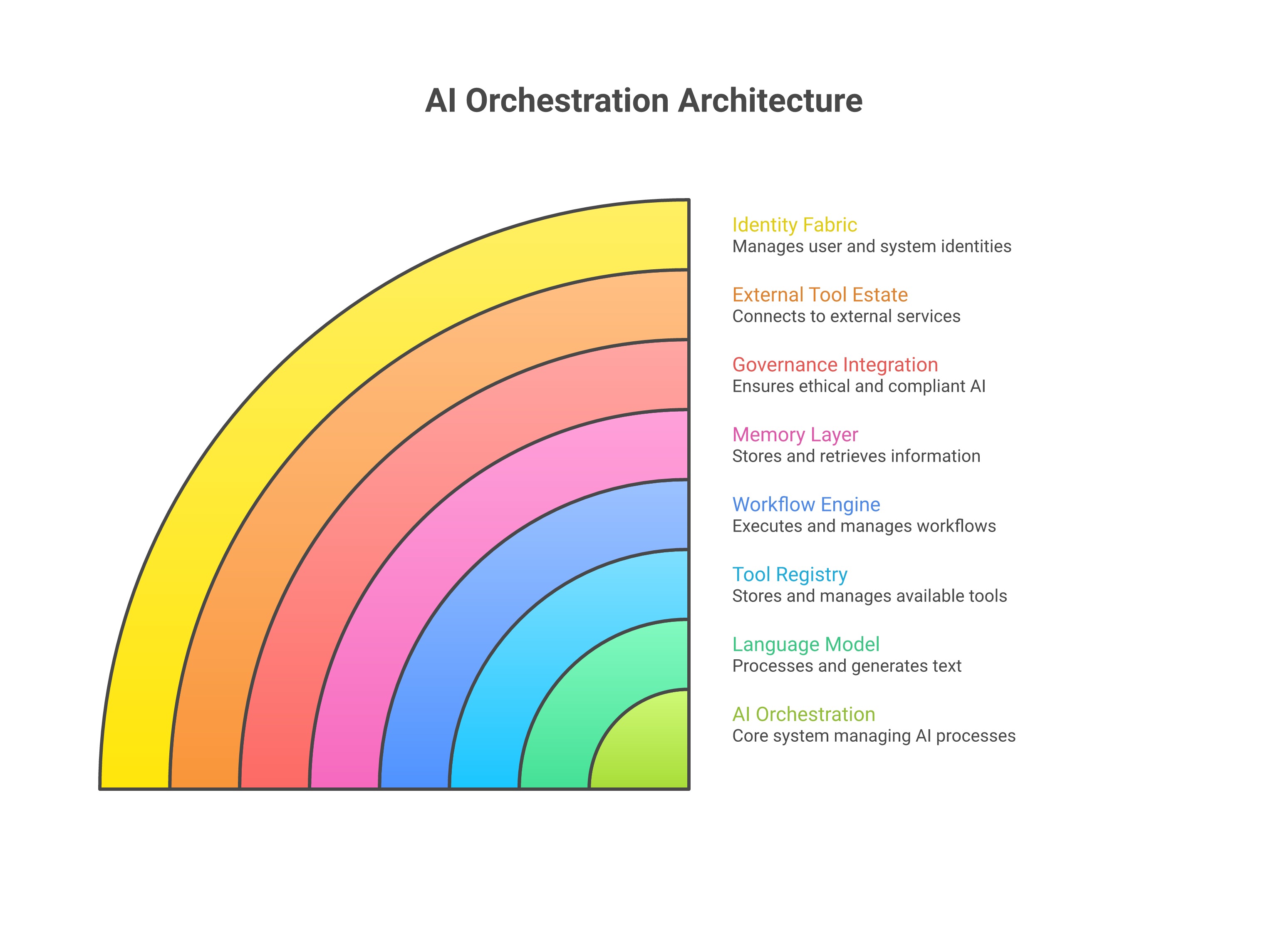
Orchestrate is composed of five functional layers, each with a distinct role and each replaceable or configurable within the constraints of the deployment model.
The language model layer is responsible for understanding operator input and generating responses. It receives the conversation history, the current user message, and a set of tool definitions, and it produces either a response to the operator or a decision to call one or more tools. Orchestrate is model-agnostic in principle; IBM deployments use models from the watsonx.ai family, and the specific model can be configured for a given deployment to satisfy data-residency or capability requirements. In sovereign deployments, this layer is a critical governance point: if the language model runs outside the sovereign zone, all conversation content—including potentially sensitive operational context—crosses the zone boundary. The architecture must account for this explicitly [2].
The tool registry is a catalogue of callable capabilities. Each entry in the registry describes a tool by name, by a natural-language description that the language model uses to decide whether the tool is relevant, by a typed input schema, and by an output schema. The language model cannot call a tool that is not in the registry; the registry therefore acts as a policy boundary. An organisation operating in a regulated sector can restrict the registry to tools that have been formally approved, just as it would restrict which runbooks may be executed in a production environment.
The workflow engine handles multi-step operations that cannot be expressed as a single tool call. It interprets flow definitions—expressed in YAML or JSON—that specify sequences of tool calls, parallel fan-outs, conditional branches, error handlers, and approval gates. The workflow engine maintains state across the steps of a workflow and returns control to the operator at defined points where confirmation or input is needed.
The memory layer provides continuity across a conversation. Short-term memory holds the content of the current session: the conversation history, the results of recent tool calls, and any context the operator has explicitly provided. Long-term memory, if configured, can retain information about the operator’s environment across sessions—persistent facts about the estate that the operator need not restate each time.
The governance integration layer connects Orchestrate to the organisation’s identity fabric, its approval systems, and its monitoring infrastructure. Authentication and authorisation flow through this layer; so do the hooks that allow watsonx.governance [3] to monitor the language model’s behaviour over time and flag anomalies in how it interprets operator intent.
Deployment model
Orchestrate is available as a Software as a Service (SaaS) offering on IBM Cloud, and as a self-managed deployment that can run on Red Hat OpenShift in any cloud, on-premises, or in an air-gapped sovereign zone. The choice between these modes is not merely a matter of operational preference; it has architectural consequences.
In SaaS mode, the control plane—including the language model layer—runs in IBM’s infrastructure. This is acceptable for many use cases, but it means that conversation content, including any operational context the operator provides, is processed outside the organisation’s own boundary. For organisations with strict data-residency requirements, or for operations that take place within a sovereign zone where the regulatory authority has specified that AI inference must remain within the jurisdiction, SaaS mode may not be available.
In self-managed mode, all five layers run within the organisation’s own infrastructure. The organisation controls which language model version is deployed, how it is updated, and what data it can access. This is a heavier operational burden, but it is the model that sovereign-zone operations typically require. The deployment model for the language model layer—specifically, where inference happens—should be treated as a first-class architectural decision, not an implementation detail [4].
17.3 The tool-calling model
The mechanism by which Orchestrate translates natural language into concrete actions is known as tool calling, and understanding it precisely is important for operators and architects who need to reason about what the system can and cannot do.
A tool definition has four mandatory components. The name is a short identifier used internally. The description is a natural-language paragraph that explains what the tool does, when it should be used, and what it requires; this is the primary signal the language model uses to decide whether a tool is relevant to a given operator request. The input schema is a typed structure—expressed in JSON Schema—that specifies the parameters the tool accepts, their types, whether they are required or optional, and any constraints on their values. The output schema similarly specifies what the tool returns.
When the operator sends a message, the language model receives the conversation history and the full set of tool definitions from the registry. It evaluates whether the operator’s request can be satisfied by calling one or more tools, or whether it should be answered directly in language. If it decides to call a tool, it generates a structured invocation: the tool name, and a JSON object matching the tool’s input schema, with parameter values extracted or inferred from the operator’s message and the conversation history [5].
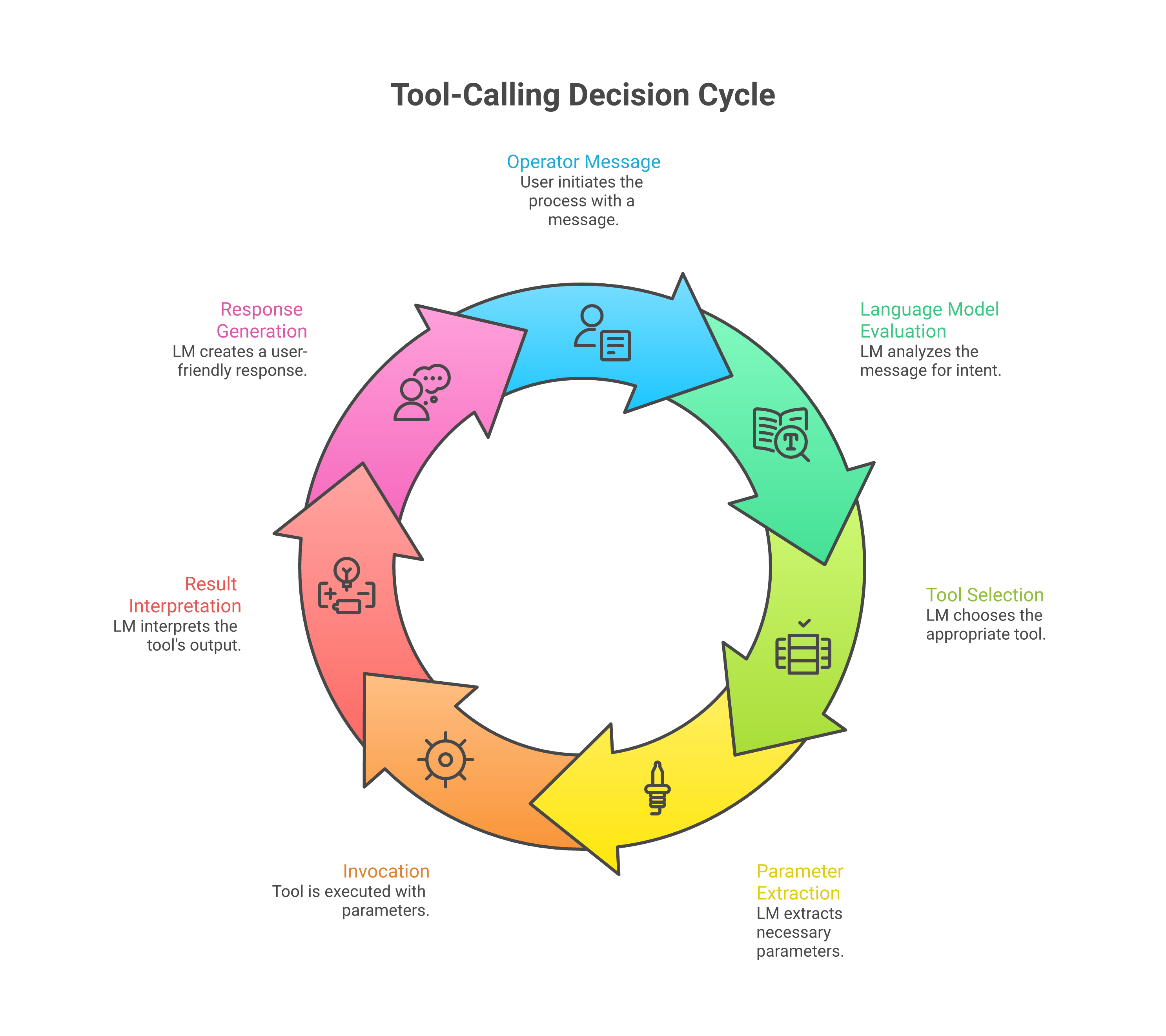
Parameter extraction deserves attention because it is the point where natural-language ambiguity meets structured data requirements. An operator who types “renew the certificate for the payments API” has not specified a subject alternative name list, a key algorithm, a validity period, or a certificate authority. The language model must either infer these values from context—if they are stored in memory or derivable from the tool description—or ask the operator to supply them before proceeding. Well-designed tool descriptions and well-configured memory layers reduce the frequency of clarification requests; poorly designed ones produce conversations that feel interrogatory rather than assistive.
Once the tool invocation is generated, it is passed to the governance integration layer, which validates it against the organisation’s policy before dispatching it. This is the point where zone-scoped tool registries matter. In a sovereign-zone deployment, different tools may be available depending on which zone the operation targets. A tool that provisions compute in a regulated zone may require elevated credentials and an approval gate; the same conceptual tool pointing at a development environment may not. The registry encodes this difference; the language model never has direct access to the underlying systems and cannot bypass registry-level controls.
Zone-scoped tool registries
The zone-scoped tool registry is one of the more important sovereign-operations patterns that Orchestrate enables. Rather than a single flat registry of all tools, the registry can be organised by zone, with each zone’s tools carrying the authentication requirements, approval configurations, and scope restrictions appropriate to that zone’s regulatory context.
An operator asking Orchestrate to “check the TLS certificate status for the payments zone” will receive results from tools scoped to the payments zone; they cannot inadvertently invoke a tool that acts on a different zone’s infrastructure unless they have the appropriate credentials and the registry explicitly permits it. This is not just a convenience; it is a defence against a class of operational errors—and potential insider risks—where an authorised action in one context is executed in the wrong context.
Tool authentication via the identity fabric
Tools do not authenticate with their target systems using the operator’s long-lived credentials. Instead, the governance integration layer requests a short-lived, scoped credential from the identity fabric described in Chapter 13, specifying the tool, the target zone, and the operation to be performed. The credential is valid only for the duration of the tool call and carries only the permissions required for that specific action [6].
This model has two important properties. First, it prevents credential sprawl: Orchestrate does not store long-lived secrets that could be exfiltrated or misused. Second, it provides the identity fabric with a complete record of every tool invocation, associated with the operator’s session token, which feeds directly into the audit trail.
17.4 Pre-built operational tools and integrations
Orchestrate ships with a library of pre-built tools covering the most common operational domains. Understanding what is available, and how to extend it, is a practical prerequisite for deploying Orchestrate in an enterprise operations context.
Concert query tools
The Concert integration provides tools for querying Concert’s application topology, retrieving recommendations, fetching risk scores, and reading the status of previously tracked findings. These tools are the primary mechanism by which Orchestrate consumes Concert’s output: rather than requiring the operator to navigate the Concert dashboard, Orchestrate can retrieve the relevant findings in response to a natural-language query and present them in conversational form. The operator can then proceed directly to remediation without leaving the Orchestrate interface.
Ansible automation tools
Ansible tools allow Orchestrate to trigger playbook executions against an Ansible Automation Platform controller. The tool definitions include playbook selection, inventory targeting, variable injection, and execution monitoring. Because Ansible is the primary runbook execution mechanism for many enterprise operations teams, this integration is one of the most heavily used. It is also one of the most sensitive: a misconfigured Ansible tool definition could allow an operator to execute a destructive playbook against the wrong inventory. Zone-scoped tool registries and approval gates are particularly important here [7].
Terraform tools
Terraform tools enable Orchestrate to interact with Terraform Cloud or a self-managed Terraform execution environment. Operations include plan retrieval, plan approval, apply execution, state inspection, and drift detection. Because Terraform changes are infrastructure-affecting, these tools are typically configured with mandatory approval gates for any operation that modifies state.
ServiceNow tools
ServiceNow tools cover the standard change management lifecycle: creating change requests, updating them with execution details, attaching evidence, and closing them. These tools allow Orchestrate to maintain ServiceNow records as a side effect of operational conversations, rather than requiring the operator to manage them separately. In organisations where change management compliance is audited, the automatic linkage between an Orchestrate conversation and a ServiceNow change record is a significant operational improvement.
GitHub and GitLab tools
Source control tools allow Orchestrate to read repository content, create branches, open pull requests, and trigger CI/CD pipelines. In a GitOps workflow, these tools are the mechanism by which Orchestrate proposes infrastructure or configuration changes: rather than applying a change directly, it commits a change to a repository, opens a pull request for review, and monitors the pipeline that applies the change once the pull request is merged.
Kubernetes tools
Kubernetes tools provide read and write access to cluster resources: reading pod logs, describing deployments, scaling workloads, applying manifests, and retrieving events. These tools are subject to the same zone-scoping requirements as Ansible tools; an operator must not be able to inadvertently apply a manifest to the wrong cluster.
Extending the tool library
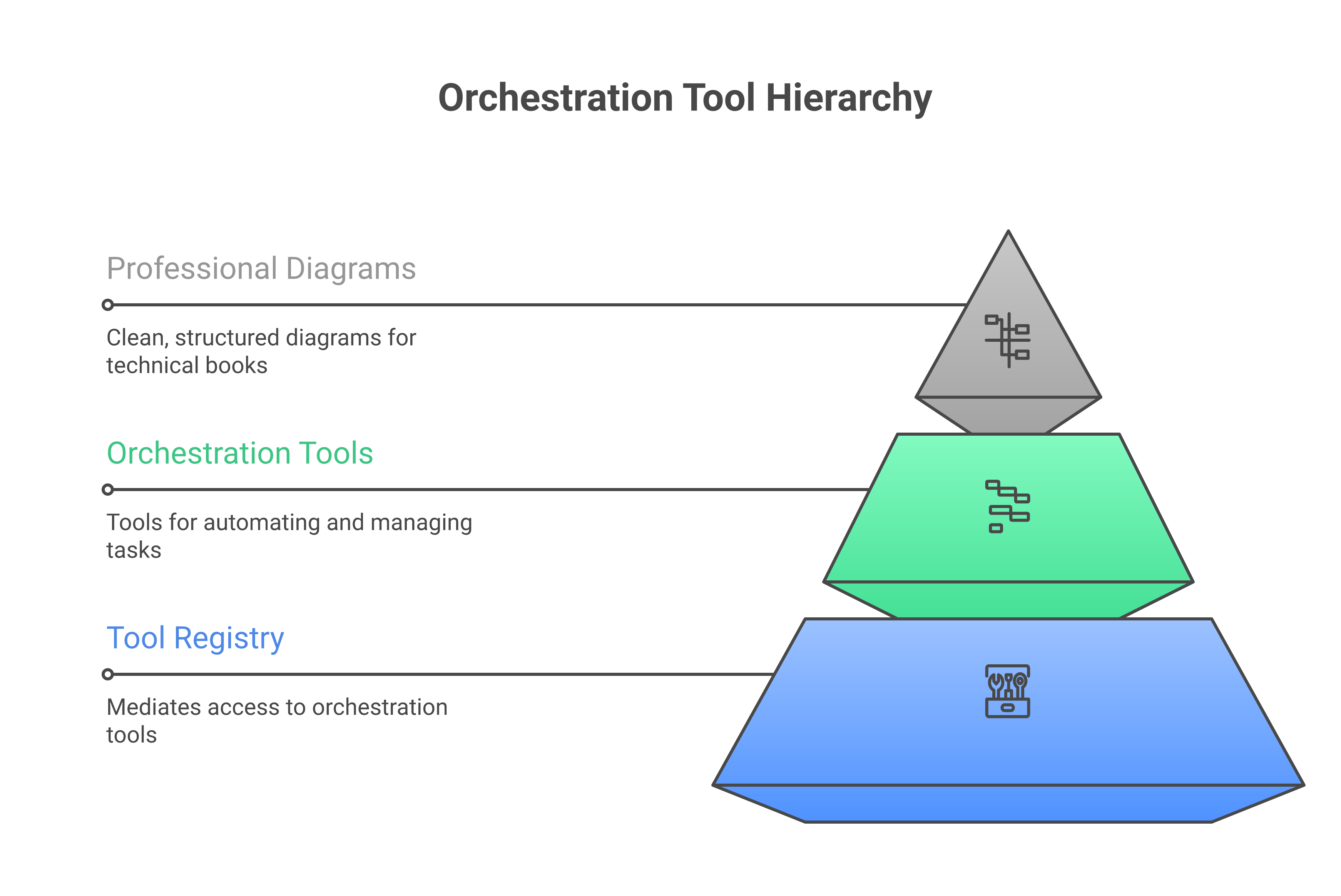
Beyond the pre-built library, Orchestrate provides three mechanisms for adding tools. The tool skill editor is a graphical interface for defining tools manually: the operator provides a name, a description, and a schema, and Orchestrate generates the corresponding registry entry. The OpenAPI import mechanism accepts an OpenAPI 3.x specification and automatically generates tool definitions for each operation defined in the spec, using the operation description and parameter definitions to populate the tool registry fields. The SDK integration allows tools to be defined programmatically in Python or JavaScript, which is appropriate for tools that require non-trivial logic between the Orchestrate invocation and the underlying system.
17.5 Workflow orchestration
Many operational tasks cannot be reduced to a single tool call. Renewing a TLS certificate involves checking the current certificate’s status, generating a new certificate signing request, submitting it to a certificate authority, receiving the signed certificate, deploying it to the affected services, verifying that the deployment succeeded, and updating the relevant change record. Each of these is a discrete operation, some of which may run in parallel, some of which depend on the results of earlier steps, and at least one of which—the deployment to production—should require explicit approval.
Orchestrate handles these sequences through its workflow engine, which interprets flow definitions that express the structure of a multi-step operation.
Flow definition structure
A flow definition is a YAML or JSON document that specifies a directed graph of steps. Each step references a tool in the registry, maps inputs from the workflow’s context or from the outputs of preceding steps, and defines success and failure conditions. Steps may be connected in sequence, in parallel fan-out, or in conditional branches that select different paths based on the results of previous steps.
name: tls-certificate-renewal
version: "1.2"
description: Renews a TLS certificate for a specified service endpoint
inputs:
  - name: service_fqdn
    type: string
    required: true
  - name: zone
    type: string
    required: true
steps:
  - id: check_current_cert
    tool: concert.certificate_status
    inputs:
      fqdn: ""
      zone: ""
  - id: generate_csr
    tool: pki.generate_csr
    depends_on: [check_current_cert]
    condition: ""
    inputs:
      fqdn: ""
      key_algorithm: RSA4096
  - id: submit_to_ca
    tool: pki.submit_csr
    depends_on: [generate_csr]
    inputs:
      csr: ""
  - id: approval_gate
    type: approval
    depends_on: [submit_to_ca]
    message: >
      Certificate for  is ready for deployment.
      New certificate valid until .
      Approve deployment to ?
  - id: deploy_certificate
    tool: ansible.run_playbook
    depends_on: [approval_gate]
    inputs:
      playbook: deploy_tls_cert
      inventory_zone: ""
      vars:
        cert_pem: ""
        key_pem: ""
  - id: verify_deployment
    tool: concert.certificate_status
    depends_on: [deploy_certificate]
    inputs:
      fqdn: ""
      zone: ""
  - id: close_change_record
    tool: servicenow.close_change
    depends_on: [verify_deployment]
    inputs:
      change_id: ""
      resolution_notes: >
        Certificate renewed successfully.
        New expiry: .
        Verification status: .
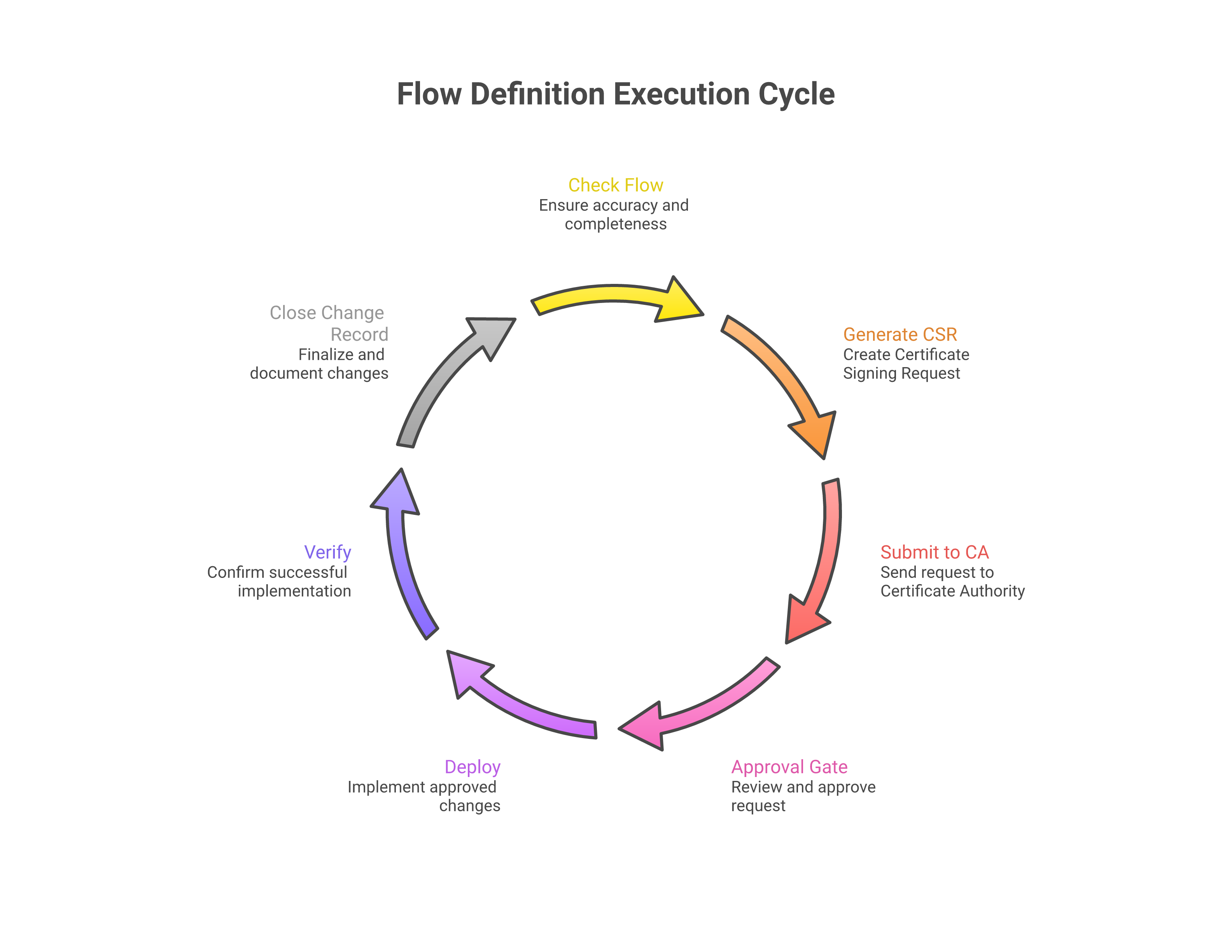
Approval gates
The approval step type pauses workflow execution and presents the operator—or a nominated approver—with a structured summary of what is about to happen. The approval gate is not merely a confirmation dialogue; it is a governance checkpoint. The gate can be configured to require approval from a specific role, to expire after a specified interval, or to escalate to a different approver if the primary approver does not respond within the timeout period. Approval decisions are logged with the approver’s identity and timestamp and attached to the workflow execution record.
In environments subject to change management controls—which is to say, most regulated environments—the approval gate is the mechanism by which Orchestrate satisfies the requirement that significant changes be authorised by a responsible person before execution. The gate can also be configured to create or update a ServiceNow change record as a side effect, so that the ServiceNow and Orchestrate records remain synchronised without requiring the operator to manage them separately.
Workflow triggers
Workflows can be initiated in four ways. Conversational triggers occur when an operator’s message is matched to a workflow, either because the language model determines that a workflow is the appropriate response, or because the operator explicitly names a workflow they want to run. Concert recommendation triggers occur when a Concert finding meets a defined threshold—severity, age, or affected service—and Orchestrate is configured to present the corresponding workflow automatically. Scheduled triggers run workflows on a time-based schedule, suitable for routine maintenance tasks. Event-driven triggers fire in response to events published to a message bus, allowing Orchestrate to respond to infrastructure events—an alert firing, a deployment completing, a policy violation being detected—without operator initiation.
Workflow versioning and GitOps
Flow definitions are version-controlled artefacts. In a GitOps workflow, they live in a Git repository alongside the infrastructure code and policy definitions they operate on. When a flow definition is updated, the change goes through the same review and approval process as any other code change. Orchestrate pulls flow definitions from the repository at execution time, so the version of the flow that runs is always the version that has been reviewed and merged.
This connection between workflow versioning and GitOps is not incidental. It means that the operational procedures of an organisation—the sequences of steps that constitute a response to a Concert recommendation—are subject to the same change-management controls as the infrastructure itself. An auditor can ask “what was the certificate renewal procedure on 14 February” and receive a precise answer by examining the Git history of the flow definition [8].
17.6 Multi-agent coordination via Orchestrate
Chapter 18 will examine multi-agent orchestration patterns in detail. This section describes the specific role Orchestrate plays in those patterns and the mechanisms by which it coordinates with other agents.
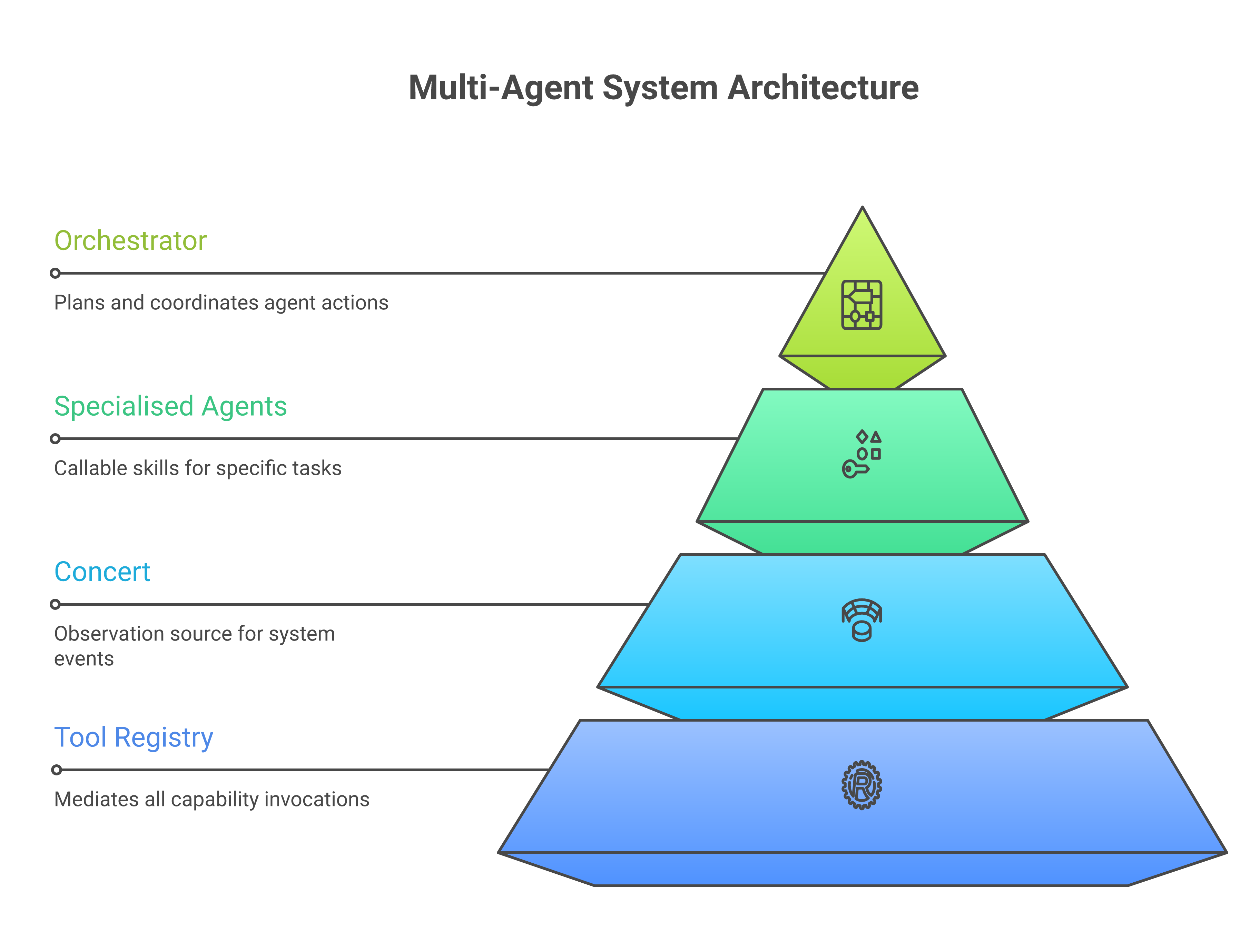
Orchestrate is designed to function as the planner agent in a multi-agent system. When a task is too complex—or too broad—to be handled by a single tool or workflow, Orchestrate decomposes it into sub-tasks and delegates them to specialised agents. Each specialised agent has a defined capability scope: one may handle all Kubernetes operations, another may specialise in security scanning, a third may coordinate with external certificate authorities. Orchestrate maintains the overall conversation context and assembles the results from the specialised agents into a coherent response for the operator.
The Orchestrate agent skill
The primary packaging mechanism for this pattern is the agent skill: a self-contained description of a specialised agent’s capabilities, expressed in the same format as a tool definition. From Orchestrate’s perspective, a specialised agent looks like a tool with a natural-language description of what it can do. Orchestrate calls it by sending a structured request; the agent returns a structured result. This uniformity is deliberate: it means that the planner does not need to know whether a capability is implemented as a direct tool call or as a call to another agent. The registry handles the indirection.
Agent-to-agent communication through Orchestrate
Communication between agents in this architecture flows through Orchestrate’s conversation context rather than directly between agents. A specialised agent does not call another specialised agent; it returns its result to Orchestrate, which decides whether to call another agent, return the result to the operator, or proceed with the next step of a workflow. This hub-and-spoke communication model has two important properties for regulated environments.
First, it means that every agent-to-agent exchange is visible to Orchestrate and therefore appears in the conversation log. There are no hidden lateral interactions between agents that would be invisible to audit. Second, it means that Orchestrate can enforce governance controls at every inter-agent boundary: it can apply the same approval-gate logic to an agent delegation that it applies to a direct tool call.
The Concert–Orchestrate integration as the primary multi-agent pattern
The most common multi-agent pattern in the sovereign-cloud-operations context is the Concert–Orchestrate pairing. Concert acts as the observation and recommendation agent; Orchestrate acts as the planning and execution agent. Concert surfaces a finding; Orchestrate receives it—either through a recommendation trigger or through an operator query—and coordinates the response.
This pairing can be extended with additional specialised agents. A security-scanning agent might be invoked to provide deeper vulnerability analysis before Orchestrate proceeds with a remediation workflow. A cost-analysis agent might be consulted before a scaling operation to verify that the proposed change falls within budget. Each of these agents plugs into the architecture as an agent skill in Orchestrate’s registry; the Concert–Orchestrate foundation remains stable as the capability set grows [9].
17.7 Governing the conversational interface
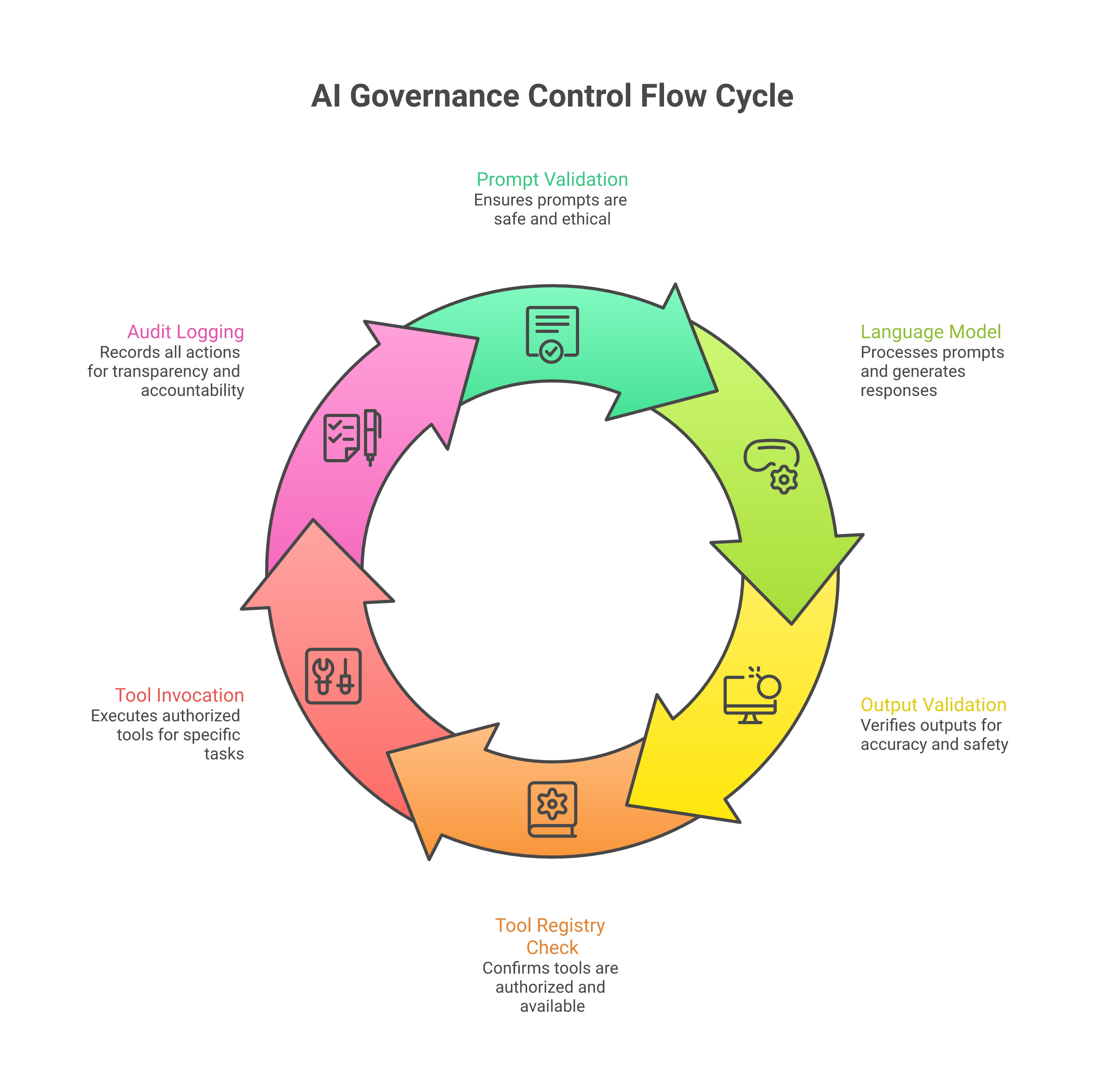
A conversational interface introduces governance challenges that do not arise in conventional scripted automation. When the control path is a script or a playbook, the range of possible actions is finite and inspectable in advance. When the control path is a natural-language conversation interpreted by a language model, the range of possible interpretations is open-ended. Governing this effectively requires controls at multiple levels.
The ambiguity problem
Natural language is inherently ambiguous. An operator who asks Orchestrate to “scale down the payments service” could mean: reduce the replica count, reduce the requested resource allocation, or—in an extreme reading—decommission the service. The language model will choose an interpretation based on context; it may choose correctly most of the time, but the consequences of an incorrect interpretation in production are potentially severe. Governance controls must account for this [10].
Prompt validation operates before the language model generates a response. It applies rules to the operator’s input to detect requests that are out of scope, that contain patterns associated with prompt injection, or that appear to request actions that are not permitted in the current operator’s role. Prompt validation is not a replacement for model-level controls; it is a first line of defence that reduces the surface area the model has to handle.
Output validation operates on the language model’s response before it is executed. Where the response includes a tool invocation, output validation checks the invocation against a set of constraints: is the tool in the registry? Are the parameter values within permitted ranges? Does the invocation target a zone that the operator is authorised to affect? Output validation is the last programmatic gate before an action reaches the tool estate, and it is the level at which most misinterpretation errors can be caught.
Conversation auditing records every turn in the conversation, including the raw content of the language model’s response before output validation, the result of validation, the tool invocations dispatched, and the results returned. This full record is necessary for post-incident analysis: it allows an investigation to determine not just what Orchestrate did, but what it interpreted the operator to have intended.
Model behaviour monitoring via watsonx.governance
The governance integration layer connects Orchestrate to IBM watsonx.governance [3], which provides ongoing monitoring of the language model’s behaviour as an operational system. The metrics of interest are not the same as those used to evaluate a model during development. In production, the relevant questions are: is the model interpreting similar requests consistently over time? Are there classes of requests that the model consistently misinterprets, leading to repeated corrections? Is the model’s rate of tool-selection errors changing as the tool registry grows?
watsonx.governance can be configured to alert when these metrics exceed defined thresholds. An organisation that detects a systematic misinterpretation pattern can intervene: updating tool descriptions to reduce ambiguity, adding prompt validation rules to handle the problematic request class, or, in extreme cases, routing the affected request class to a human operator until the underlying model behaviour is understood and corrected.
Compliance considerations under the EU AI Act
The EU AI Act [11], which came into force in 2024, establishes obligations for high-risk AI systems—a category that is likely to encompass AI systems used in the operation of critical infrastructure. Orchestrate, when deployed in a regulated context, is plausibly a high-risk AI system. The Act requires, among other things, that high-risk systems maintain logs sufficient to enable post-hoc auditability, that human oversight be maintained for consequential decisions, and that the system be subject to ongoing monitoring.
Orchestrate’s architecture—structured conversation logs, approval gates, watsonx.governance integration—is designed to satisfy these requirements. Organisations deploying Orchestrate in contexts covered by the Act should document the mapping between Orchestrate’s governance controls and the Act’s specific obligations as part of their conformity assessment [11]. The NIST Artificial Intelligence Risk Management Framework [14] provides a complementary, sector-neutral structure for identifying, assessing and mitigating AI risks; organisations operating across multiple jurisdictions will find it useful to map Orchestrate’s governance controls to both the EU AI Act and the NIST AI RMF simultaneously, ensuring that a single set of controls satisfies both frameworks.
17.8 The operator experience
Architecture and governance exist to make the operator’s experience safe and auditable. This section describes what that experience looks like in practice, walking through a complete scenario from Concert recommendation to confirmed resolution, and then examining the design principles that should guide how organisations configure the conversational interface.
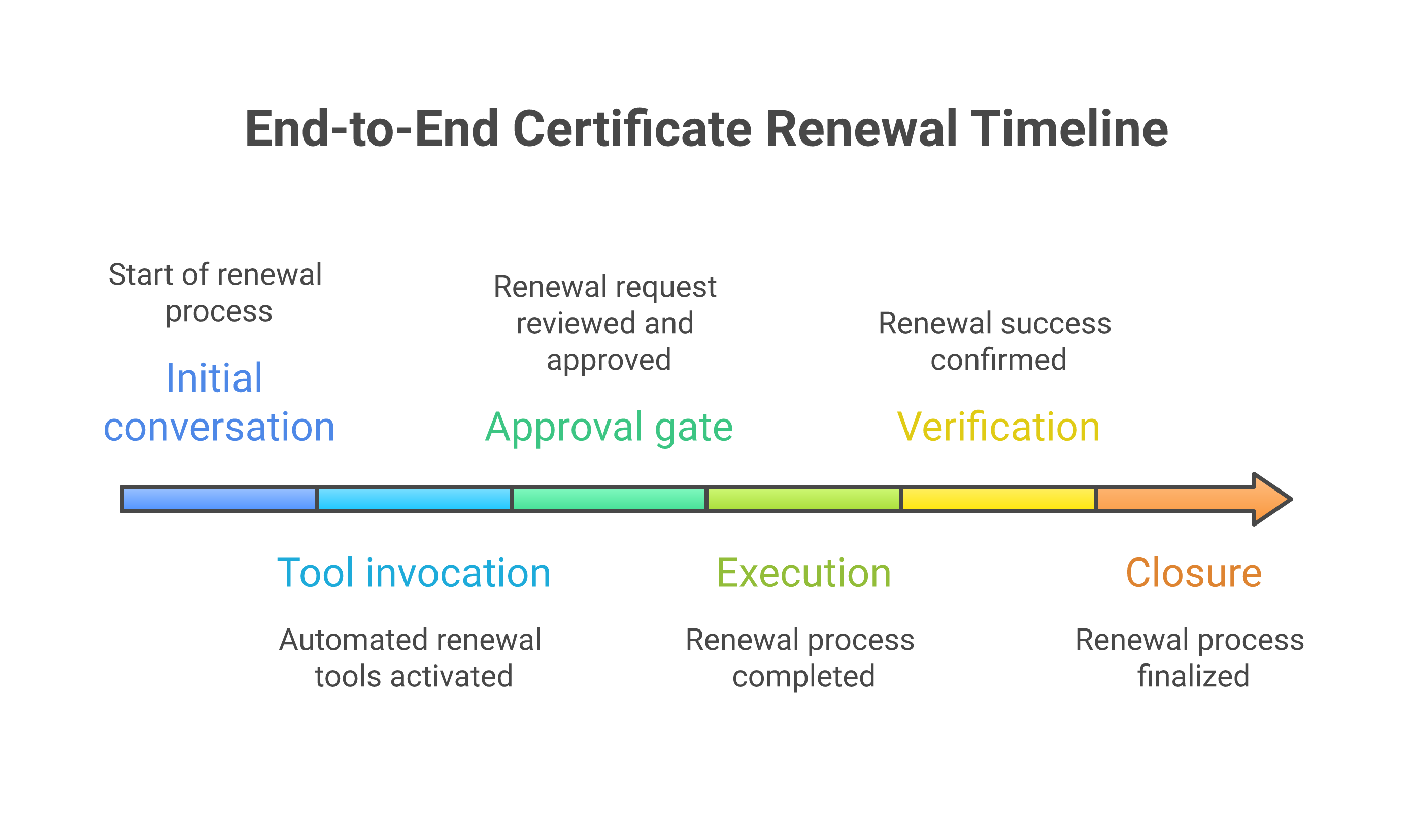
An end-to-end walkthrough
It is a Thursday morning. The operator opens their terminal and queries Orchestrate:
> What are my highest-priority open findings from Concert this morning?
Orchestrate invokes the concert.list_findings tool with parameters priority=critical&status=open&limit=5 and receives five findings. It presents them in order:
I found 5 critical open findings in Concert. The top item:

  [CERT-0041] TLS certificate for api.payments.example.internal
  expires in 9 days (Zone: payments-prod).
  Affected services: 3 downstream consumers.
  Risk score: 94/100.

The remaining 4 are lower-scoring certificate and CVE findings.
Would you like me to start the certificate renewal workflow for CERT-0041?
The operator confirms. Orchestrate initiates the tls-certificate-renewal workflow, linking it to finding CERT-0041 and creating a ServiceNow change request as a side effect. The first three steps—checking the current certificate, generating a CSR, and submitting it to the internal certificate authority—complete automatically and take approximately forty seconds. Orchestrate then pauses at the approval gate:
The new certificate for api.payments.example.internal is ready.
  Subject: CN=api.payments.example.internal
  SANs: api.payments.example.internal, api.payments.internal
  Valid until: 2027-02-28T23:59:59Z
  Issuer: Payments-Zone-CA-G3

Change request CHG0198432 has been opened. Deployment will target
the payments-prod zone using playbook deploy_tls_cert against
inventory group payments_api_servers (4 hosts).

Do you approve deployment to payments-prod?
The operator reviews the certificate details, confirms the inventory group is correct, and types yes. Orchestrate records the approval with the operator’s identity and timestamp, invokes the Ansible playbook, monitors the execution, and runs a post-deployment verification tool against the Concert API. The conversation concludes:
Deployment complete. Post-deployment verification shows:
  api.payments.example.internal: certificate valid, new expiry confirmed.
  All 4 hosts updated successfully.

CHG0198432 has been closed with resolution notes.
Finding CERT-0041 has been marked resolved in Concert.

Full execution log available at:
  orchestrate://conversations/conv-20260228-0841/exec-log
The entire sequence—from the initial query to closure—took eleven minutes, two of which were the operator’s own decision time at the approval gate. The same operation, coordinated manually across Concert, Ansible, the PKI portal, and ServiceNow, would typically require between forty-five minutes and two hours.
Design principles for operational conversational UX
The experience described above is not accidental; it reflects deliberate design choices about how a conversational interface for operations should behave. Three principles are particularly important.
Precision over fluency. A consumer-facing conversational interface is optimised for naturalness and warmth. An operational interface should be optimised for precision. When Orchestrate presents the approval gate, it does not summarise or paraphrase; it presents the exact certificate details, the exact inventory group, and the exact playbook that will be invoked. The operator should never have to trust that Orchestrate interpreted their request correctly; they should be able to verify it directly from the information presented [12]. Research into conversational UX design reinforces this principle: interfaces that prioritise transparent, structured information disclosure over conversational fluency produce higher task completion rates and fewer critical errors in professional contexts [13].
Progressive disclosure. An operator handling a critical incident does not need to see the tool invocation JSON for every step. But when something goes wrong—or when an auditor asks—that information must be available. Orchestrate presents results at the appropriate level of detail for normal operation, with full execution logs accessible on demand. This is progressive disclosure in its operational form: the information is there; it is simply not in the way.
Explicit handoffs. Every point at which control passes from Orchestrate to an automated tool, from Orchestrate to a human approver, or from a completed workflow back to the operator, should be explicitly marked. The operator should never be uncertain about whether an action has been taken, is waiting for approval, or is still running. Ambiguity about the state of an operational action is dangerous; the conversational interface must eliminate it, not introduce it.
Building trust over time
Trust in a conversational operations interface is not established by the quality of its first response; it is established by the consistency of its behaviour across hundreds of interactions, many of which will be routine and some of which will be high-stakes. Operators build a mental model of what Orchestrate will and will not do; the stability of that model is as important as its accuracy.
Organisations should treat the tuning of Orchestrate’s tool descriptions, prompt validation rules, and workflow definitions as ongoing operational work, not a one-time deployment activity. As the tool library grows, as Concert adds new recommendation types, and as the organisation’s operational patterns evolve, the configuration of Orchestrate must evolve with them. The conversation logs and watsonx.governance metrics provide the data needed to drive this evolution systematically, identifying the cases where the model’s behaviour diverged from operator expectation and correcting the underlying configuration rather than simply accepting the divergence as a limitation of conversational AI.
Key Takeaways
-
IBM watsonx Orchestrate closes the gap between Concert’s recommendations and the multi-tool actions required to act on them, providing a single conversational interface that abstracts the tool estate and produces a structured audit trail as a natural by-product of operation.
-
Orchestrate’s architecture comprises five functional layers—language model, tool registry, workflow engine, memory, and governance integration—each configurable or replaceable to meet deployment constraints, including sovereign-zone requirements for where language model inference runs.
-
The tool-calling model translates natural-language operator intent into structured tool invocations via a registry of typed tool definitions; zone-scoped registries and short-lived scoped credentials from the identity fabric ensure that tool calls respect zone boundaries and principle of least privilege.
-
The workflow engine handles multi-step operations through YAML or JSON flow definitions that support sequential steps, parallel fan-outs, conditional branches, approval gates, and versioned, GitOps-managed definitions, treating operational procedures as code.
-
Orchestrate functions as the planner agent in multi-agent architectures, treating specialised agents as callable skills in its registry and routing all agent-to-agent communication through its conversation context, ensuring that every inter-agent exchange is visible and governed.
-
Governance of the conversational interface requires controls at three levels: prompt validation before model processing, output validation before tool dispatch, and ongoing model behaviour monitoring via watsonx.governance; the EU AI Act imposes specific obligations on high-risk deployments that Orchestrate’s architecture is designed to address.
-
Effective operational conversational UX prioritises precision over fluency, progressive disclosure of execution detail, and explicit handoffs between automated and human control; trust is built through consistent behaviour across many interactions, refined by systematic analysis of conversation logs and governance metrics.
Bridge to Chapter 18 — Multi-Agent Orchestration
This chapter has described Orchestrate as a planner agent, capable of decomposing complex tasks and delegating them to specialised agents through its tool registry. That description anticipates a question that the architecture raises but does not yet answer: what does a mature multi-agent system look like when Orchestrate is one component among several, and how should an organisation design the boundaries between agents, the flows of information between them, and the governance controls that apply to each boundary?
Chapter 18 takes up that question directly. It examines the patterns by which organisations build and manage multi-agent systems for cloud operations: the distinction between planner and executor agents, the role of agent capability registries, the design of inter-agent communication protocols, and the failure modes that emerge when agents interact in ways their individual designers did not anticipate. It also examines how the Concert–Orchestrate pairing scales to encompass additional specialised agents—each responsible for a defined capability domain—without losing the coherent governance and auditability that make agentic operations safe to deploy in a regulated environment. The transition from a single conversational interface to a coordinated network of autonomous agents is not merely a technical step; it is an organisational and regulatory challenge, and Chapter 18 addresses all three dimensions.
References
[1] IBM Corporation, IBM watsonx Orchestrate Documentation, IBM Cloud Docs, 2024. [Online]. Available: https://cloud.ibm.com/docs/watson-orchestrate
[2] IBM Corporation, IBM watsonx Orchestrate: On-premises Deployment Guide, IBM Documentation, 2024. [Online]. Available: https://www.ibm.com/docs/en/watson-orchestrate
[3] IBM Corporation, IBM watsonx.governance Documentation, IBM Cloud Docs, 2024. [Online]. Available: https://cloud.ibm.com/docs/ai-openscale
[4] A. Hamilton, “Sovereign zone deployment considerations for AI inference workloads,” in Sovereign Cloud Operations, ch. 5, 2026.
[5] OpenAI, Function Calling — OpenAI API Documentation, OpenAI, 2024. [Online]. Available: https://platform.openai.com/docs/guides/function-calling
[6] A. Hamilton, “The identity fabric: zero-trust authentication for cloud operations,” in Sovereign Cloud Operations, ch. 13, 2026.
[7] Red Hat, Ansible Automation Platform Documentation, Red Hat, 2024. [Online]. Available: https://docs.redhat.com/en/documentation/red_hat_ansible_automation_platform
[8] W. Scherer, T. Limoncelli, and C. Hogan, The Practice of Cloud System Administration, Addison-Wesley, 2014. [Online]. Available: https://www.pearson.com/en-us/subject-catalog/p/practice-of-cloud-system-administration-the-devops-and-sre-practices-for-web-services-volume-2/P200000009530
[9] IBM Research, “Conversational AI for IT Operations: Design Patterns and Governance Considerations,” IBM Research Blog, 2023. [Online]. Available: https://research.ibm.com/blog/conversational-ai-itops
[10] S. Amershi, D. Weld, M. Vorvoreanu, A. Fourney, B. Nushi, P. Collisson, J. Suh, S. Iqbal, P. N. Bennett, K. Inkpen, J. Teevan, R. Kikin-Gil, and E. Horvitz, “Software engineering for machine learning: a case study,” in Proc. 41st Int. Conf. Software Engineering: Software Engineering in Practice (ICSE-SEIP), 2019, pp. 291–300. [Online]. Available: https://doi.org/10.1109/ICSE-SEIP.2019.00042
[11] European Parliament and Council of the European Union, “Regulation (EU) 2024/1689 of the European Parliament and of the Council of 13 June 2024 laying down harmonised rules on artificial intelligence (Artificial Intelligence Act),” Official Journal of the European Union, L 2024/1689, July 2024. [Online]. Available: https://eur-lex.europa.eu/legal-content/EN/TXT/?uri=CELEX%3A32024R1689
[12] K. Shneiderman, Designing the User Interface: Strategies for Effective Human-Computer Interaction, 6th ed. Pearson, 2016. [Online]. Available: https://www.pearson.com/en-us/subject-catalog/p/designing-the-user-interface-strategies-for-effective-human-computer-interaction/P200000003258
[13] Nielsen Norman Group, “Conversational UX Design: A Research-Backed Framework,” NNGroup Report, 2023. [Online]. Available: https://www.nngroup.com/reports/conversational-design/
[14] National Institute of Standards and Technology, Artificial Intelligence Risk Management Framework (AI RMF 1.0), NIST AI 100-1, NIST, Jan. 2023. [Online]. Available: https://doi.org/10.6028/NIST.AI.100-1
Sovereign Cloud Operations: AI-Driven Management of Sovereign Estates
© 2026 by Alan Hamilton
is licensed under CC BY-SA 4.0


