Chapter 30 — Agent-Assisted Incident Management
Summary
This chapter addresses major incidents that exceed the envelope of autonomous self-healing — situations demanding human investigation, judgement, cross-team coordination, and regulatory accountability — and describes how AI agents augment each phase of the incident lifecycle without displacing human responsibility. It covers agent-assisted triage that produces structured situation reports within minutes, automated root cause analysis that synthesises temporal alignment and causal graph reasoning into ranked hypotheses, and war room coordination agents that handle action tracking, progress summarisation, and multi-audience communication drafting. The chapter examines cross-zone remediation patterns in which agents operate within sovereign boundaries while exchanging abstracted situational awareness, and details agent-assisted post-incident review that automates timeline reconstruction, root cause documentation, and knowledge base updates. Architects will find guidance on incident management metrics that capture both speed and quality, along with the feedback loops that make each incident a source of institutional improvement.
The previous chapter examined autonomous self-healing: the closed-loop patterns through which known failure modes are detected, diagnosed and remediated without human intervention. That capability is powerful, but it operates within a well-defined envelope. The failure must have been anticipated, the remediation must have been pre-approved, and the blast radius must fall within the guardrails that policy permits an agent to act upon alone. For a significant proportion of operational events—the routine, the repetitive, the well-understood—autonomous self-healing is sufficient and appropriate.
Major incidents are different. A P1 incident affecting a regulated payment processing service at peak transaction volume, with cascading failures across three dependent services and ambiguous root cause signals, is not a problem that falls within any pre-approved remediation envelope. It demands investigation, judgement, coordination across multiple teams, communication with stakeholders who have differing information needs, and decisions that carry regulatory consequences. These are fundamentally human responsibilities. No responsible enterprise delegates them to an agent acting alone, regardless of how capable the underlying models may be.
What agents can do—and what this chapter examines in detail—is assist humans at every stage of the incident management lifecycle. The distinction between autonomous action and assisted action is not merely semantic; it is the architectural boundary that determines whether an organisation’s incident management process remains governable under the regulatory frameworks that sovereign operations must satisfy. DORA’s Article 17 [1] requires documented incident management processes with defined roles and responsibilities. NIS2’s Article 23 [2] imposes notification obligations that demand structured, timely communication. ISO/IEC 27001:2022’s Clause A.5.24 [3] requires information security incident management planning and preparation. None of these frameworks prohibits the use of AI agents in incident management, but all of them require that human accountability remain unambiguous. Agent-assisted incident management, properly architected, strengthens rather than undermines that accountability by ensuring that human decision-makers have better information, faster, at every point where a decision is required.
30.1 The anatomy of a major incident
Understanding what agents can assist with requires first understanding what actually happens during a major incident in a large enterprise—not the idealised lifecycle depicted in process documentation, but the messy, time-pressured, information-starved reality that operations teams experience at three o’clock in the morning.
The lifecycle begins with detection: something is wrong, and the monitoring systems know about it. In a modern observability estate, detection is rarely the problem. Instana’s anomaly detection, infrastructure metric thresholds, synthetic monitoring failures, application performance management alerts—these systems produce signals prolifically. The problem is that they produce too many signals. A single underlying failure in a database cluster may generate alerts from the database health monitor, from every application that depends on the database, from the load balancers that detect unhealthy backends, from the synthetic monitors whose test transactions are now failing, and from the capacity monitoring system that observes the connection pool exhaustion. Within minutes, the on-call engineer’s pager has fired a dozen times, each alert presenting a different symptom of the same underlying cause. Distinguishing the root cause from the symptoms, under this alert storm, is the first cognitive challenge of major incident management.
Triage follows detection. The on-call engineer must determine the severity of the incident, identify which services are affected, estimate the business impact, and decide whether to escalate. This requires contextual knowledge that the engineer may or may not possess: which services are tier-one versus tier-three, which customers are affected, what the current transaction volume is, whether a maintenance window is in progress, whether a recent change might be the cause. In organisations with deep operational experience, senior engineers carry this context in their heads. In organisations with high staff turnover—or at three o’clock in the morning when the on-call happens to be a junior team member—this contextual knowledge is simply unavailable at the speed required.
Escalation is the organisational act of marshalling the right people. The incident commander must be identified, the relevant subject matter experts must be paged, and for significant incidents, a war room must be established. In practice, escalation is often delayed because the initial responder is uncertain about severity, reluctant to wake colleagues unnecessarily, or unable to identify who the correct subject matter experts are for the affected components. Every minute of escalation delay extends the incident duration.
Investigation is the most cognitively demanding phase. Multiple engineers, often from different teams, work in parallel to identify the root cause. They query logs, examine metrics, review traces, check recent deployments, inspect configuration changes, and compare current behaviour against baselines. The investigation is complicated by the fact that each engineer has a partial view: the database team sees the database symptoms, the network team sees the network symptoms, and the application team sees the application symptoms. Synthesising these partial views into a coherent causal narrative is the central intellectual challenge of incident response. It is also the phase most susceptible to cognitive biases: anchoring on the first plausible hypothesis, confirmation bias in selecting evidence, and premature closure when the pressure to restore service overwhelms the discipline of thorough investigation [4].
Remediation is the application of a fix, which may range from a simple service restart to a complex failover, rollback, or configuration change. The remediation must be authorised—emergency change governance applies even under time pressure—and it must be executed carefully, because a poorly chosen remediation can make the situation worse. The decision of when to apply a remediation involves a judgement about whether the root cause is sufficiently understood to justify action, or whether the business impact is severe enough to justify action even without full understanding.
Communication runs in parallel with investigation and remediation. Internal stakeholders—management, other affected teams, the service desk fielding customer complaints—need regular updates. External stakeholders—customers, regulators, partners—may need formal notifications. The communication burden falls on the incident commander or a designated communications lead, diverting attention from the technical work of resolution. In regulated environments, communication is not merely a courtesy; it is a compliance obligation. DORA requires major ICT-related incident notifications to competent authorities within prescribed timeframes. NIS2 requires early warnings to national CSIRTs within twenty-four hours. Failure to meet these obligations carries regulatory consequences that compound the operational impact of the incident itself.
Post-incident review is the final stage, conducted after service is restored. The PIR reconstructs the timeline, identifies the root cause, evaluates the effectiveness of the response, and produces action items to prevent recurrence. In principle, the PIR is how the organisation learns from incidents. In practice, PIRs are often delayed, abbreviated, or skipped entirely because the team is exhausted and already dealing with the next crisis. When they are conducted, the quality depends on the memories of participants—memories that are unreliable, particularly for events that occurred under stress and fatigue.
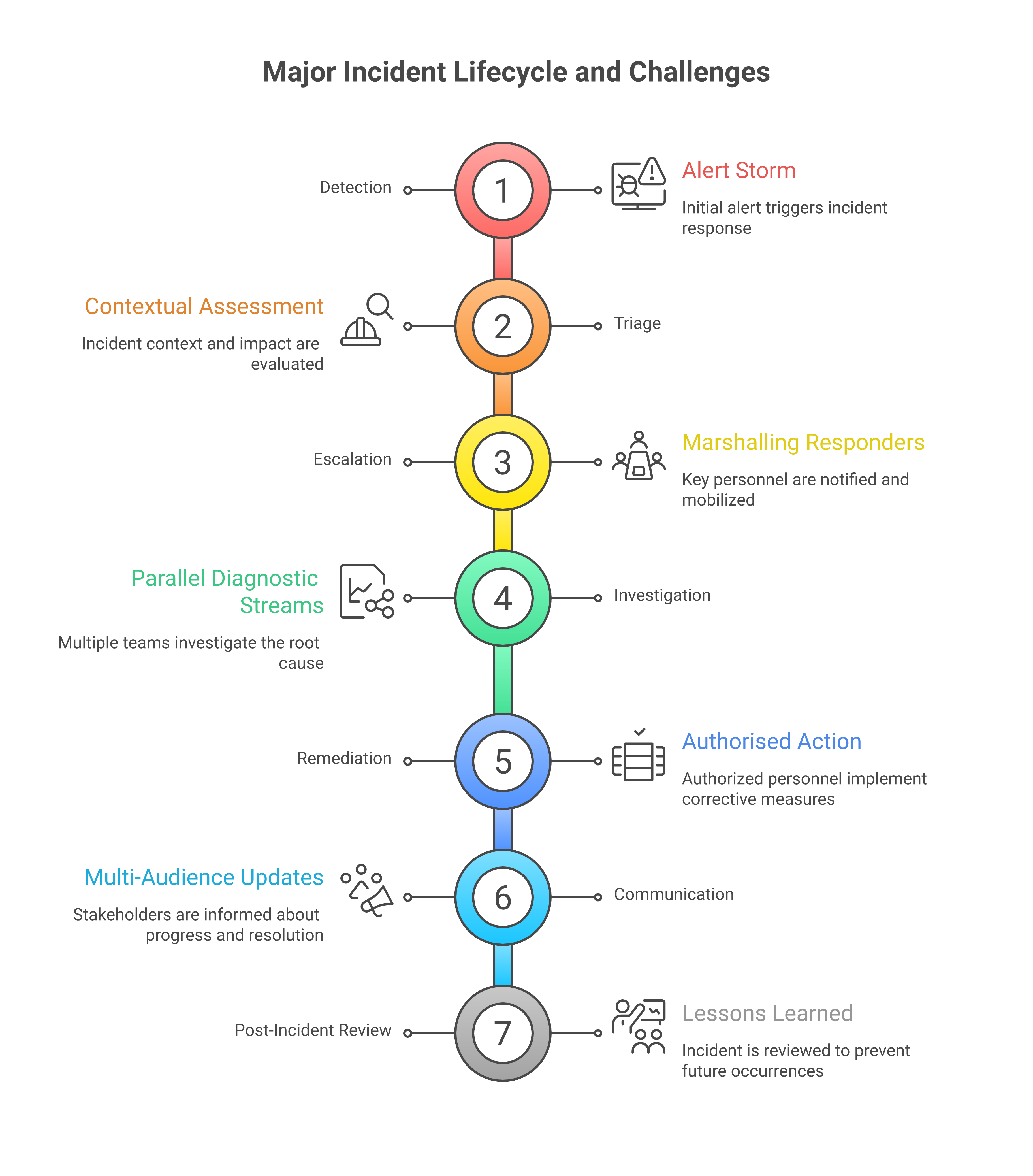
Each of these stages presents specific challenges where agent assistance can reduce time, improve quality, or both. The remainder of this chapter examines each in turn.
30.2 Agent-assisted triage and initial diagnosis
The triage phase is where agent assistance delivers its most immediate and measurable value. The cognitive task facing the initial responder—correlate alerts, assess scope, estimate impact, retrieve context—is precisely the kind of task that agents perform faster and more consistently than humans under pressure.
Within the architecture described in earlier chapters, IBM Concert [5] serves as the correlation engine. When multiple alerts fire within a compressed time window, Concert’s topology-aware correlation groups them by probable common cause. Rather than presenting the on-call engineer with seventeen individual alerts, each requiring separate inspection, Concert presents a single correlated situation that identifies the probable epicentre—the database cluster, the network path, the application deployment—and the downstream services affected by propagation. This correlation, which might take a human engineer twenty to thirty minutes of cross-referencing dashboards, is available within seconds of the alert storm beginning.
A watsonx Orchestrate [6] agent, triggered by the Concert situation event, then performs the contextual enrichment that converts a technical alert into an actionable situation report. The agent queries multiple sources in parallel. From Concert’s topology model, it retrieves the full dependency graph of the affected services, identifying which upstream and downstream services are in the blast radius. From the change management system—ServiceNow [7] or equivalent—it retrieves all changes applied to the affected components in the preceding seventy-two hours, a window chosen because deployment-related incidents most commonly manifest within this period [8]. From Instana’s real-time observability data, it retrieves the current performance posture of the affected services: response times, error rates, throughput, and resource utilisation. From the CMDB, it retrieves the service ownership, the tier classification, and the customer impact mapping.
The agent assembles these inputs into a structured situation report that is delivered to the on-call engineer within two to three minutes of the initial alert. The report follows a standardised format:
The situation summary states, in plain language, what appears to be happening: “Database cluster payments-db-prod-01 is experiencing connection pool exhaustion, causing elevated error rates across three dependent services: payments-api, settlement-engine, and fraud-scoring. The cluster entered this state at 02:47 UTC.”
The blast radius assessment identifies the scope of impact: which services are affected, which customers are exposed, and what the estimated transaction impact is based on current throughput data.
The recent change correlation lists any changes applied to the affected components or their dependencies within the review window, with a relevance score based on temporal proximity and topological relationship. A deployment to the payments-api service completed at 02:30 UTC—seventeen minutes before the onset of symptoms—is flagged as a high-relevance correlation.
The historical pattern match queries the operational knowledge base (described in Chapter 20) for previous incidents with similar signatures. If the organisation experienced a comparable connection pool exhaustion event six months ago, and the post-incident review from that event identified a specific root cause and remediation, the agent surfaces that reference with the key findings.
The recommended severity classification proposes a priority level based on the assessed business impact, using the organisation’s priority matrix: the combination of a tier-one service, customer-facing impact, and active transaction volume suggests P1 classification, with full war room mobilisation.
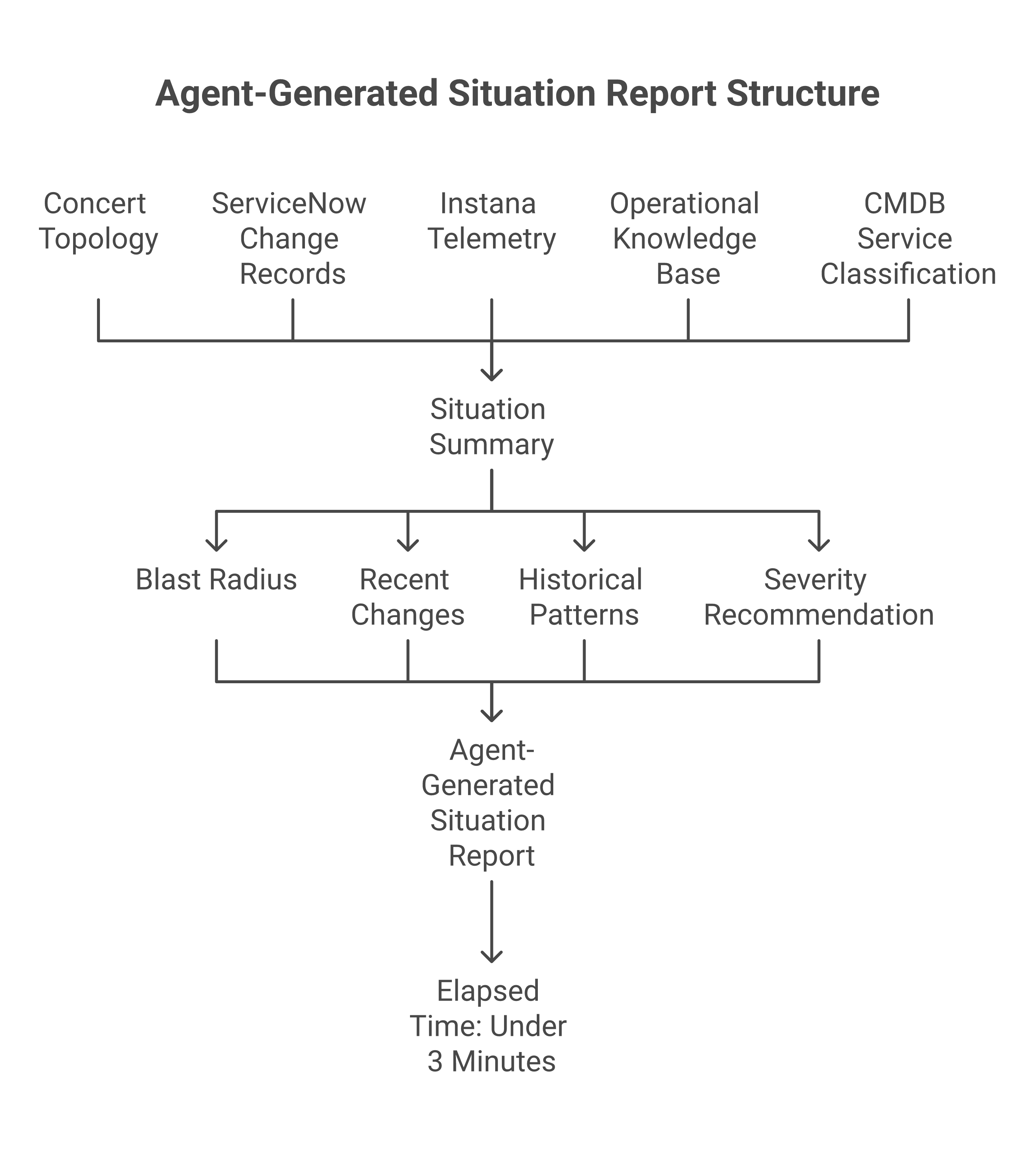
The value of this structured report is not merely speed, though speed matters enormously when a P1 incident is unfolding. The value is also completeness and consistency. A human engineer performing the same triage might check the change log but forget to query the knowledge base for historical patterns. A different engineer might check the knowledge base but overlook the recent deployment. The agent checks all sources, every time, producing a report whose completeness does not depend on who happens to be on call.
The situation report is written to the ServiceNow incident record as the initial enrichment, establishing the baseline for all subsequent investigation. It is also posted to the designated war room channel—Slack, Microsoft Teams, or whatever collaboration platform the organisation uses—so that responders joining the incident have immediate context without needing to ask “what do we know so far?”
For the incident commander, the structured situation report transforms the opening minutes of the incident from chaos to directed investigation. Instead of asking “what is going on?” and waiting for answers, the commander reads a concise briefing and immediately begins directing investigation towards the most probable causes. This shift—from reactive information gathering to directed investigation—is the fundamental improvement that agent-assisted triage delivers.
30.3 Automated root cause analysis
If triage tells the incident team what is happening, root cause analysis tells them why. RCA during a live incident is the most intellectually demanding activity in operations, and it is conducted under precisely the conditions least conducive to careful analytical reasoning: time pressure, incomplete information, multiple competing hypotheses, and cognitive fatigue. Agent-assisted RCA does not replace human judgement in this process. It augments it by performing the data-intensive analysis that humans do poorly under pressure and presenting the results in a form that supports human reasoning.
The agent’s approach to RCA during a live incident follows a structured methodology that mirrors the causal reasoning process experienced engineers use, but executes it faster and more systematically.
Temporal alignment is the first analytical step. The agent establishes a precise timeline of events leading up to the incident onset, drawing from multiple signal sources: deployment timestamps from the CI/CD pipeline, configuration change timestamps from the IaC version control system, infrastructure events from the cloud provider’s activity log, application metric inflection points from Instana, and alert firing times from the monitoring system. These events are aligned on a single timeline and presented in chronological order, making temporal correlations visually and analytically apparent. A deployment that completed eleven minutes before the first anomaly in a dependent service is a different kind of correlation from a network configuration change that occurred three days prior. Temporal alignment makes these distinctions explicit.
Causal graph analysis is the second step. Concert’s topology model provides the structural basis: the directed graph of service dependencies that defines the paths through which failures propagate. The agent overlays the observed anomaly data onto this graph, identifying which nodes show primary symptoms (anomalies that precede downstream effects) and which show secondary symptoms (anomalies that are consistent with propagation from an upstream cause). This overlay produces a candidate set of root cause nodes—the points in the topology graph where the anomaly pattern originates rather than propagates through.
The distinction between primary and secondary symptoms is critical and often difficult for human investigators to make in real time. When ten services are showing errors simultaneously, the natural human tendency is to investigate the service that is most visible or most familiar, rather than the service that is topologically upstream of all others. The agent’s topology-aware analysis is immune to this bias: it follows the dependency graph rather than human attention patterns.
Cross-signal correlation is the third analytical layer. A root cause hypothesis is strengthened when multiple independent signal types converge on the same explanation. If the temporal analysis identifies a deployment as a candidate cause, and the causal graph analysis identifies the deployed service as the topological origin of the failure propagation, and the log analysis reveals error messages in that service that reference a code path introduced in the deployment, the convergence of these three independent signals substantially increases confidence in the deployment as the root cause. Conversely, if the temporal analysis points to a deployment but the causal graph analysis identifies a different topological origin, the agent flags this divergence as grounds for further investigation rather than premature conclusion.
The agent performs these analyses in parallel, using the multi-agent architecture described in Chapter 18. Executor agents are dispatched to examine specific signal streams: one agent analyses the database metrics, another examines the network path latency, a third reviews the application logs for the candidate root cause service, and a fourth queries the change management system for the full deployment manifest of the recent change. Each executor agent reports its findings to the planner agent, which synthesises them into a structured hypothesis.
The output of the RCA process is not a single assertion but a ranked set of hypotheses, each with an associated confidence level and the evidence that supports it. A typical output might present three hypotheses:
Hypothesis 1 (High confidence, 0.85): The deployment of payments-api version 2.14.3 at 02:30 UTC introduced a connection pool configuration regression. The deployment manifest shows that the maximum pool size was reduced from 200 to 50 connections. This is temporally aligned with the onset of connection pool exhaustion at 02:47 UTC and is consistent with the gradual depletion pattern observed as existing connections were recycled under load.
Hypothesis 2 (Low confidence, 0.30): The database cluster is experiencing underlying storage I/O degradation. Storage latency metrics show a modest increase beginning at 01:15 UTC, which could contribute to connection hold times and eventual pool exhaustion. However, the storage latency increase is within historical variance and would not, in isolation, explain the observed severity.
Hypothesis 3 (Low confidence, 0.20): Network micro-partitioning between the application tier and the database tier is causing intermittent connection failures. No direct evidence supports this hypothesis; it is included because it has been a root cause of similar symptoms in two previous incidents (PIR-2024-0847, PIR-2025-0112).
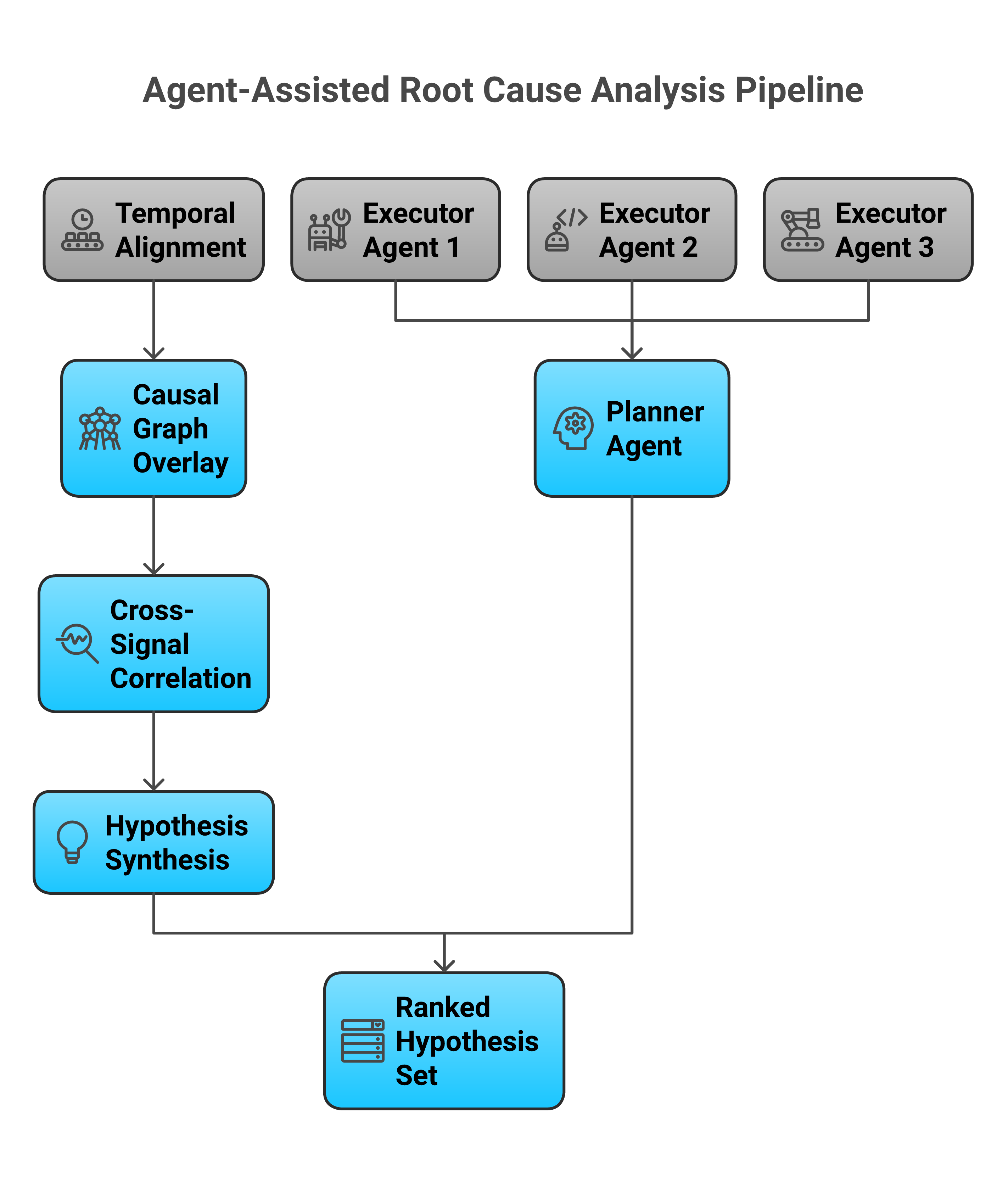
This structured, multi-hypothesis presentation serves the incident commander in two ways. First, it directs investigation towards the most probable cause without foreclosing alternative explanations—a discipline that experienced incident commanders value highly but that is difficult to maintain under pressure. Second, it provides the evidential basis for remediation decisions: if the highest-confidence hypothesis identifies a deployment regression, the remediation path (rollback) is clear, and the evidence supporting that decision is documented in the incident record before the rollback is executed.
The RCA output is appended to the ServiceNow incident record as a structured analysis note, attributed to the agent, with timestamps and references to the underlying data sources. This documentation serves both the immediate operational need—engineers joining the war room can read the current analytical state without verbal briefing—and the longer-term governance need: regulators and auditors examining the incident record after the fact can see that a structured analytical process was followed, that multiple hypotheses were considered, and that the remediation was based on identified evidence rather than guesswork.
30.4 War room orchestration and communication
A war room for a major incident is a coordination challenge as much as a technical one. Multiple engineers from different teams work in parallel, each pursuing investigative threads. The incident commander must maintain situational awareness of what each team is doing, ensure that efforts are not duplicated, track action items to completion, communicate status to stakeholders at appropriate intervals, and manage the handover when shifts change. In a sustained major incident—lasting six, twelve, or twenty-four hours—the coordination burden is substantial, and it competes directly with the cognitive resources needed for technical problem-solving.
AI agents can serve as war room coordinators, handling the mechanical aspects of coordination so that human participants can focus on the technical and judgemental aspects that require their expertise.
Action item tracking is one of the most straightforward and valuable coordination functions an agent can perform. During a war room discussion—whether in a Slack channel, a Teams meeting, or a PagerDuty [9] incident response flow—participants propose investigative actions, volunteer for tasks, and report findings. In a traditional war room, these action items are tracked on a whiteboard, in a shared document, or, most commonly, in the incident commander’s head. Items are forgotten, duplicated, or left incomplete because no one is systematically tracking them. A war room coordination agent monitors the discussion channel, identifies action items as they are proposed (“I’ll check the database replication lag,” “Can someone verify the DNS resolution path?”), records them as structured entries with an assigned owner and a status, and periodically surfaces the current action item list with status updates. When an engineer reports a finding, the agent updates the relevant action item and appends the finding to the incident record.
Progress summarisation addresses the information asymmetry that develops during long incidents. An engineer who has been investigating a specific technical thread for ninety minutes has deep knowledge of that thread but has lost track of what other threads have discovered. An incident commander who joined the war room thirty minutes ago needs a briefing on everything that has happened. A stakeholder checking in from a different timezone needs a high-level status update. The coordination agent produces summaries at multiple levels of detail and at configurable intervals. A five-minute summary for the war room channel captures what has been tried, what has been found, and what the current working hypothesis is. A fifteen-minute executive summary for stakeholders captures the current status, the estimated time to resolution, the customer impact, and any decisions that require management input.
Stakeholder communication is a distinct function from internal coordination. The audiences for incident communication have different information needs and different communication norms. The war room needs technical detail. The service desk needs enough information to respond to customer enquiries. Management needs business impact and estimated resolution time. Customers, where direct communication is appropriate, need a clear statement of what is happening, what the impact is, and what is being done—without internal jargon or blame attribution. Regulatory notifications, where required, need precise, structured information that meets the notification template requirements of the relevant regulation.
The communication agent generates drafts for each audience from the same underlying incident data, adapting tone, detail level, and format to the audience. Internal status updates are posted automatically. External communications—customer notifications, regulatory reports—are generated as drafts and routed to the incident commander or communications lead for review and approval before publication. This human approval step is essential: external communications carry legal and reputational implications that require human judgement, and no agent should publish them autonomously.
For regulatory notifications specifically, the agent tracks compliance timelines against the applicable framework. If the incident meets the materiality criteria for DORA major incident notification, the agent calculates the notification deadline, monitors progress towards the deadline, and escalates to the incident commander if the deadline is approaching without the notification having been submitted. The notification itself is pre-populated with the structured data that the regulation requires—incident classification, impact assessment, timeline of events, remediation actions—drawn from the incident record. The incident commander reviews and submits; the agent ensures the deadline is not missed through oversight.
Shift handover management is critical for incidents that span multiple working periods. When the incident commander or a key investigator hands over to a colleague at the end of a shift, the quality of the handover determines whether the incoming team can continue effectively or must spend the first hour reconstructing context. The coordination agent generates a structured handover briefing that includes the current status, the working hypotheses with their evidence, the actions in progress, the actions completed and their findings, the outstanding decisions, and the communication commitments (when the next stakeholder update is due, whether a regulatory notification is pending). This briefing is both posted to the war room channel and written to the incident record, ensuring that the handover is documented as well as communicated.
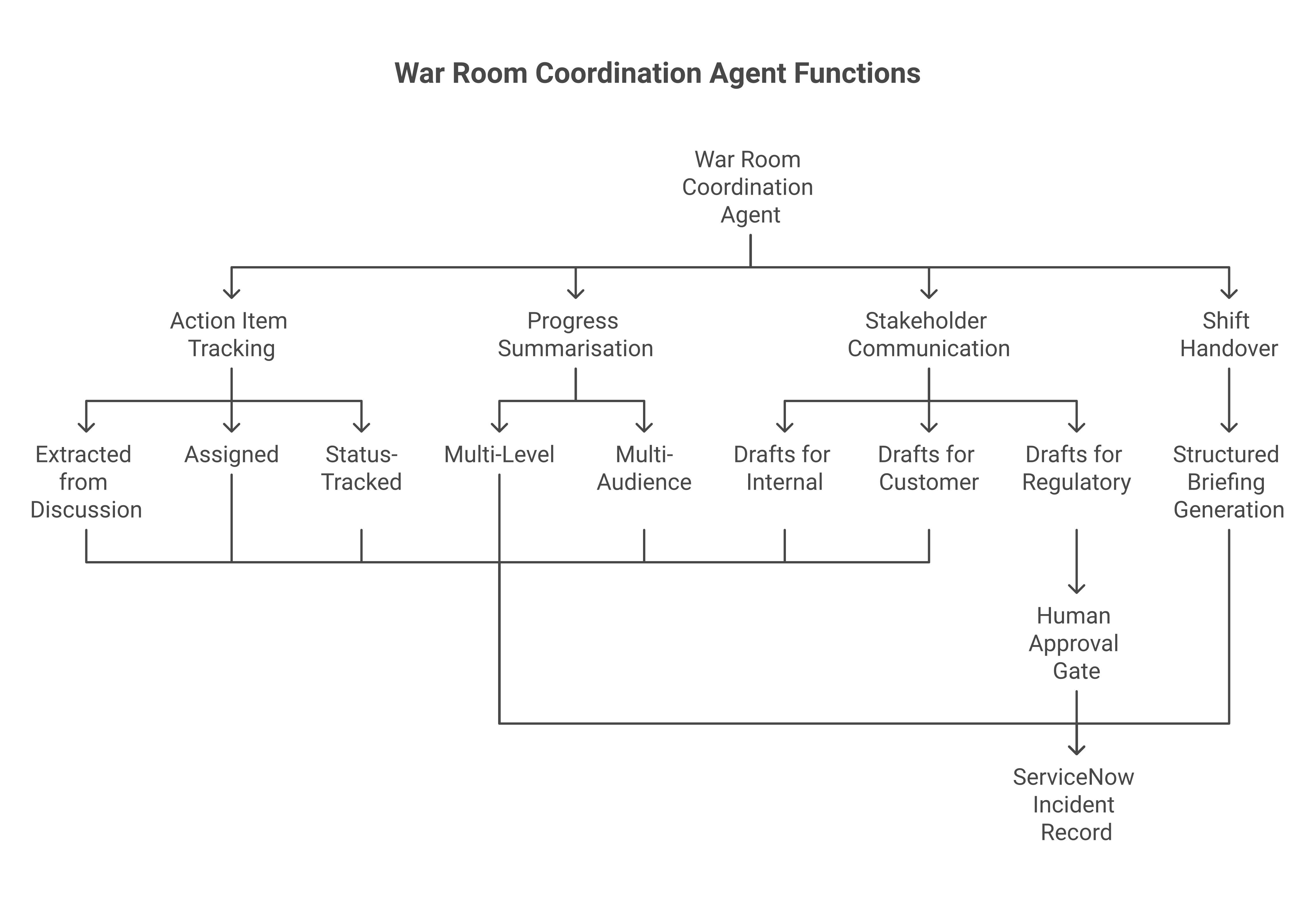
The integration with collaboration platforms—Slack, Microsoft Teams, PagerDuty—is architecturally significant. The war room agent operates within the collaboration platform as a visible participant: it posts summaries, surfaces action items, and responds to queries directed at it. Engineers can ask the agent for specific information (“what was the error rate on payments-api at 02:45?”) and receive an answer drawn from the observability data without leaving the war room channel to query a separate dashboard. This conversational interface, powered by watsonx Orchestrate’s natural language capabilities, reduces the context-switching overhead that fragments attention during incident response.
The agent’s presence in the war room channel also creates an automatic, structured record of the incident response process. Every summary, every action item, every finding report is captured in both the collaboration platform and the ServiceNow incident record. When the post-incident review is conducted, the raw material for timeline reconstruction is already assembled, attributed, and timestamped—a significant improvement over the traditional approach of relying on participants’ memories and scattered chat logs.
30.5 Remediation coordination across sovereign zones
The preceding sections have assumed, implicitly, that the incident and its remediation are contained within a single operational domain. In a sovereign cloud architecture, this assumption frequently does not hold. An incident in a payment processing service may involve infrastructure in a European sovereign zone, a data processing pipeline in a regional zone subject to specific data residency requirements, and a shared platform service that spans zones. Remediation that is technically straightforward in a single-zone environment becomes architecturally constrained when sovereign zone boundaries must be respected.
The constraints are not merely policy preferences; they are regulatory obligations. Data that resides in a sovereign zone—transaction records, customer identifiers, telemetry containing personal data—cannot be extracted from that zone for diagnostic purposes unless the extraction is specifically authorised under the applicable data protection framework. An engineer in a central war room cannot simply query the logs of a sovereign zone service and share the results in a cross-zone Slack channel. Nor can an agent operating in one zone execute remediation actions in another zone without the credentials and authorisation appropriate to the target zone.
Agent-assisted incident management in a multi-zone architecture addresses these constraints through a pattern of zone-local execution with cross-zone situational awareness. The principle is that investigative and remediation actions are executed by agents that operate within the sovereign zone where the affected resources reside, using credentials scoped to that zone, and subject to the policy guardrails defined for that zone. Cross-zone coordination is achieved through the exchange of abstracted situational information—status summaries, anonymised metrics, hypothesis descriptions—rather than through the sharing of raw operational data.
Concretely, this means that a major incident spanning two sovereign zones involves two sets of zone-local executor agents, each operating within its own zone, each with access only to the data and systems within that zone’s boundary. A cross-zone planner agent, operating at the coordination layer, receives abstracted findings from both zones—”database latency in Zone A is elevated,” “network path between Zone A and Zone B shows packet loss”—and synthesises them into a cross-zone hypothesis. The planner can direct investigation in each zone (“check the firewall rules on the Zone A egress,” “verify the DNS resolution for the Zone B endpoint”) but cannot directly access Zone A data from Zone B or vice versa.
This architecture imposes overhead. Cross-zone incident resolution takes longer than single-zone resolution because every cross-zone data exchange must pass through the abstraction layer, and because zone-local agents must perform locally the investigations that a centralised agent could perform more efficiently with full access. This overhead is the operational cost of sovereignty, and it is a cost that the architecture must acknowledge rather than attempt to circumvent. Attempting to circumvent it—by granting cross-zone data access during incidents, for example, or by routing raw telemetry to a central war room—creates regulatory exposure that far exceeds the operational cost of the constrained approach.
The zero-copy integration pattern, introduced in earlier chapters, applies directly to cross-zone incident data sharing. Observability signals remain in the zone where they were generated. What crosses zone boundaries is metadata: service health scores, anomaly classifications, dependency status indicators, and structured hypothesis fragments. These metadata elements carry sufficient information for cross-zone coordination without exposing the underlying data that sovereignty constraints protect. The cross-zone planner agent reasons over these metadata elements to construct a global situational picture, while the zone-local executor agents retain exclusive access to the raw signals within their respective zones.
The cross-zone coordination agent must also manage the regulatory implications of the incident itself. If an incident in Zone A causes data to be processed incorrectly, the data protection implications are governed by the regulatory framework applicable to Zone A. If the same incident causes a service disruption that affects customers in Zone B’s jurisdiction, the notification obligations are governed by Zone B’s framework. The coordination agent tracks these parallel regulatory obligations and ensures that zone-appropriate notification processes are triggered independently in each affected zone.
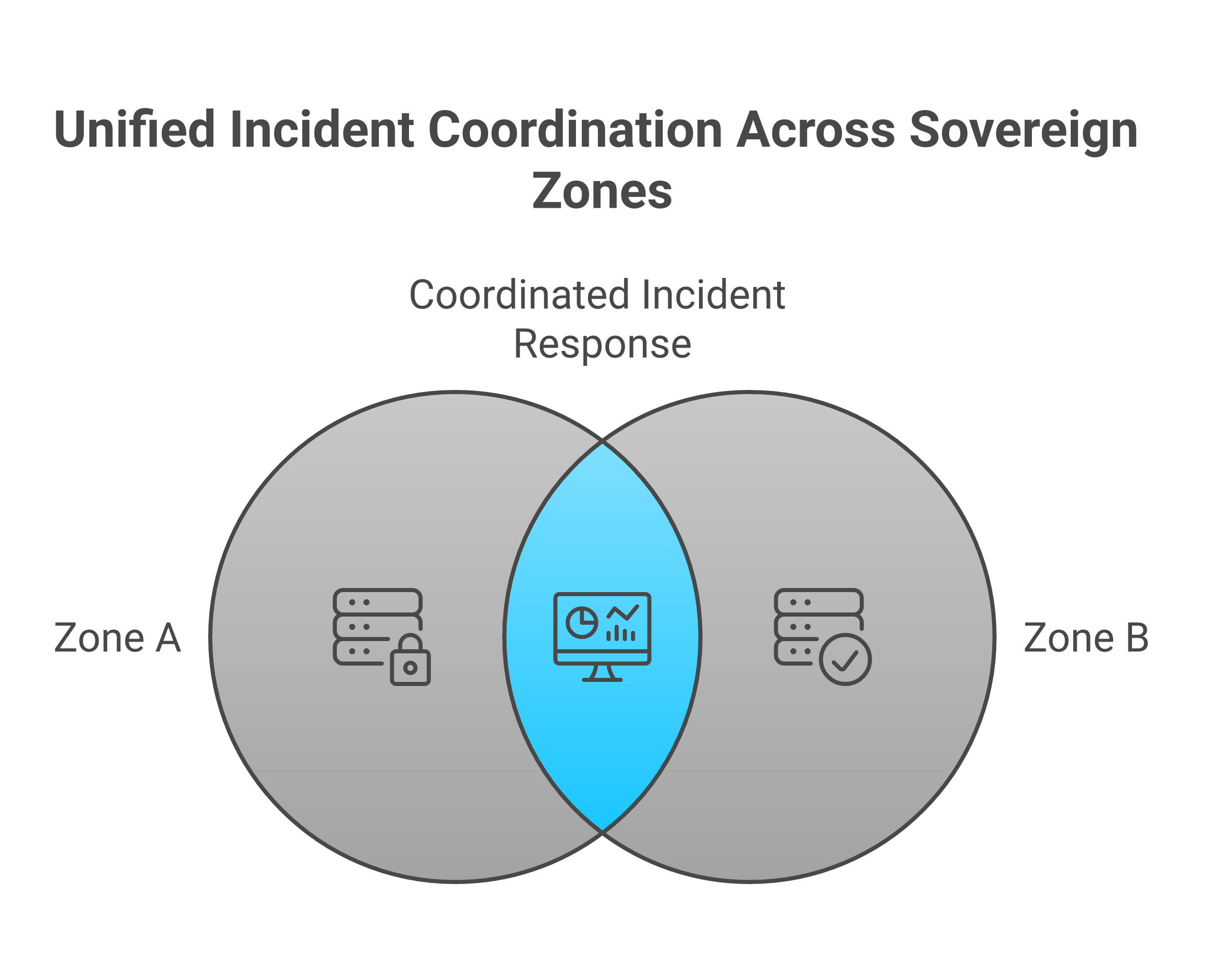
IBM Concert’s multi-zone topology model supports this architecture by maintaining a federated view of the service topology that respects zone boundaries. Concert can represent the dependency relationship between a Zone A service and a Zone B service without requiring either zone’s detailed telemetry to be visible to the other. The cross-zone dependency is expressed at the service level—”payments-api in Zone A depends on settlement-service in Zone B”—and the health status of each service is represented as an abstracted score rather than as raw metric data. This federated topology model is the informational substrate on which cross-zone incident coordination operates.
The practical effect is that cross-zone incidents are managed through a combination of local depth and global breadth: deep investigation within each zone, coordinated across zones at a level of abstraction that preserves sovereignty. It is slower than unconstrained access. It is also the only approach consistent with the regulatory frameworks that sovereign operations exist to satisfy.
30.6 Post-incident review and knowledge capture
The post-incident review is where the organisation converts an operational failure into institutional knowledge. Done well, it prevents recurrence, improves response processes, and strengthens the operational posture of the estate. Done poorly—or not done at all—it ensures that the same failures recur, the same investigation paths are retraced, and the same lessons are learned repeatedly without ever being retained.
The primary obstacle to effective PIR is not reluctance but effort. Reconstructing the timeline of a major incident from memory, chat logs, and scattered ticket updates is laborious work, and it competes for attention with the operational backlog that accumulated during the incident itself. Agent-assisted PIR addresses this obstacle directly by automating the mechanical aspects of post-incident review while preserving the interpretive and judgemental aspects for human participants.
Automated timeline reconstruction is the foundation. The coordination agent, which has been tracking action items, summarising progress, and logging findings throughout the incident, already possesses a structured record of the incident chronology. The PIR agent extends this record by incorporating data from additional sources: the alert firing sequence from the monitoring system, the exact timestamps of remediation actions from the change management system, the metric recovery curves from Instana, and the communication timestamps from the collaboration platform. These are assembled into a comprehensive, timestamped timeline that shows what happened, in what order, with what effect, and who was involved at each point.
This automated timeline eliminates the most time-consuming aspect of traditional PIR preparation and resolves the memory reliability problem. Human memory of events that occurred at three o’clock in the morning, under stress, is notoriously unreliable—particularly regarding sequence and timing [4]. The automated timeline, drawn from system records rather than human recollection, provides an objective chronological foundation on which the interpretive discussion can build.
Root cause documentation takes the RCA output produced during the incident (Section 30.3) and structures it for the PIR record. The agent presents the hypotheses that were considered, the evidence for and against each, the hypothesis that was ultimately validated by the successful remediation, and any residual uncertainty about contributing factors. This documentation is more thorough than what most teams produce manually, because it captures not only the final root cause determination but the analytical path that led to it—including the blind alleys and false hypotheses that are often omitted from manually written PIRs but that contain valuable information about how the team’s diagnostic process can be improved.
Action item extraction identifies the preventive and corrective actions that emerge from the PIR discussion. During the review meeting, participants propose actions: “We need to add a pre-deployment check for connection pool configuration,” “The runbook for database connection issues needs to be updated,” “We should add a synthetic monitor that specifically tests the connection pool under load.” The PIR agent captures these as structured action items with proposed owners, links them to the incident record, and—critically—creates the corresponding tickets in the task management system so that they are tracked to completion rather than recorded in a PIR document that is filed and forgotten.
Knowledge base updates close the learning loop. The completed PIR document, once reviewed and approved by the incident team, is automatically ingested into the operational knowledge base described in Chapter 20. The ingestion pipeline indexes the PIR with appropriate metadata: the services involved, the root cause category, the sovereign zone, the date, and the severity. Future incidents with similar characteristics will retrieve this PIR through the RAG-based knowledge retrieval process, making the organisation’s learning from this incident available at the point of need during subsequent events.
The PIR agent also evaluates whether existing knowledge base content should be updated in light of the incident. If the incident revealed that an existing runbook was incomplete or incorrect—a remediation step that the runbook recommended but that proved ineffective, for example—the agent flags the specific runbook section for review and creates a maintenance task for the knowledge base team. If the incident revealed a gap in monitoring coverage—a failure mode that was not detected by existing alerts—the agent creates a monitoring enhancement request with the specific metric, threshold, and service reference needed to close the gap.
This feedback from PIR to the agent training and runbook corpus is architecturally important. The agents that perform triage, RCA, and war room coordination in future incidents draw on the knowledge base for historical pattern matching and remediation guidance. Every PIR that updates the knowledge base improves the quality of the information those agents will surface during subsequent incidents. The learning is not merely organisational—captured in documents that humans may or may not read—but operational, embedded in the retrieval corpus that agents query automatically during every incident response.
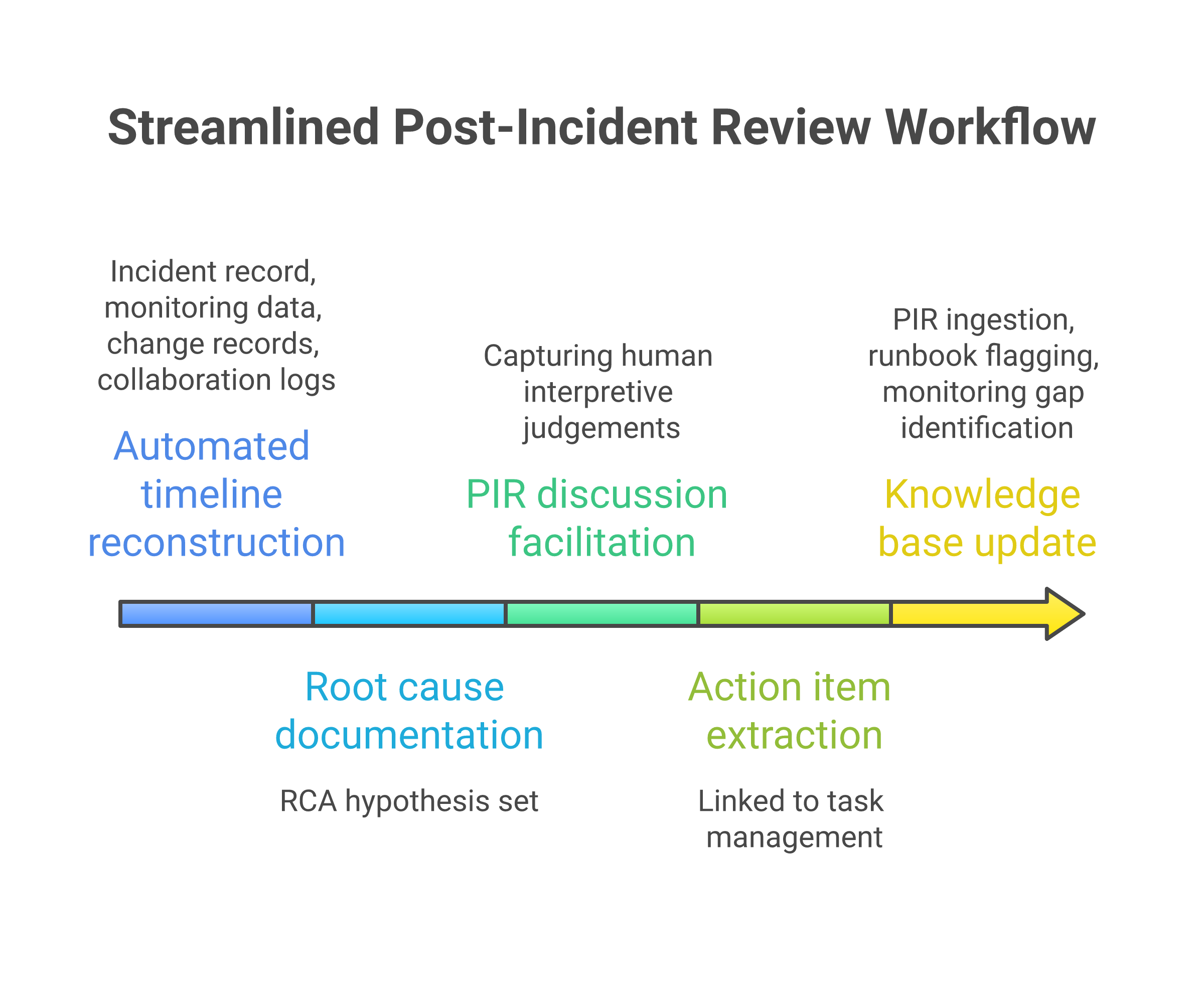
This feedback loop—from incident through PIR through knowledge base update through future incident retrieval—is the mechanism through which agent-assisted incident management becomes continuously self-improving. Each incident that is properly reviewed and documented makes the agents more effective at triaging, investigating, and supporting the resolution of future incidents. The compounding effect is significant: organisations that sustain this feedback loop for twelve to eighteen months report measurable improvements not only in resolution speed but in the quality and consistency of their incident response process [8].
30.7 Incident management metrics and continuous improvement
Measuring the effectiveness of agent-assisted incident management requires metrics that capture both speed and quality—two dimensions that do not always move together. An incident resolved quickly but with an incorrect root cause determination will recur; an incident analysed thoroughly but resolved slowly imposes unnecessary business impact. The metrics framework must capture both dimensions and make the trade-offs visible.
Mean Time to Detect (MTTD) measures the elapsed time between the onset of a service-affecting condition and the generation of an actionable alert. Agent assistance affects MTTD primarily through Concert’s correlation capability: by grouping related alerts into a single correlated situation, the time between “something is generating alerts” and “someone understands that there is a coherent incident requiring response” is reduced. Organisations deploying Concert’s correlation engine typically observe MTTD reductions of 40 to 60 per cent for correlated incident types, because the correlation eliminates the manual analysis time previously required to distinguish signal from noise in the alert stream [5].
Mean Time to Acknowledge (MTTA) measures the elapsed time between alert generation and the first human engagement with the incident. Agent-assisted triage affects MTTA in two ways. First, the structured situation report delivered to the on-call engineer provides immediate context, reducing the time spent in the “what is going on?” phase that precedes meaningful engagement. Second, the automated severity classification and escalation recommendation ensure that the right responders are paged immediately, rather than after the initial responder has spent fifteen minutes assessing severity manually.
Mean Time to Resolve (MTTR) is the metric most commonly cited and most frequently misused. MTTR as a single number obscures the distinction between incidents resolved quickly because they were simple and incidents resolved quickly because the response was effective. For evaluating agent assistance, MTTR should be segmented by incident complexity: the improvement in MTTR for complex, multi-service, multi-team incidents is the meaningful signal, because these are the incidents where agent assistance delivers the greatest value. Simple incidents that a single engineer can resolve in fifteen minutes are unlikely to benefit materially from agent assistance.
For complex P1 and P2 incidents, organisations with mature agent-assisted incident management report MTTR reductions in the range of 30 to 50 per cent, driven primarily by faster triage, more systematic RCA, and reduced coordination overhead in the war room [8]. These reductions are significant not only operationally but financially: the cost of a P1 incident for a tier-one financial service is measured in thousands of pounds per minute of downtime, and a 30 per cent reduction in MTTR translates directly to reduced business impact.
RCA quality is harder to measure than speed but equally important. A useful proxy is the repeat incident rate: the frequency with which incidents with the same root cause recur after a PIR has been conducted and action items have been assigned. A declining repeat incident rate indicates that the RCA process is identifying genuine root causes and that the preventive actions are effective. An agent-assisted PIR process that systematically captures root causes, creates tracked action items, and updates the knowledge base should produce a measurably lower repeat incident rate than a manual process that is inconsistently applied.
Action item completion rate from PIRs is a leading indicator of whether the learning loop is functioning. Action items that are created but never completed represent learning that was identified but never applied. Agent-assisted PIR improves this metric by creating structured, tracked tickets for each action item rather than recording them in a document. The tracking is visible: incomplete PIR action items can be surfaced in operational reviews, and their completion rate can be reported as a metric of the organisation’s learning discipline.
Human satisfaction with agent assistance is a qualitative metric that deserves explicit attention. If engineers find the agent’s situation reports unhelpful, the RCA hypotheses misleading, or the war room coordination intrusive, the agent assistance will be circumvented rather than adopted. Regular feedback collection—through post-incident surveys, periodic retrospectives, and direct observation of agent usage patterns—provides the signal needed to calibrate agent behaviour. An agent that produces situation reports with too much detail, or that surfaces historical patterns that are consistently irrelevant, or that posts war room summaries too frequently, needs to be tuned. The metrics should capture not only what agents produce but whether what they produce is valued by the humans they assist.
The relationship between these metrics is not always straightforward. An improvement in MTTR might coincide with a decline in RCA quality if the pressure to resolve quickly leads agents to present premature hypotheses that engineers accept without sufficient scrutiny. A decline in repeat incident rate might reflect genuine improvement in root cause identification, or it might reflect a reduction in the total number of incidents due to unrelated infrastructure improvements. The metrics must be interpreted in context, and they must be reviewed as a set rather than as individual numbers.
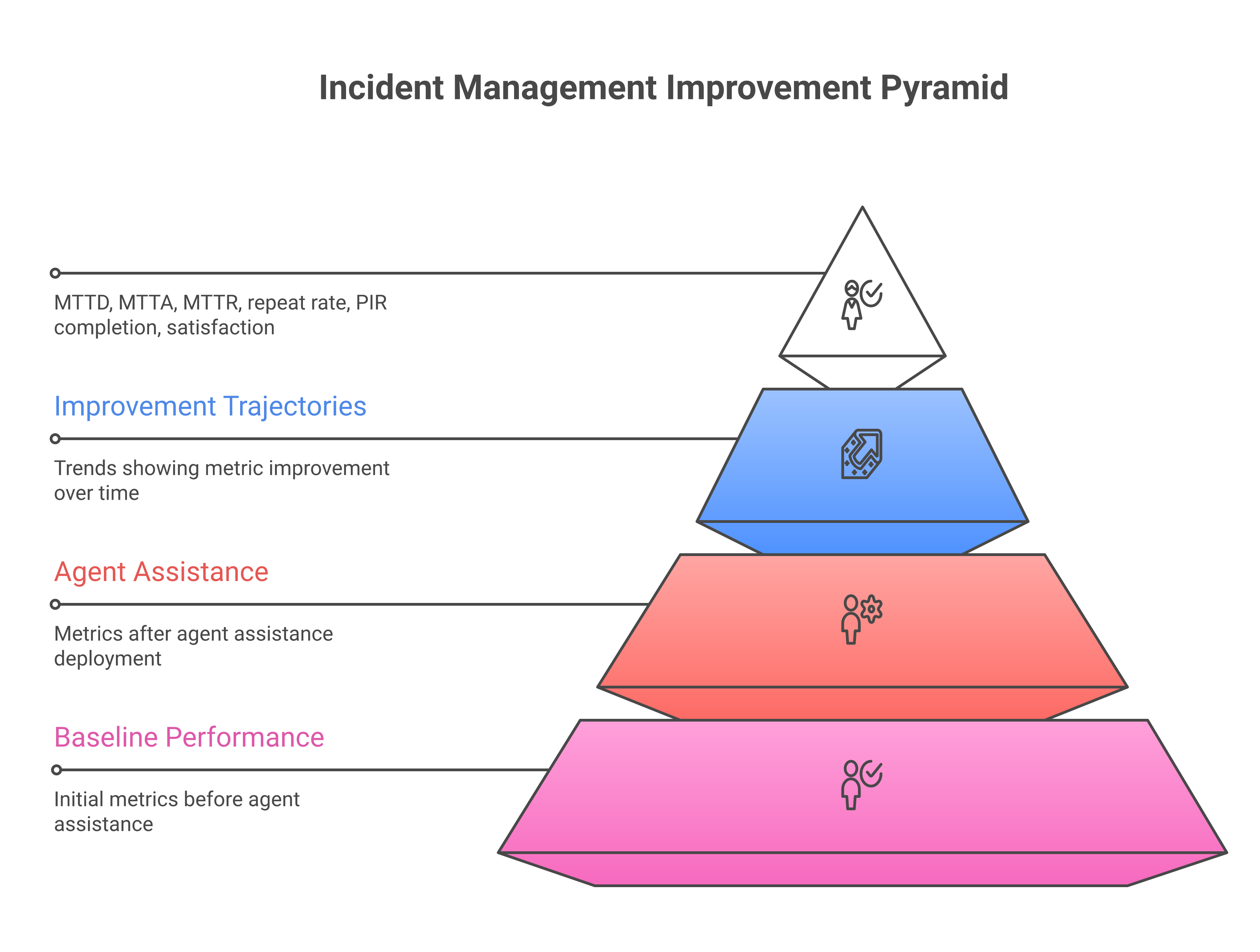
Continuous improvement in agent-assisted incident management is driven by the feedback loop between these metrics and the agent configuration. When MTTR for a specific incident category is not improving, the investigation should examine whether the agents are retrieving relevant historical patterns, whether the RCA methodology is appropriate for that failure mode, and whether the war room coordination is effectively directing human effort. When human satisfaction is low for a specific agent function, the function should be examined for calibration issues: is the agent providing too much or too little detail, is it surfacing relevant or irrelevant context, is it respecting the human decision-making role or appearing to override it?
This improvement process is itself a form of operational learning—the organisation learning not only about its systems but about how to use agents effectively in managing those systems. It is a capability that develops over months and years, not one that is fully realised at initial deployment. The organisations that derive the greatest value from agent-assisted incident management are those that treat the agents not as products to be installed but as capabilities to be cultivated, calibrated, and continuously refined in response to operational experience.
Key Takeaways
-
Major incidents involve detection, triage, escalation, investigation, remediation, communication, and post-incident review; each stage presents specific cognitive and coordination challenges that agent assistance can address without displacing human accountability.
-
Agent-assisted triage produces structured situation reports within minutes by correlating alerts, querying topology, retrieving recent changes, and matching historical patterns, transforming the opening phase of incident response from reactive information gathering to directed investigation.
-
Automated root cause analysis synthesises temporal alignment, causal graph analysis, and cross-signal correlation to produce ranked hypotheses with associated evidence, supporting rather than replacing human diagnostic judgement.
-
War room coordination agents handle action item tracking, progress summarisation, multi-audience communication drafting, and shift handover briefings, freeing human participants to focus on technical and judgemental work.
-
Cross-zone incident remediation requires zone-local execution with cross-zone situational awareness: agents operate within sovereign zone boundaries, exchanging abstracted findings rather than raw data, accepting the operational overhead as the cost of regulatory compliance.
-
Agent-assisted post-incident review automates timeline reconstruction, root cause documentation, action item extraction, and knowledge base updates, closing the learning loop that makes each incident a source of institutional improvement.
-
Metrics for agent-assisted incident management must capture both speed (MTTD, MTTA, MTTR) and quality (RCA accuracy, repeat incident rate, PIR action item completion), along with human satisfaction to ensure the assistance is valued by the engineers it serves.
Bridge to Chapter 31 — Operating Model and Shift-Left Operations
This chapter, and Parts VII through IX more broadly, have examined the technical capabilities that constitute an agentic operations platform: from observability and compliance automation through infrastructure-as-code and configuration management, to the AI-driven capabilities of predictive analytics, autonomous self-healing, and agent-assisted incident management. These capabilities are substantial, and they represent a genuine transformation in what is operationally possible.
But capabilities alone do not produce outcomes. A sophisticated agentic operations platform deployed into an organisation whose operating model, team structures, skill profiles, and governance processes were designed for a manual operations era will underperform its potential—not because the technology is inadequate, but because the organisational context does not support the ways of working that the technology enables. The shift-left operations model, in which operational concerns are addressed earlier in the development lifecycle and operational expertise is distributed more broadly across the organisation, is not merely a nice-to-have complement to the technical platform. It is the organisational transformation without which the technical platform cannot deliver its full value.
Chapter 31 examines this organisational dimension: the operating model changes, the skill development, the governance evolution, and the cultural shifts that translate technical capability into sustained operational improvement. The transition from Part IX to Part X is, in this sense, the transition from what the platform can do to how the organisation must change to realise its potential.
References
[1] European Parliament and Council, “Regulation (EU) 2022/2554 on digital operational resilience for the financial sector (DORA),” Official Journal of the European Union, vol. L 333, pp. 1–79, Dec. 2022. [Online]. Available: https://eur-lex.europa.eu/legal-content/EN/TXT/?uri=CELEX:32022R2554
[2] European Parliament and Council, “Directive (EU) 2022/2555 on measures for a high common level of cybersecurity across the Union (NIS2),” Official Journal of the European Union, vol. L 333, pp. 80–152, Dec. 2022. [Online]. Available: https://eur-lex.europa.eu/legal-content/EN/TXT/?uri=CELEX:32022L2555
[3] International Organization for Standardization, “ISO/IEC 27001:2022 — Information security, cybersecurity and privacy protection — Information security management systems — Requirements,” ISO/IEC, Geneva, 2022. [Online]. Available: https://www.iso.org/standard/27001
[4] S. Dekker, The Field Guide to Understanding ‘Human Error’, 3rd ed. Boca Raton, FL: CRC Press, 2014. [Online]. Available: https://doi.org/10.1201/9781317031833
[5] IBM, “IBM Concert: AI-powered IT estate management,” IBM Documentation, 2024. [Online]. Available: https://www.ibm.com/docs/en/concert
[6] IBM, “IBM watsonx Orchestrate: AI assistant for business automation,” IBM Documentation, 2024. [Online]. Available: https://www.ibm.com/docs/en/watsonx-orchestrate
[7] ServiceNow, “IT Service Management,” ServiceNow Documentation, 2024. [Online]. Available: https://docs.servicenow.com/bundle/itservice-management
[8] N. R. Murphy, B. Beyer, C. Jones, and J. Petoff, Site Reliability Engineering: How Google Runs Production Systems. Sebastopol, CA: O’Reilly Media, 2016. [Online]. Available: https://sre.google/sre-book/table-of-contents/
[9] PagerDuty, “Incident response and on-call management,” PagerDuty Documentation, 2024. [Online]. Available: https://www.pagerduty.com/docs/
[10] AXELOS, ITIL Foundation: ITIL 4 Edition. London: TSO (The Stationery Office), 2019. [Online]. Available: https://www.axelos.com/certifications/itil-service-management/itil-4-foundation
[11] G. Kim, J. Humble, P. Debois, J. Willis, and N. Forsgren, The DevOps Handbook, 2nd ed. Portland, OR: IT Revolution Press, 2021. [Online]. Available: https://itrevolution.com/product/the-devops-handbook-second-edition/
Sovereign Cloud Operations: AI-Driven Management of Sovereign Estates
© 2026 by Alan Hamilton
is licensed under CC BY-SA 4.0


