Chapter 27 — Chat-First Operations: Conversational Interfaces for Sovereign Estates
Summary
This chapter presents the conversational interface as the primary interaction surface for sovereign cloud operations, resolving the context-switching overhead that arises when operators navigate between disparate monitoring, ITSM, pipeline, and compliance tools. It establishes design principles for operational conversational UX — progressive disclosure, structured responses, actionable suggestions, and explicit confirmation for destructive actions — and describes the natural-language-to-operational-action pipeline in architectural detail: a five-stage process of intent classification, entity extraction with canonical mapping, slot filling against tool parameter schemas, action routing with plan presentation, and confirmation gating. The chapter provides worked interaction patterns for incident triage, change approval, compliance queries, and cross-zone data requests with sovereign boundary enforcement, alongside concrete error-handling flows for ambiguous intent, conflicting instructions, unauthorised requests, model uncertainty, and graceful degradation when backend tools are unavailable. It extends the conversational paradigm to multi-modal interaction including inline visualisations, topology diagrams, voice interfaces, and mobile clients, while addressing the sovereign-aware boundaries that enforce user-scoped data visibility, zone isolation, and classification-tagged conversation histories. Architects will also find guidance on team collaboration patterns such as war room channels, shared investigation threads, and shift handover summaries, alongside a quantitative measurement framework — with specific metrics, thresholds, and a traffic-light scorecard — for continuous improvement of conversational effectiveness.
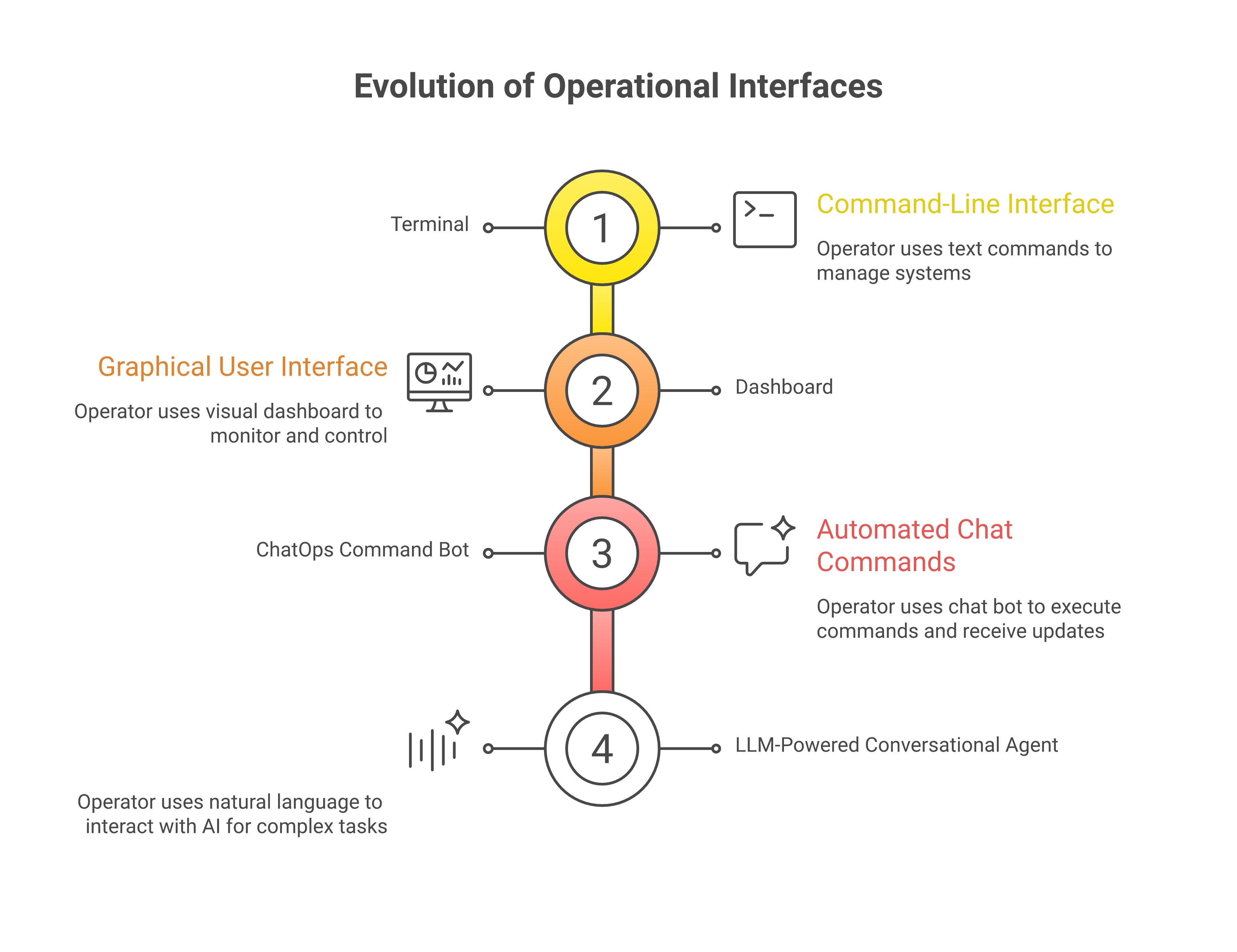
Every generation of operational tooling has been defined by its primary interaction surface. Mainframe operations happened through green-screen terminals. The Unix era introduced the shell, and with it the expectation that competent operators would carry a mental library of command flags, pipe chains, and file paths. The graphical monitoring era replaced command lines with dashboards: Nagios, Grafana, bespoke single-pane-of-glass portals, each requiring operators to learn where to click, which tabs to open, and how to read the particular visual grammar of each tool. The cloud era multiplied these surfaces without consolidating them. A typical cloud operations engineer in a large enterprise today navigates between a container orchestration console, an observability platform, an ITSM portal, a CI/CD pipeline viewer, a secrets manager, a chat application, and often a spreadsheet that someone maintains because no single tool provides the view they need.
The cumulative cost of this proliferation is not measured in tool licences. It is measured in context switches: the cognitive overhead of moving between interfaces, re-establishing mental state in each, and maintaining a coherent picture of an operational situation across systems that share no common interaction model. Studies of software engineering productivity have consistently identified context switching as one of the most significant drains on effective work time, with recovery periods of fifteen to twenty minutes after each interruption being typical even for experienced practitioners [1]. In operations, the cost is amplified because context switches happen under time pressure—during incidents, change windows, and compliance assessments—and because the consequences of losing context mid-operation are not merely lost productivity but potential misdiagnosis, missed steps, and compliance gaps.
This chapter argues that the conversational interface—the chat-first paradigm—is the interaction model that resolves this fragmentation. Not because chat is inherently superior to dashboards or command lines, but because a well-designed conversational interface can sit in front of all of them, translating operator intent into the appropriate tool calls, presenting results in a unified format, and maintaining a continuous, auditable thread of operational context that no collection of separate tools can replicate. Chapter 17 described the architecture of IBM watsonx Orchestrate, the conversational and workflow engine that makes this paradigm concrete. This chapter extends that foundation into the broader territory of conversational user experience: the design principles, the operational patterns, the sovereignty constraints, the collaborative workflows, and the measurement frameworks that determine whether a chat-first operations model delivers on its promise or merely adds another surface to the existing proliferation.
27.1 Why chat is the operations interface of the future
The case for conversational operations rests on three structural arguments, each reinforced by a decade of practical evidence from the ChatOps movement and by the more recent capabilities of large language model (LLM)-powered conversational agents.
The first argument is reduced context switching. When an operator can query the state of a service, examine its recent change history, review its dependency topology, and initiate a remediation workflow without leaving a single interface, the cognitive overhead of navigating between tools is eliminated. The operator’s attention remains on the operational situation rather than on the mechanics of tool navigation. This is not a minor ergonomic improvement. In incident response, the difference between an operator who maintains continuous situational awareness and one who loses ten minutes switching between four tools to assemble context is often the difference between a twenty-minute resolution and a two-hour escalation. The value of Orchestrate’s single-interface model, described in Chapter 17, is precisely this: the operator stays in one place while the tools work behind the conversation [2].
The second argument is democratised access to operational intelligence. Traditional operational tooling assumes deep familiarity with each tool’s interface, query language, and data model. A junior engineer who needs to check whether a certificate is approaching expiry in a particular sovereign zone must know which tool to open, which dashboard to navigate to, and which filters to apply. In a conversational interface, the same engineer types a natural-language question and receives an answer. The barrier to accessing operational intelligence drops from “knows the tool” to “can describe what they need.” This does not eliminate the need for expertise—the engineer must still understand what the answer means and what to do with it—but it removes the tool-specific friction that prevents less experienced team members from contributing effectively during incidents and routine operations alike.
The third argument is auditability as a by-product. Every conversation turn in a well-designed chat-first interface is a timestamped, attributed record of what was asked, what was done, and what was returned. This is not a logging feature bolted on after the fact; it is an inherent property of the conversational medium. The conversation is the audit trail. In sovereign-zone operations, where the obligation to demonstrate control is continuous and explicit, this property is not merely convenient—it is a compliance mechanism that satisfies requirements under DORA Article 12 and comparable frameworks without requiring operators to maintain separate evidence records [3].
The ChatOps movement, which emerged in the early 2010s through tools such as Hubot at GitHub and subsequently spread through Slack-based bot integrations across the industry, established the foundational insight that chat channels could serve as operational control surfaces rather than merely communication channels [4]. Early ChatOps implementations were limited by the brittleness of their command parsers: operators had to memorise precise command syntaxes, and any deviation from the expected format produced an error rather than a clarification. The introduction of LLM-powered conversational agents has removed this limitation. An operator no longer needs to remember that the command is /cert-check --fqdn api.payments.example.internal --zone payments-prod; they can type “check the certificate status for the payments API in the regulated zone” and receive the same result, with the language model handling the translation from intent to structured tool invocation.
The convergence of these three arguments—reduced context switching, democratised access, and inherent auditability—makes conversational operations not merely a convenience layer but an architectural choice with structural implications for how operations teams are organised, how knowledge is shared, and how compliance is demonstrated. The remainder of this chapter examines how to realise this potential without introducing the new failure modes that poorly designed conversational interfaces inevitably create.
27.2 Conversational UX design principles for operations
A conversational interface for operations is not a consumer chatbot. The design principles that govern consumer conversational UX—warmth, personality, conversational flow, error recovery through humour—are at best irrelevant and at worst actively harmful in an operational context. An operator managing an incident at three o’clock in the morning does not want the system to be friendly. They want it to be precise, predictable, and transparent about what it is doing. The design principles for operational conversational UX must be derived from the specific requirements of operational work, informed by research on human-AI interaction guidelines [12], but adapted to the particular demands of operational contexts rather than imported wholesale from consumer interaction design.
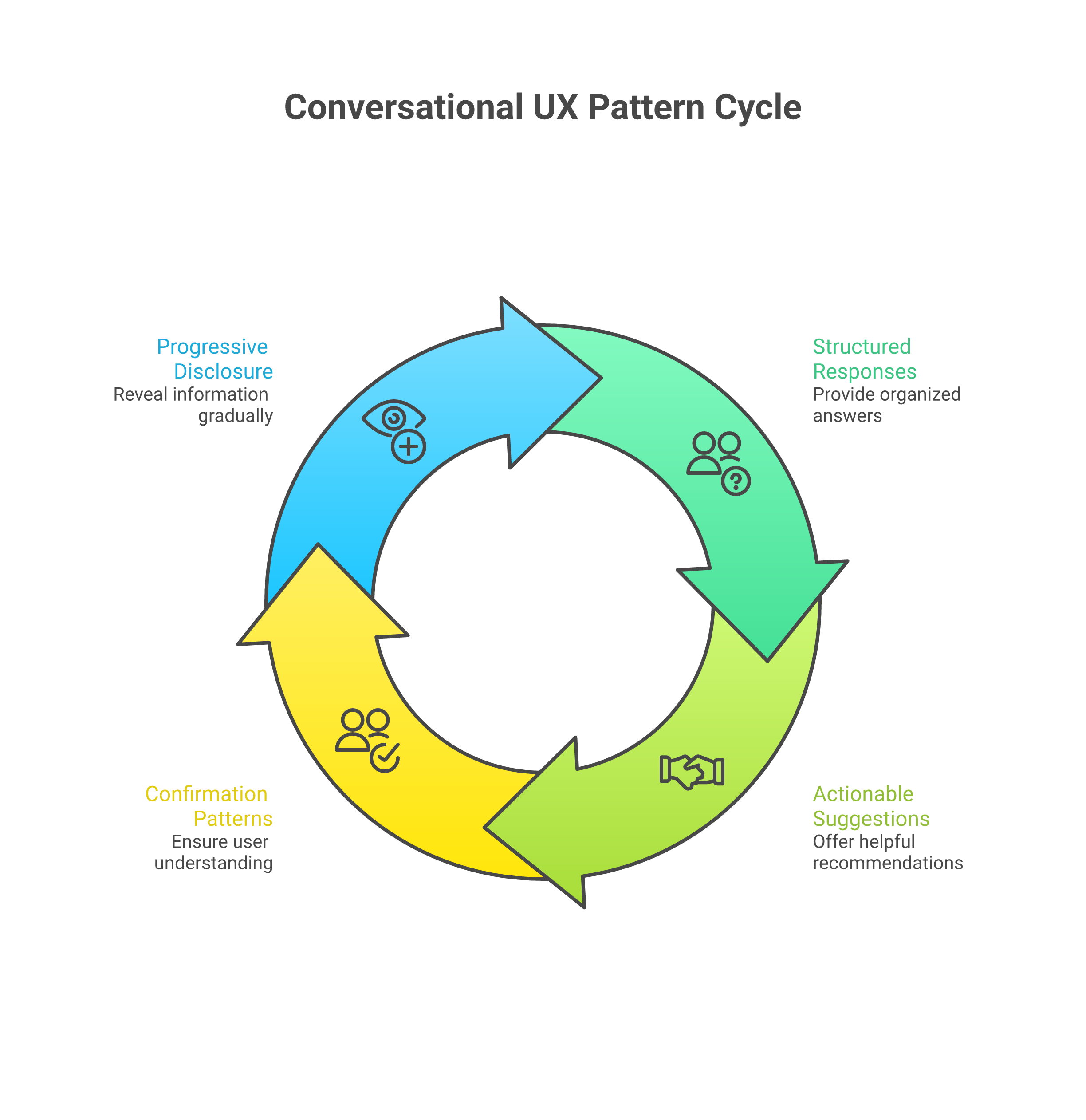
Progressive disclosure is the first and most important principle. An operational conversation generates large quantities of structured data: tool invocation parameters, API responses, metric time series, topology graphs, execution logs. Presenting all of this in the conversation stream would overwhelm the operator and obscure the information that matters. The conversational interface must present results at the appropriate level of detail for the current context, with the ability to expand into full detail on demand. When Orchestrate reports that a certificate renewal workflow completed successfully, the default response should be a concise summary: the certificate subject, the new expiry date, the number of hosts updated, and the change record identifier. The full execution log—every API call, every response payload, every timing measurement—should be accessible through a single action (a click, a command, a follow-up question) but should not clutter the primary conversation flow. Chapter 17 identified this as a core Orchestrate design principle; it applies equally to any operational conversational interface [5].
Structured responses distinguish operational chat from free-form conversation. When an operator asks for the status of services in a sovereign zone, the response should not be a paragraph of prose. It should be a structured table or list with consistent formatting: service name, status, last check time, zone assignment. When the response includes a recommendation, the recommendation should be clearly separated from the supporting evidence, with each element labelled. Structured responses serve two purposes: they are faster to scan under pressure, and they are easier to parse programmatically when the conversation log is consumed by downstream audit or analytics systems.
Actionable suggestions are the mechanism by which a conversational interface reduces the number of conversation turns required to complete a task. When the system presents a finding—a certificate approaching expiry, a vulnerability detected, a capacity threshold crossed—it should simultaneously present the available actions: “Would you like me to start the certificate renewal workflow?” or “I can open a change request for this remediation. Shall I proceed?” The operator should not need to formulate the next step from scratch; the interface should anticipate it and offer it. This pattern, sometimes called proactive assistance, must be carefully calibrated: offering too many suggestions is as disruptive as offering too few, and offering suggestions that are irrelevant to the operator’s current focus erodes trust. The suggestions should be derived from the operational context—the type of finding, the operator’s role, the available workflows—rather than from generic heuristics [6].
Confirmation patterns for destructive actions are a non-negotiable governance requirement. Any conversational action that modifies production state—deploying a configuration change, scaling a service, rotating a credential, executing a runbook—must include an explicit confirmation step that presents the operator with the specific parameters of the action before execution. The confirmation must not be a generic “are you sure?” dialogue. It must present the exact action, the exact target, and the exact parameters, so that the operator can verify that the system’s interpretation of their intent matches their actual intent. Chapter 17’s approval gate mechanism is the workflow-level implementation of this principle; conversational confirmation extends it to single-step actions that do not involve a formal workflow [2].
Avoiding the “magic command” anti-pattern is as important as the positive principles. The magic command anti-pattern occurs when an operational conversational interface develops an implicit command language that operators must learn through trial and error: specific phrasings that produce correct results while semantically equivalent phrasings produce errors or unexpected behaviour. This anti-pattern reintroduces the very problem that conversational interfaces are meant to solve—the requirement for operator-side knowledge of tool-specific syntax—but makes it worse by hiding the syntax behind a veneer of natural language. Avoiding this anti-pattern requires investment in the quality of tool descriptions in the Orchestrate registry, in the breadth of the language model’s training on operational vocabulary, and in systematic testing of conversational inputs against expected outputs. If an operator discovers that “check the cert for payments” works but “what’s the certificate status for the payments service” does not, the interface has failed at its most fundamental promise.
27.3 Natural language to operational action
The translation from natural language to operational action is the core technical challenge of chat-first operations. Chapter 17 described Orchestrate’s tool-calling model in architectural terms: the language model receives the conversation history and the tool registry, evaluates whether a tool call is appropriate, and generates a structured invocation. This section examines the cognitive and linguistic layers of that process—intent recognition, entity extraction, disambiguation, and multi-step planning—and the design decisions that determine whether the translation is reliable enough for production operations.
Intent recognition is the process of determining what the operator wants to accomplish. In operational contexts, intents cluster around a manageable taxonomy: query (retrieve information about the estate), diagnose (investigate a symptom or anomaly), remediate (take corrective action), provision (create or modify infrastructure), and administer (manage access, credentials, or configuration). A well-designed conversational operations system classifies the operator’s message into one of these categories—or into a more granular taxonomy specific to the organisation—before selecting which tools or workflows to invoke. The classification is not always explicit in the operator’s language. “The payments API is slow” is syntactically a statement, but its operational intent is diagnosis: the operator wants to know why, and expects the system to begin investigating. Recognising implicit intent requires the language model to understand operational conversational conventions, which it acquires through its training data and through the contextual signals provided by the conversation history and the tool registry descriptions [7].
Entity extraction identifies the specific operational objects referenced in the operator’s message: service names, zone identifiers, time ranges, severity levels, hostnames, cluster names, and other domain-specific entities. Entity extraction in operational contexts is complicated by the variety of naming conventions across tools and teams. The same service may be referred to as “payments API,” “payments-api,” “svc-payments,” or “the payments thing” by different operators. A robust conversational interface must maintain a mapping between colloquial references and canonical identifiers in the estate model—a mapping that can be seeded from Concert’s entity model (Chapter 14) and refined through conversation history. When the mapping is ambiguous, the system must ask for clarification rather than guessing: “I found three services matching ‘payments’: payments-api-prod, payments-api-staging, and payments-batch. Which one do you mean?”
Disambiguation extends beyond entity extraction to the full scope of the operator’s request. Consider the instruction “scale down the payments service.” Does the operator mean reduce the replica count? Lower the resource requests? Remove it from the load balancer? The correct interpretation depends on context: the current state of the service, the operator’s role, the recent conversation history, and the available tools. A well-designed system uses all of these signals before acting, and when the ambiguity cannot be resolved from context, it asks. The cost of a clarification question is a few seconds; the cost of an incorrect action in production can be hours of recovery and a compliance incident. Orchestrate’s output validation layer, described in Chapter 17, provides a programmatic safety net for ambiguity that the language model fails to catch, but the conversational design should aim to resolve ambiguity before it reaches the tool invocation stage [2].
Multi-step planning is the process by which the conversational interface decomposes a complex operator request into a sequence of tool calls. An operator who asks “investigate the latency spike in the payments zone and open a ticket if it looks like a real issue” has described a multi-step workflow: query Concert for recent findings in the payments zone, retrieve latency metrics from Instana, correlate with recent change events, evaluate whether the evidence supports a genuine issue, and conditionally create a ServiceNow incident record. Orchestrate’s workflow engine can execute predefined multi-step flows (Chapter 17, Section 17.5), but the conversational interface must also handle ad hoc multi-step requests that do not correspond to a predefined workflow. The language model’s ability to decompose these requests into a coherent plan—and to present that plan to the operator for confirmation before execution—is one of the distinguishing capabilities of LLM-powered conversational operations compared to earlier ChatOps implementations.
The reliability of this translation pipeline is not a fixed property of the system; it improves over time as tool descriptions are refined, as the entity mapping is enriched, and as conversation logs are analysed to identify patterns where the system’s interpretation diverged from operator intent. Section 27.7 discusses the metrics that drive this continuous improvement.
27.3.1 Pipeline architecture in detail
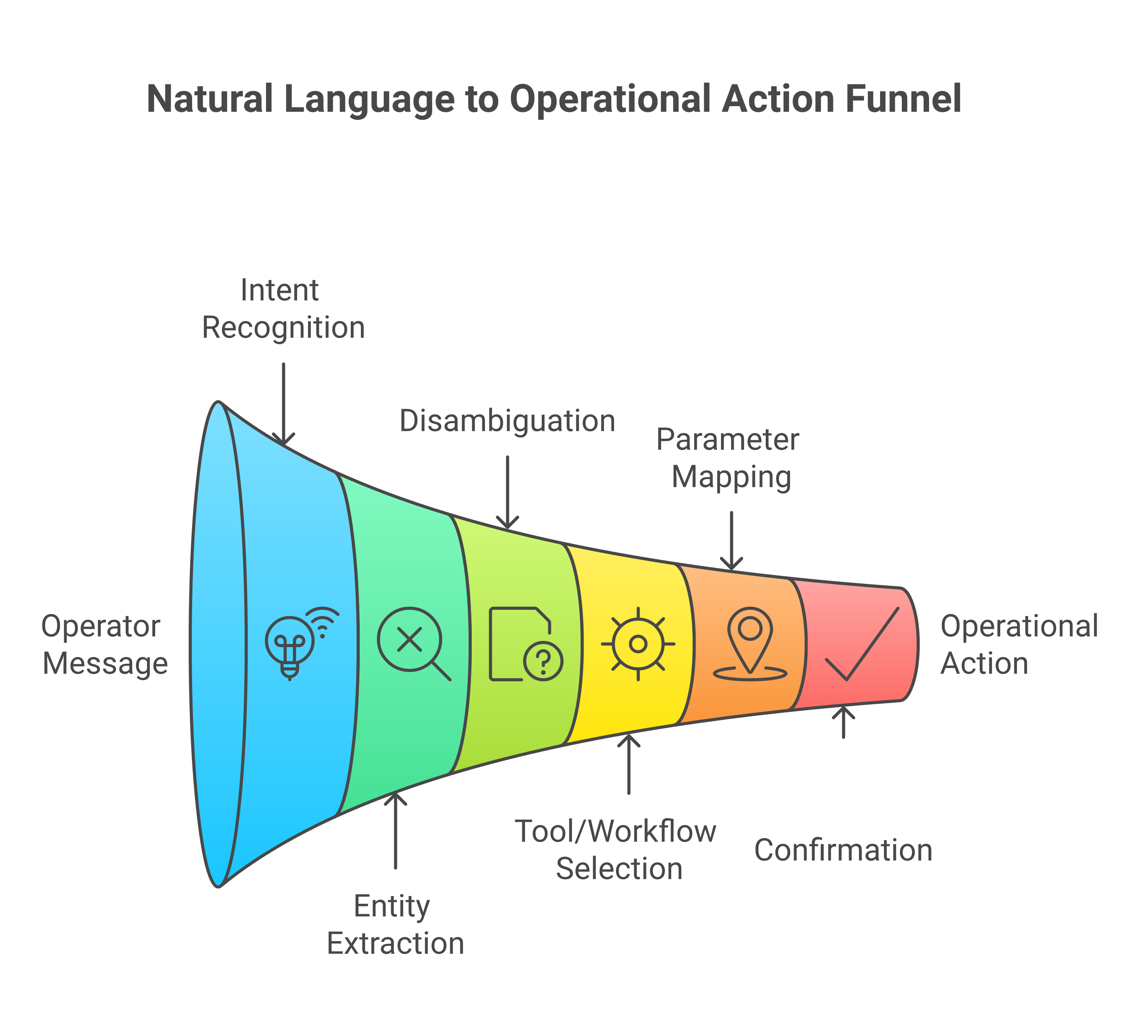
The natural-language-to-action pipeline is not a single monolithic inference pass; it is a staged pipeline in which each stage produces structured intermediate representations that are inspectable, auditable, and individually tuneable. The following describes the concrete stages that Orchestrate implements when processing an operator utterance.
Stage 1 — Intent classification. The language model evaluates the operator’s message against a taxonomy of operational intents. A reference taxonomy suitable for most sovereign estates contains five primary intents, each with subtypes:
| Primary intent | Subtypes | Example utterance |
|---|---|---|
| Query | status, metric, topology, compliance-posture | “What is the error rate for checkout-svc?” |
| Diagnose | root-cause, correlation, anomaly-investigation | “Why is payments-db latency elevated?” |
| Remediate | restart, scale, rollback, failover, patch | “Roll back the last deployment to checkout-svc.” |
| Provision | create, modify, decommission | “Provision a new Redis cluster in the staging zone.” |
| Administer | access-grant, credential-rotate, config-change | “Rotate the TLS certificate for api-gateway.” |
The model assigns a confidence score to each candidate intent. Orchestrate’s default configuration requires a confidence threshold of 0.85 for autonomous action routing; utterances scoring between 0.60 and 0.85 trigger a disambiguation prompt; utterances below 0.60 receive a clarification request that restates the system’s best interpretation and asks the operator to confirm or rephrase. These thresholds are configurable per organisation and should be tuned based on the misinterpretation rate metrics described in Section 27.7.
Stage 2 — Entity extraction and canonical mapping. Once intent is established, the pipeline extracts operational entities from the utterance and maps them to canonical identifiers in Concert’s entity model. Entity extraction operates over several categories: service names, zone identifiers, environment labels (production, staging, development), time expressions, severity levels, and infrastructure identifiers (cluster names, node names, namespace identifiers). The mapping layer resolves aliases and colloquial references using a synonym table maintained in the Orchestrate configuration. For example, an organisation might define the following mappings:
"payments API"      → svc:payments-api-prod (zone: eu-regulated)
"payments"           → svc:payments-api-prod (zone: eu-regulated)  [requires disambiguation if staging exists]
"the checkout thing" → svc:checkout-svc-prod (zone: eu-regulated)
"staging payments"   → svc:payments-api-staging (zone: eu-staging)
When an utterance contains an entity reference that maps to multiple candidates, the pipeline halts and presents the operator with the candidates rather than selecting one. The cost of a five-second disambiguation exchange is negligible compared with the cost of executing an action against the wrong service.
Stage 3 — Slot filling. Each tool in the Orchestrate registry declares a parameter schema — the slots that must be populated before the tool can be invoked. Slot filling is the process of mapping extracted entities to tool parameters and identifying any required parameters that remain unfilled. For a certificate-renewal tool with the schema {fqdn: string, zone: string, validity_days: int, approval_ticket: string}, the utterance “renew the certificate for api.payments.example.internal in the regulated zone” fills fqdn and zone but leaves validity_days and approval_ticket empty. The pipeline checks each unfilled slot against a defaults table: validity_days may have a policy-defined default of 365, while approval_ticket has no default and must be requested from the operator. The system responds: “I will renew the certificate for api.payments.example.internal in eu-regulated with a validity of 365 days. I need an approved change ticket number to proceed — do you have one, or shall I create a change request?”
Stage 4 — Action routing and plan presentation. With intent classified, entities resolved, and slots filled, the pipeline selects the tool or workflow to invoke. For single-tool actions, routing is direct: the pipeline matches intent and entity types to the appropriate tool in the registry. For multi-step requests, the pipeline constructs an execution plan — an ordered sequence of tool invocations with data dependencies between them — and presents this plan to the operator before execution begins. The plan is presented as a numbered list of steps, each with its target tool, parameters, and expected output:
Plan for: "Investigate the latency spike in the payments zone and open a ticket if warranted"

1. Query Concert findings for payments-api-prod in eu-regulated (last 2 hours)
2. Retrieve latency metrics from Instana for payments-api-prod (last 2 hours)
3. Retrieve recent change events from Concert for eu-regulated zone (last 4 hours)
4. Correlate findings, metrics, and changes to assess root cause
5. If evidence supports a genuine issue → Create ServiceNow incident (priority derived from impact assessment)

Shall I proceed with this plan?
The operator may approve, modify, or cancel the plan. Modification is supported through conversational refinement: “Skip step 3, I already checked changes — there were none” adjusts the plan without requiring the operator to restate the entire request.
Stage 5 — Confirmation gate. Before any action that modifies state, the pipeline presents a confirmation prompt that specifies the exact action, target, and parameters. The confirmation prompt follows a standardised template:
Action:   Restart service
Target:   svc:payments-api-prod
Zone:     eu-regulated
Method:   Rolling restart (zero-downtime)
Impact:   3 pods will be recycled sequentially; estimated duration 4 minutes
Requires: Change ticket CHG-2026-04471 (approved)

Confirm? [yes / no / modify]
Read-only queries do not require confirmation. The classification of which actions are read-only and which are state-modifying is defined in the tool registry metadata, not inferred by the language model, ensuring that the confirmation requirement cannot be circumvented by creative phrasing.
27.3.2 Worked interaction patterns
The following worked examples illustrate the complete pipeline in action across four common operational scenarios. Each example shows the operator’s utterance, the pipeline’s internal processing, and the conversational exchange as the operator experiences it.
Example 1 — Incident triage dialogue.
An on-call engineer receives a PagerDuty alert and opens the Orchestrate interface.
OPERATOR:  payments-api is throwing 503s in production. What's going on?

SYSTEM:    [Intent: diagnose/anomaly-investigation, confidence: 0.94]
           [Entity: payments-api-prod, zone: eu-regulated]

           I am investigating payments-api-prod in eu-regulated. Here is what I
           have found so far:

           ┌──────────────────────────────────────────────────────────┐
           │ Service:       payments-api-prod                        │
           │ Zone:          eu-regulated                             │
           │ Status:        DEGRADED — 34% error rate (5xx)         │
           │ Since:         2026-02-28 02:17 UTC (23 minutes ago)   │
           │ Upstream deps: payments-db-prod (HEALTHY)              │
           │                redis-cache-prod (HEALTHY)              │
           │ Recent changes: Deploy #4471 at 02:14 UTC (config      │
           │                 update: connection pool max_size        │
           │                 changed from 50 to 500)                │
           │ Concert finding: CONC-8821 — probable misconfiguration  │
           │                  (confidence: high)                    │
           └──────────────────────────────────────────────────────────┘

           Concert finding CONC-8821 correlates the error onset with deploy
           #4471, which changed the connection pool max_size from 50 to 500.
           The payments-db connection limit is 200, so the new pool size
           exceeds the database's capacity.

           Recommended action: Roll back deploy #4471 to restore the previous
           connection pool configuration.
           Shall I initiate the rollback?

OPERATOR:  Yes, roll it back.

SYSTEM:    Action:   Roll back deployment
           Target:   payments-api-prod (deploy #4471)
           Zone:     eu-regulated
           Method:   Revert to deploy #4470 (connection pool max_size = 50)
           Impact:   Rolling redeployment; estimated 3 minutes to full rollout
           Ticket:   Auto-creating emergency change CHG-2026-04472

           Confirm? [yes / no / modify]

OPERATOR:  Confirm.

SYSTEM:    Rollback initiated. Tracking deployment...
           ✓ Pod 1/3 rolled back (02:42 UTC)
           ✓ Pod 2/3 rolled back (02:43 UTC)
           ✓ Pod 3/3 rolled back (02:44 UTC)

           Deployment #4470 is now active. Error rate has dropped from 34%
           to 0.2% over the last 60 seconds. Service status: HEALTHY.

           Emergency change CHG-2026-04472 has been created and linked to
           Concert finding CONC-8821. Shall I page the deploy author to
           discuss the configuration error, or close the incident?
This interaction completes an incident triage, root cause identification, remediation, and documentation cycle in under three minutes and five conversation turns.
Example 2 — Change approval flow.
A platform engineer needs to scale a service ahead of a planned traffic event.
OPERATOR:  I need to scale checkout-svc to 10 replicas in the regulated zone
           before the sale event tomorrow.

SYSTEM:    [Intent: remediate/scale, confidence: 0.91]
           [Entity: checkout-svc-prod, zone: eu-regulated]
           [Slot: target_replicas=10, current_replicas=3]

           checkout-svc-prod currently runs 3 replicas in eu-regulated. Scaling
           to 10 replicas will require approximately 2.8 vCPU and 5.6 GiB
           additional memory. The zone has 12 vCPU and 24 GiB available.

           This action requires an approved standard change ticket. I can
           create one for you — it will route to the CAB-lite automated
           approval queue since this is a horizontal scale action with no
           configuration change.

           Shall I create the change request?

OPERATOR:  Yes, go ahead.

SYSTEM:    Change request CHG-2026-04473 created.
           Type:      Standard change (horizontal scale)
           Approval:  CAB-lite automated queue
           Status:    Approved (automated — met all policy criteria)

           Shall I execute the scaling action now, or schedule it for a
           specific time?

OPERATOR:  Schedule it for tomorrow at 06:00 UTC.

SYSTEM:    Scheduled: Scale checkout-svc-prod to 10 replicas at 2026-03-01
           06:00 UTC. Change ticket CHG-2026-04473 updated with scheduled
           execution window. You will receive a notification when the scaling
           completes. Shall I also schedule a scale-down after the event?
Example 3 — Compliance query.
A compliance officer needs to verify the estate’s posture before a regulatory review.
OPERATOR:  Show me the compliance posture for all services in the EU regulated
           zone against the DORA ICT risk framework.

SYSTEM:    [Intent: query/compliance-posture, confidence: 0.96]
           [Entity: zone=eu-regulated, framework=DORA-ICT-risk]

           Compliance posture for eu-regulated against DORA ICT Risk Framework:

           ┌─────────────────────┬────────┬───────────┬─────────────────────┐
           │ Service             │ Status │ Score     │ Open findings       │
           ├─────────────────────┼────────┼───────────┼─────────────────────┤
           │ payments-api-prod   │ PASS   │ 94/100    │ 1 low (log rotation)│
           │ checkout-svc-prod   │ PASS   │ 97/100    │ 0                   │
           │ payments-db-prod    │ WARN   │ 82/100    │ 2 medium            │
           │ redis-cache-prod    │ PASS   │ 91/100    │ 1 low               │
           │ api-gateway-prod    │ PASS   │ 96/100    │ 0                   │
           │ identity-svc-prod   │ PASS   │ 99/100    │ 0                   │
           └─────────────────────┴────────┴───────────┴─────────────────────┘

           Zone aggregate score: 93/100 (PASS)
           Framework version: DORA ICT Risk v2.1
           Last full assessment: 2026-02-27 18:00 UTC

           payments-db-prod has 2 medium findings:
           • CONC-8804: Backup encryption key rotation overdue (17 days)
           • CONC-8809: Disaster recovery test not executed in current quarter

           Shall I generate the full compliance report for the regulatory
           review, or would you like to drill into the payments-db findings?

OPERATOR:  Drill into CONC-8804.

SYSTEM:    Finding CONC-8804 — Backup encryption key rotation overdue

           Policy:         Backup encryption keys must be rotated every 90 days
           Last rotation:  2025-12-24 (66 days ago; threshold: 90 days)
           Status:         Overdue by 0 days (warning issued at 73 days)
           Affected asset: payments-db-prod backup volume (vol-eu-reg-0442)
           Remediation:    Execute key rotation runbook RB-0031

           The key rotation can be performed without service interruption.
           Estimated duration: 12 minutes. Shall I initiate runbook RB-0031?
Example 4 — Cross-zone data request with sovereign boundary enforcement.
An operator attempts a query that crosses sovereign zone boundaries.
OPERATOR:  Compare the p99 latency of payments-api across all three zones —
           EU regulated, EU staging, and APAC regulated.

SYSTEM:    [Intent: query/metric, confidence: 0.93]
           [Entities: payments-api in eu-regulated, eu-staging, apac-regulated]
           [Access check: operator cleared for eu-regulated, eu-staging;
            NOT cleared for apac-regulated]

           I can retrieve latency data for payments-api in eu-regulated and
           eu-staging, but your current role (eu-platform-engineer) does not
           include authorisation for the apac-regulated zone. I am unable to
           include APAC data in this comparison.

           Partial results for your authorised zones:

           ┌──────────────────┬──────────────┬──────────────┐
           │ Metric           │ eu-regulated │ eu-staging   │
           ├──────────────────┼──────────────┼──────────────┤
           │ p99 latency      │ 142 ms       │ 168 ms       │
           │ p95 latency      │ 98 ms        │ 121 ms       │
           │ Error rate       │ 0.2%         │ 0.4%         │
           │ Request volume   │ 12,400 rpm   │ 1,200 rpm    │
           └──────────────────┴──────────────┴──────────────┘

           If you require the APAC comparison, you may request temporary
           cross-zone read access through the identity fabric — shall I
           initiate that access request?

OPERATOR:  Yes, request APAC read access.

SYSTEM:    Access request ACR-2026-0891 submitted to the APAC zone
           administrator. Request type: temporary read-only, duration: 4
           hours, justification: cross-zone performance comparison.

           You will be notified when the request is approved or denied.
           Typical approval time for this request type is 15–30 minutes.
This interaction demonstrates three critical architectural behaviours: the system never silently returns partial results, it explains exactly which boundary was enforced and why, and it offers the operator a legitimate path to obtain the restricted data through the governance process rather than simply refusing.
27.3.3 Error handling, edge cases, and graceful degradation
A production conversational interface encounters failure modes that do not arise in demonstrations or controlled testing. The architecture must handle each category of failure explicitly, with defined behaviour that preserves operator trust and operational safety.
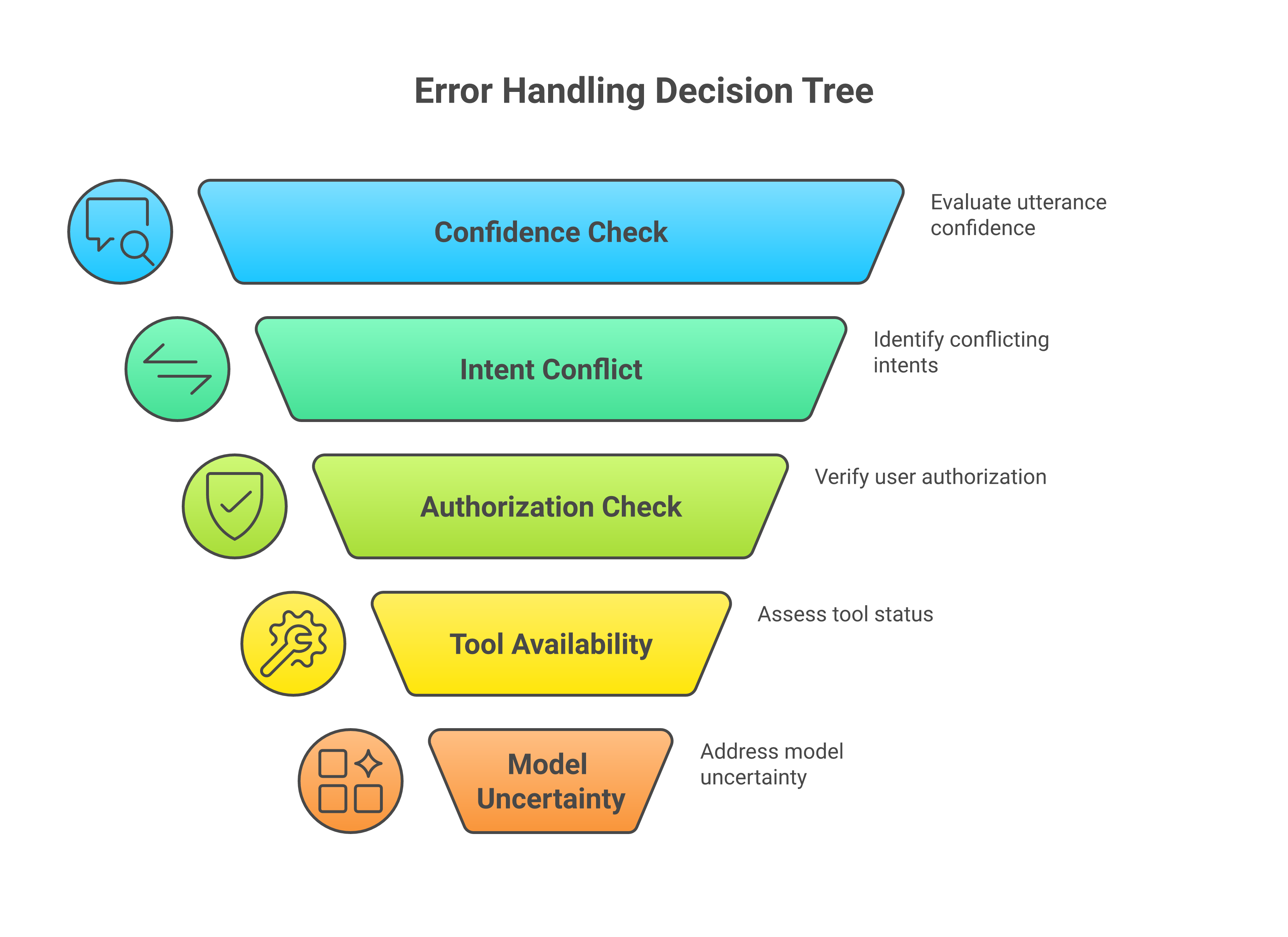
Ambiguous intent. When the confidence score for intent classification falls below the action threshold but above the clarification threshold (the 0.60–0.85 band in the default configuration), the system must not guess. It must present its interpretation and ask for confirmation. The response follows a standardised pattern:
OPERATOR:  Check payments.

SYSTEM:    I'm not certain what you'd like me to check. My best interpretations:

           1. Query the health status of payments-api-prod in eu-regulated
           2. Check the TLS certificate expiry for payments-api-prod
           3. Run the payments reconciliation check (runbook RB-0019)

           Which of these did you mean, or could you rephrase your request?
The disambiguation options are ranked by the model’s confidence scores and filtered to actions the operator is authorised to perform. Presenting more than five options is counterproductive; if the model cannot narrow the interpretation to five or fewer candidates, the system should ask the operator to rephrase rather than presenting a long menu.
Conflicting intents within a single utterance. Operators occasionally issue compound requests that contain contradictory instructions — “scale up the payments service and also reduce its resource allocation.” The pipeline must detect logical conflicts between the actions implied by a compound request and flag them rather than executing both:
OPERATOR:  Scale payments-api to 10 replicas and reduce its CPU allocation
           to 0.25 cores per pod.

SYSTEM:    These actions may conflict. Scaling to 10 replicas at 0.25 cores
           per pod would give payments-api a total of 2.5 vCPU, which is
           less than its current allocation of 3 replicas × 1.0 core = 3.0
           vCPU. This would be a net reduction in compute capacity despite
           the increase in replica count.

           Would you like to:
           1. Scale to 10 replicas, keeping 1.0 core per pod (total: 10 vCPU)
           2. Reduce to 0.25 cores per pod, keeping 3 replicas (total: 0.75 vCPU)
           3. Proceed as stated: 10 replicas at 0.25 cores (total: 2.5 vCPU)
Unauthorised request handling. When an operator requests an action they are not authorised to perform, the system must refuse clearly, state which authorisation is missing, and offer a path to obtaining it. The refusal must never reveal information about the target resource that the operator is not cleared to see. An operator who is not authorised for the regulated zone and asks “restart payments-api in the regulated zone” receives a response that confirms the authorisation gap but does not disclose the current state, configuration, or existence of the service in that zone:
SYSTEM:    Your current role (eu-staging-engineer) does not include
           authorisation to execute actions in the eu-regulated zone.
           To request access, contact your zone administrator or I can
           submit an access request on your behalf. Shall I proceed?
Zone boundary violations in conversational context. Beyond explicit cross-zone queries (illustrated in Example 4 above), subtle boundary violations can occur through conversational context. If an operator discusses a regulated-zone service in turns 1–5, then a colleague with lower clearance joins a shared thread at turn 6, the system must re-evaluate the conversation’s classification level. The architectural response is a classification watermark on each conversation turn. When a new participant joins, the system checks whether any preceding turns contain data above the new participant’s clearance. If so, those turns are redacted from the new participant’s view, and the system issues a notification:
SYSTEM:    [To new participant] You have joined an active investigation
           thread. Some earlier messages in this thread contain data from
           zones outside your current authorisation and have been redacted
           from your view. You can see and contribute to the thread from
           this point forward within the scope of your authorisation.
Model uncertainty and hallucination detection. In operational contexts, a language model that fabricates a metric value, invents a service name, or confabulates a remediation procedure is not merely unhelpful — it is dangerous. The architecture employs three defences against hallucination. First, all factual claims in system responses must be grounded in tool outputs: the model does not report that “the error rate is 2.3%” from its parametric knowledge; it calls the Instana metrics API and reports the returned value. Second, the pipeline includes a grounding verification step — architecturally analogous to the retrieval-augmented generation pattern described in [13] — that checks whether the entities and values in the model’s proposed response correspond to entities and values in the tool outputs it received. Third, when the model is asked a question for which no tool exists and no grounded answer is available, it must say so explicitly rather than generating a plausible-sounding response:
SYSTEM:    I do not have a tool that can answer this question. The capacity
           planning model for the APAC zone is maintained by the APAC
           platform team and is not currently integrated with Orchestrate.
           I can connect you with the APAC platform team lead, or you can
           access the capacity model directly at [internal link].
The grounding verification step logs every instance where the model’s proposed response was modified or blocked, feeding this data into the misinterpretation rate metric described in Section 27.7.
Graceful degradation when backend tools are unavailable. The conversational interface depends on the availability of backend tools — Instana for metrics, Concert for findings, ServiceNow for ticketing, the identity fabric for authorisation. When one or more of these tools become unavailable, the system must degrade gracefully rather than failing opaquely. The degradation strategy follows a hierarchy:
-
Partial results with disclosure. If three out of four data sources respond, the system presents the available data and explicitly states which source is unavailable: “Instana metrics are currently unavailable (connection timeout after 10 seconds). The following results are based on Concert findings and ServiceNow records only. Latency data is not included.”
-
Cached data with staleness warning. If the system has recent cached results from an unavailable tool, it may present them with a staleness indicator: “The following metrics are from cache and are 12 minutes old. Live data from Instana is temporarily unavailable.”
-
Capability disclosure. If a tool outage means the system cannot fulfil the operator’s request at all, it states what it cannot do, suggests alternatives, and offers to queue the request for retry: “I am unable to execute runbook RB-0031 because the automation controller is unreachable. You can execute it manually via the automation console at [internal link], or I can retry automatically when connectivity is restored.”
-
Fallback to read-only mode. If the tool outage affects action execution but not queries, the system announces that it is operating in read-only mode: “The ServiceNow integration is currently unavailable. I can query the estate and provide diagnostic information, but I am unable to create or modify tickets until connectivity is restored.”
Each degradation event is logged with the affected tool, the duration of the outage, and the number of operator requests that were degraded, providing data for the availability metrics described in Section 27.7.
27.4 Multi-modal operational conversations
Text is the natural medium for conversational interfaces, but operational work is not exclusively textual. An operator diagnosing a latency anomaly needs to see a time-series chart. An architect reviewing a topology change needs to see a dependency graph. An on-call engineer responding to an alert at home needs to interact with the system from a mobile device. A data centre operator performing a physical maintenance procedure needs hands-free interaction. A mature chat-first operations model must accommodate these modalities within the conversational paradigm rather than forcing the operator out of the conversation to access them.
Inline visualisations are the most immediately valuable extension beyond text. When an operator asks “show me the latency trend for the payments API over the last four hours,” the response should include an embedded chart—a time-series plot rendered directly in the conversation stream—rather than a link to an external dashboard. The chart should be annotated with relevant events: deployment markers, configuration changes, alert thresholds. Orchestrate can generate these visualisations by querying Instana’s metric APIs and rendering the results using a chart library embedded in the conversational client. The visualisation is part of the conversation record; it is timestamped, attributed, and retrievable for audit purposes, just as a text response would be.
Topology diagrams serve a different purpose: they show structure rather than temporal behaviour. When Concert identifies that a degraded database is affecting three downstream services in a sovereign zone, presenting the dependency subgraph as a visual diagram—nodes for entities, edges for dependencies, colour-coded by health status—communicates the situation faster and more completely than a textual list. The diagram should be interactive where the client supports it: clicking a node should expand its details within the conversation, not navigate away from it. In environments where the conversational client is a web application, interactive SVG or canvas-based diagrams can be embedded directly. In environments where the client is a messaging platform with more limited rendering capabilities, a static image with a link to an interactive view is the pragmatic compromise.
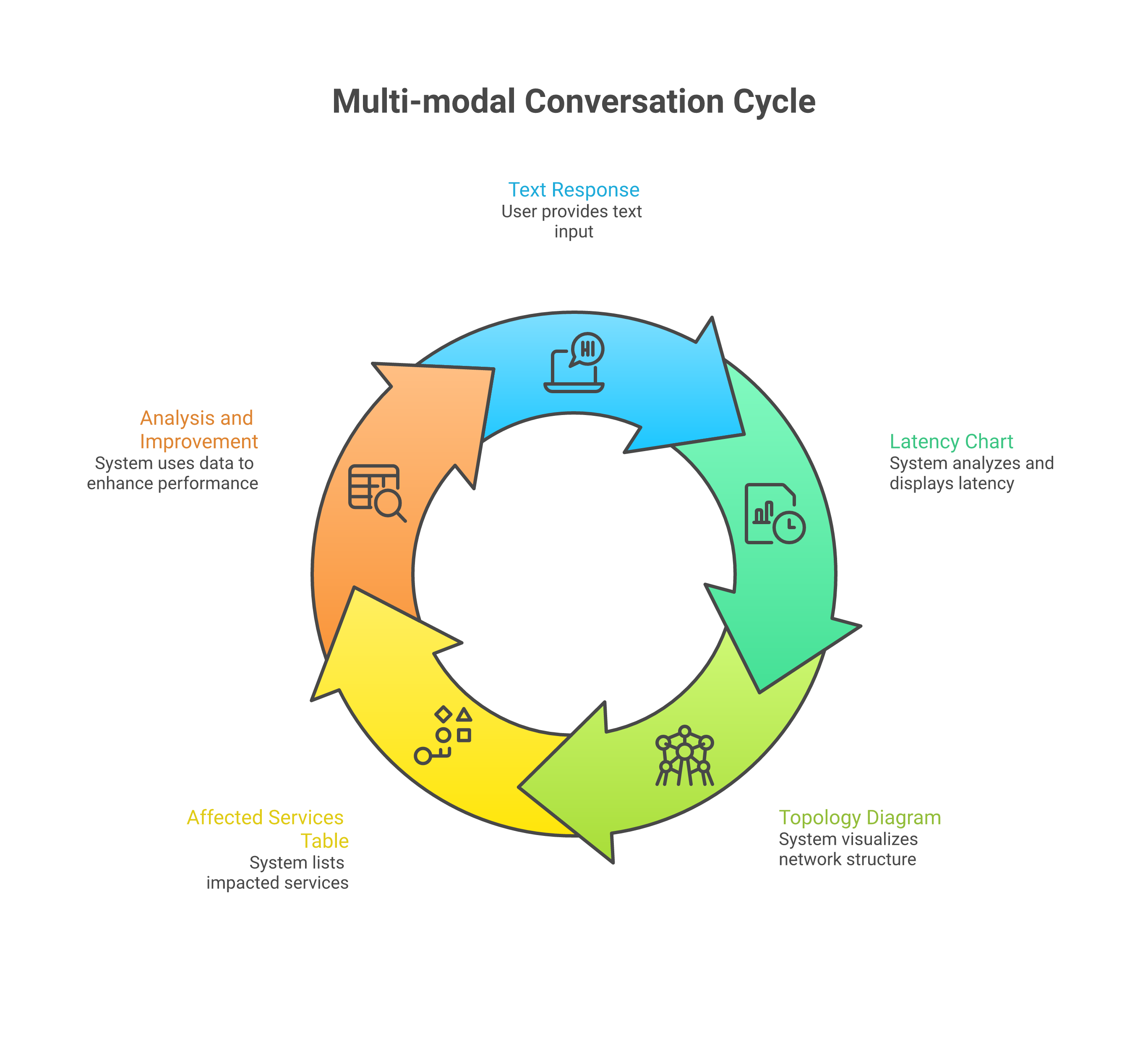
Metric dashboards on demand extend inline visualisations to more comprehensive views. An operator who asks “give me the full health dashboard for the regulated zone” should receive a composite view: key metrics for each service in the zone, alert status, recent change activity, and compliance posture. This is not a replacement for the full Instana or Concert dashboard; it is a contextual snapshot assembled for the conversation, reflecting the operator’s current focus. The distinction matters because the conversational dashboard is scoped to the operator’s query and access permissions, whereas the full dashboard may contain information from zones the operator is not cleared to view. Section 27.5 examines this scoping in detail.
Voice interfaces address the hands-free use case. A data centre engineer performing a physical hardware replacement cannot type. A voice interface that accepts spoken operational queries and returns spoken responses—supplemented by visual elements on a nearby screen or heads-up display—enables the engineer to maintain the conversational interaction model without interrupting their physical work. The technical requirements for voice in operational contexts differ from consumer voice assistants: operational vocabulary is specialised, background noise in data centres is significant, and the consequences of misrecognition are higher. Voice interfaces for operations should therefore use domain-adapted speech recognition models and should apply the same confirmation patterns described in Section 27.2—repeating back the recognised intent before executing any action—with particular rigour. IBM’s watsonx.ai speech capabilities can be integrated with Orchestrate’s conversational layer to provide this voice interface, though the deployment considerations for sovereign zones—where voice data must be processed within the zone boundary—apply as they do for text-based interactions [8].
Mobile operational interfaces acknowledge that operations does not always happen at a desk. An on-call engineer responding to a weekend alert from their phone needs a conversational interface that works on a small screen, over a mobile connection, with the same security controls as the desktop interface. Mobile conversational clients must be designed for constrained interaction: shorter responses, swipeable structured elements, biometric authentication for sensitive actions, and graceful degradation when connectivity is intermittent. The conversational paradigm is, in some respects, better suited to mobile than dashboard-based interfaces, because a conversation naturally presents information in a sequential, scrollable format that fits a narrow screen, whereas a dashboard designed for a widescreen monitor requires awkward scaling or redesign for mobile use.
27.5 Sovereign-aware conversational boundaries
A conversational interface that can query the entire estate and display any information to any operator is a sovereignty violation waiting to happen. In a sovereign, multi-zone architecture, the conversational layer must enforce the same boundaries that govern every other component of the operations control plane: data residency, access classification, zone isolation, and audit logging. The challenge is to enforce these boundaries without making the conversational experience so restrictive that operators route around it—reverting to direct tool access, which is less auditable and less governed.
User-scoped data visibility is the foundational control. When an operator initiates a conversation with Orchestrate, the system authenticates them against the identity fabric described in Chapter 13 and retrieves their role, clearance level, and zone authorisations. Every subsequent query in the conversation is evaluated against these authorisations before results are returned. An operator cleared for the development zone but not the regulated production zone will receive results only from services, metrics, and findings within their authorised scope. The filtering is applied at the tool invocation level—Orchestrate’s tool calls include the operator’s authorisation context, and the tools themselves enforce scoping—so that sensitive data never enters the conversation stream, even transiently [9].
Zone boundary enforcement in queries prevents operators from inadvertently constructing queries that cross zone boundaries. An operator who asks “compare the latency of the payments API in production and staging” is requesting data from two zones. If those zones have different classification levels, the conversational interface must evaluate whether the operator is authorised to view data from both before executing the comparison. If they are not, the response should explain which zone’s data is available and which is restricted, rather than silently returning partial results. Silent partial results are dangerous because the operator may draw incorrect conclusions from incomplete data—concluding, for example, that the production service is performing normally when in fact the production data was simply not returned.
Preventing data leakage through conversation context is a subtler challenge. Language models maintain conversation history to provide continuity across turns. If an operator with high clearance discusses a sensitive finding in one conversation, and a different operator with lower clearance later accesses a shared conversation channel, the conversation history could expose information beyond the second operator’s authorisation. The architectural response is to scope conversation history by operator session and clearance level. Shared channels (discussed in Section 27.6) must apply the most restrictive clearance level of any participant, or, where mixed-clearance collaboration is required, the system must filter conversation history before presenting it to each participant based on their individual authorisation.
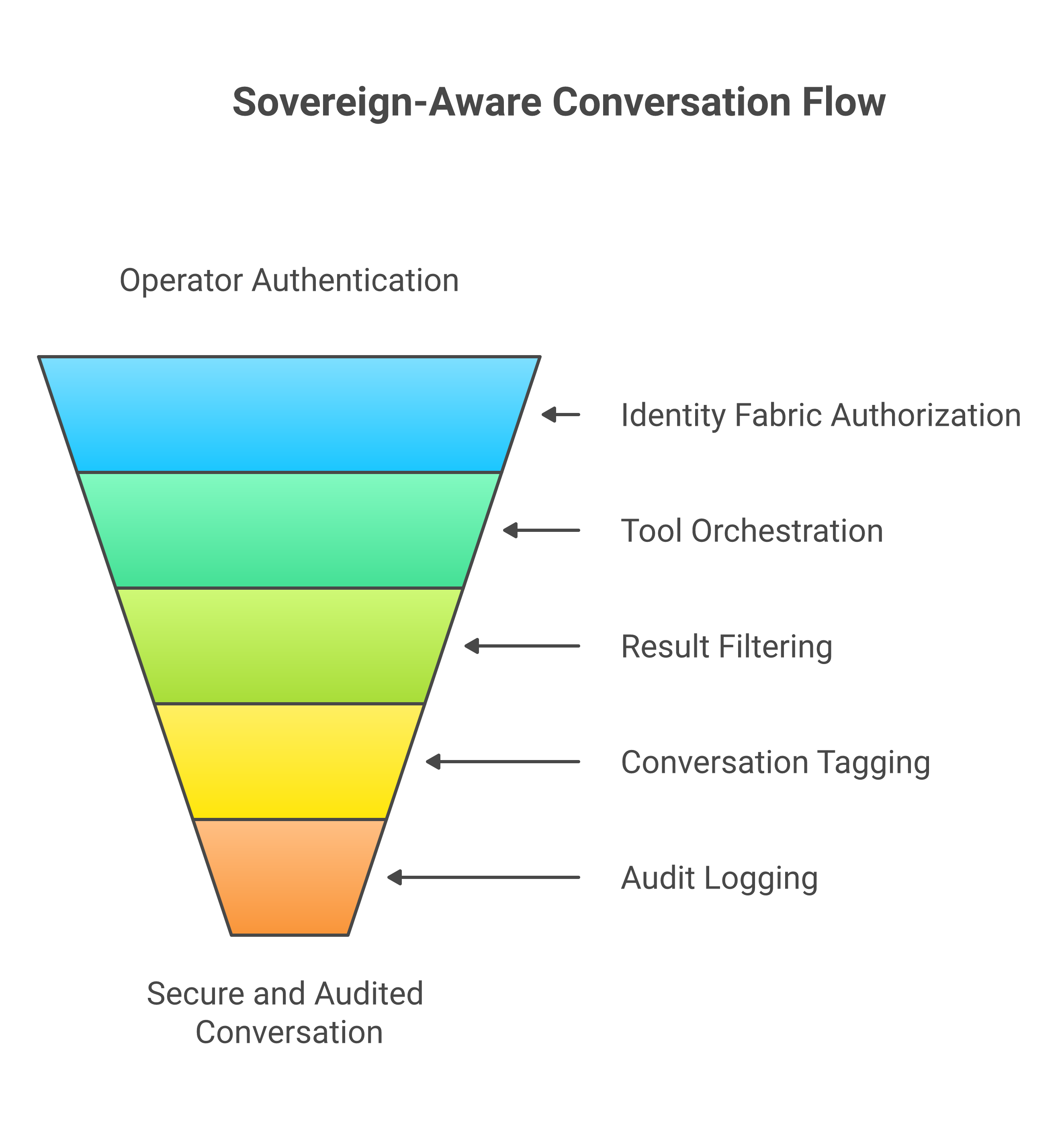
Audit logging of conversational interactions is the accountability mechanism that underpins all other controls. Every conversation turn—the operator’s message, the system’s interpretation, the tool invocations dispatched, the results returned, and any data that was filtered or redacted—must be logged in a tamper-evident audit store within the appropriate sovereign zone. The audit log must capture not only what was shown to the operator but what was withheld and why, so that a subsequent review can verify that the access controls were applied correctly. In environments subject to DORA or NIS2, these logs form part of the organisation’s evidence of operational control and must be retained for the periods specified by the applicable regulation [3].
Guardrails for conversational scope define what the conversational interface will and will not do, independent of the operator’s authorisation. Even a highly privileged operator should not be able to use the conversational interface to perform certain categories of action—deleting a production namespace, modifying identity federation configuration, or disabling audit logging, for example—without triggering an out-of-band approval process. These guardrails are configured in Orchestrate’s governance integration layer and enforced regardless of the operator’s role. They represent the organisation’s judgement about which actions are too consequential to be initiated through a conversational interface alone, and they serve as a safety net against both operator error and potential compromise of operator credentials.
The goal of sovereign-aware conversational boundaries is not to make the conversational interface less useful but to make it trustworthy. An operator who knows that the system will only show them what they are authorised to see, and will only execute actions they are authorised to perform, can trust the conversational interface as a reliable representation of their operational world. That trust is the foundation on which all the other benefits of chat-first operations—reduced context switching, democratised access, inherent auditability—depend.
27.6 Team collaboration through shared operational chat
Operations is rarely a solitary activity. Incidents involve multiple teams. Change windows require coordination between application owners, platform engineers, security reviewers, and sometimes regulators. Shift handovers require the outgoing team to transfer situational awareness to the incoming team. The conversational interface must support these collaborative patterns as naturally as it supports individual operator interactions.
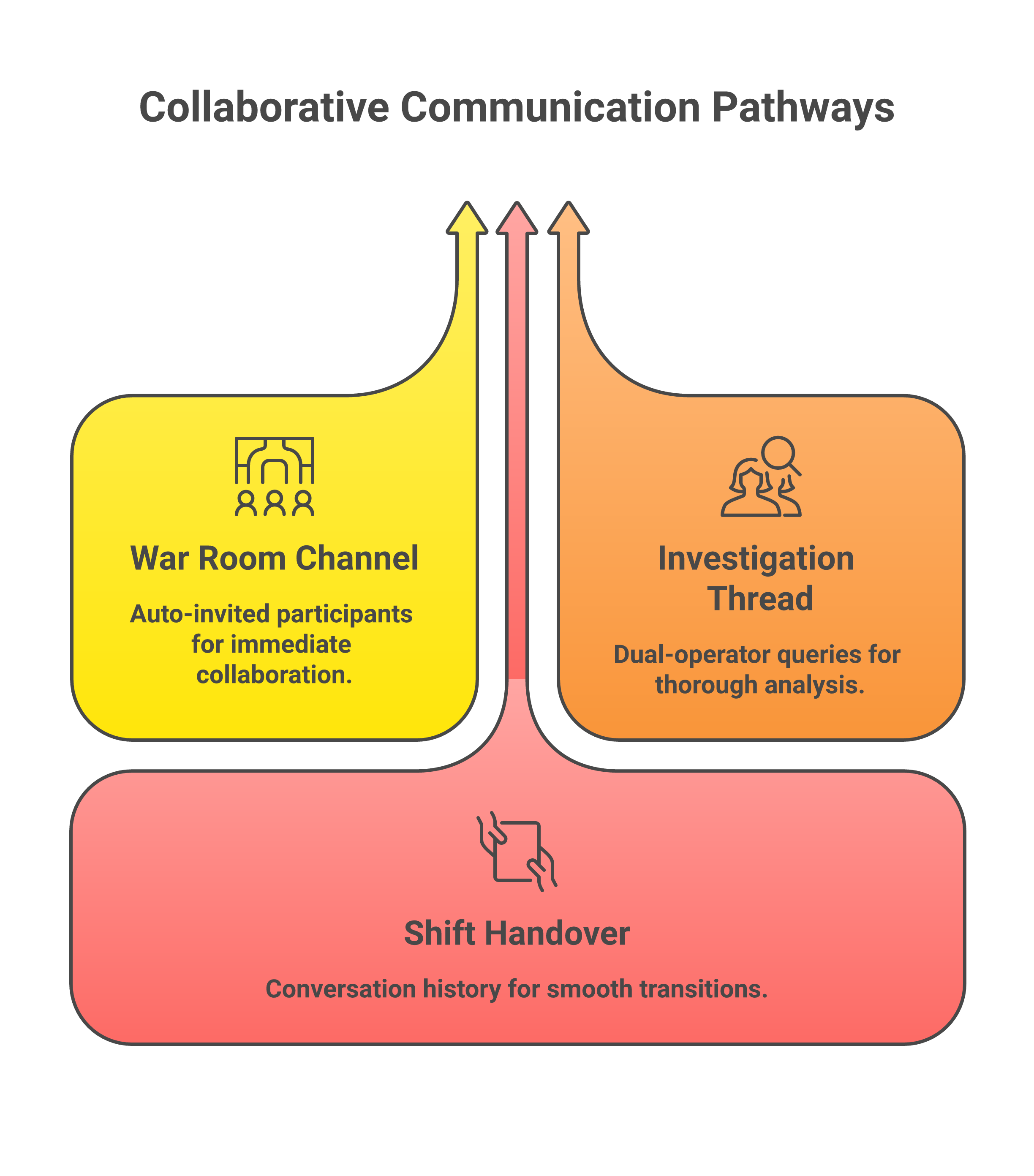
War room channels are the collaborative pattern for major incidents. When Concert identifies a situation that meets the threshold for a major incident, Orchestrate can automatically provision a dedicated chat channel—in Slack, Microsoft Teams, or a native Orchestrate collaboration space—and invite the relevant participants based on the affected services’ ownership metadata in Concert’s entity model. The channel becomes the single coordination surface for the incident: all queries to Orchestrate within the channel are contextualised to the incident, all results are visible to all participants, and the channel history constitutes the incident’s operational record. This pattern, established in the ChatOps tradition and formalised in incident management frameworks such as PagerDuty’s incident response guide [10], gains new capabilities when the channel includes an LLM-powered conversational agent. The agent can maintain a running summary of the incident’s status, automatically update the ServiceNow incident record as new information emerges, and answer contextual questions from participants who join the channel mid-incident without requiring a human to brief them.
The war room agent’s ability to provide contextual onboarding for late joiners deserves particular emphasis. In a major incident, participants arrive at different times as escalation proceeds. Each arrival traditionally requires a human to pause diagnostic work and brief the newcomer—a costly interruption during a time-critical situation. A conversational agent that maintains a continuously updated incident summary can provide this briefing automatically: “You are joining an active investigation of elevated error rates in the payments-api service in the EU regulated zone. The incident was detected forty-two minutes ago. Current hypothesis is a connection pool exhaustion in payments-db following a configuration change deployed at 14:17. Remediation playbook RB-0047 has been approved and is awaiting execution. Three other engineers are active in this channel.” This briefing takes seconds to generate and saves minutes of human explanation.
Shared investigation threads support a more focused collaborative pattern. Two engineers investigating a complex problem—a performance degradation that spans multiple services in a sovereign zone, for example—can work in a shared conversation thread where both can issue queries and both can see results. The thread maintains a unified context that reflects both engineers’ contributions, enabling a form of collaborative diagnosis that is difficult to achieve when each engineer works in their own tool and exchanges findings through side-channel messages. Shared threads must respect the sovereign-aware boundaries described in Section 27.5: if the two engineers have different clearance levels, the thread must apply appropriate filtering to each participant’s view.
Shift handover through chat history addresses one of the most persistent problems in operations: the loss of context during shift transitions. When an outgoing shift has been managing a developing situation—a slow-building capacity issue, an intermittent network anomaly, a change window that ran long—the incoming shift needs to understand what has happened, what has been tried, what is still in progress, and what decisions are pending. In a traditional model, this handover happens through a brief verbal summary, a ticket update, or a shared document. In a chat-first model, the handover is the conversation itself. The incoming shift reads the conversation history, which contains not just what was discussed but what was queried, what was found, and what actions were taken. Orchestrate can generate a structured handover summary—an automated precis of the conversation thread, highlighting open actions, pending approvals, and unresolved findings—that gives the incoming shift a five-minute briefing without requiring the outgoing shift to compose it manually.
Integration with ITSM ticket workflows connects the conversational collaboration surface to the organisation’s formal process records. When a war room channel is active for a major incident, every significant action taken through the channel—diagnostic queries, remediation steps, approval decisions—should be reflected in the corresponding ServiceNow incident record. Orchestrate can be configured to append structured activity summaries to the ticket at defined intervals or at key milestones (diagnosis complete, remediation initiated, service restored). This integration ensures that the ITSM record is not a sparse afterthought composed once the incident is over but a contemporaneous record enriched throughout the incident’s lifecycle. Chapter 19 described the agent-mediated ITSM integration patterns in detail; the conversational collaboration layer extends those patterns to multi-operator scenarios.
Slack and Microsoft Teams integrations are the pragmatic deployment surface for collaborative operational chat. Most enterprise operations teams already use one of these platforms as their primary communication tool. Rather than requiring operators to switch to a separate Orchestrate interface for collaborative work, Orchestrate can be deployed as a bot or app within the existing messaging platform, bringing its conversational capabilities—tool calling, workflow execution, sovereign-aware scoping, audit logging—into the environment where operators already coordinate. The integration must preserve all the governance controls described in this chapter: authentication must flow through the identity fabric, zone scoping must be applied, and conversation logs must be captured in the audit store even when the conversation happens within a third-party messaging platform. This is an integration requirement that organisations must validate explicitly; a Slack bot that bypasses the governance layer because Slack’s native logging is deemed sufficient is a compliance gap, not an integration.
27.7 Measuring conversational effectiveness
A conversational operations interface is not a static deployment. Its effectiveness depends on the quality of tool descriptions, the accuracy of entity mappings, the coverage of predefined workflows, and the language model’s ability to interpret the operational vocabulary of the specific organisation. These factors change over time as the estate evolves, as new tools are added, and as operators develop new conversational patterns. Measuring effectiveness—and using those measurements to drive continuous improvement—is therefore not optional; it is an operational discipline as important as monitoring the health of any other production system.
Task completion rate (TCR) is the primary effectiveness metric. It is defined as the ratio of operator sessions that result in a successfully completed operational action — a query answered, a workflow executed, a ticket created — to total operator sessions, excluding sessions where the operator explicitly chose to exit without completing a task (browsing, exploratory queries). Formally:
TCR = (sessions with successful action completion) / (total action-oriented sessions) × 100
TCR should be computed both in aggregate and per intent category. A mature conversational operations deployment should target an aggregate TCR of 90 per cent or above, with per-category targets reflecting the inherent complexity of each category: query intents should achieve 95 per cent or above (these are the simplest interactions), remediation intents 85 per cent or above (these involve multi-step workflows and confirmation gates), and provisioning intents 80 per cent or above (these often require external approvals that may not complete within a single session). A TCR below 75 per cent in any category indicates that operators are routinely falling back to direct tool access, with all the context-switching and audit-gap costs that implies. The measurement infrastructure should flag any week-over-week decline of more than 5 percentage points as an anomaly requiring investigation.
Mean turns to resolution (MTTR-turns) measures the efficiency of the conversational interaction. It is computed as the average number of operator-system exchange pairs (turns) required to complete a task, counted from the operator’s initial utterance to the system’s final confirmation of action completion or result delivery. Benchmarks by intent category provide actionable targets:
| Intent category | Target MTTR-turns | Investigation threshold |
|---|---|---|
| Query (simple status) | 1–2 turns | >3 turns |
| Query (complex, multi-entity) | 2–3 turns | >5 turns |
| Diagnose | 3–5 turns | >7 turns |
| Remediate (single action) | 2–3 turns (including confirmation) | >5 turns |
| Remediate (multi-step plan) | 4–6 turns | >8 turns |
| Provision | 3–5 turns | >7 turns |
An operator who achieves their goal in three turns — initial query, confirmation, result — is well served. An operator who requires eight turns because the system repeatedly misidentifies the target service, asks unnecessary clarification questions, or presents irrelevant results is not. A sudden increase in MTTR-turns after a tool registry update suggests that the new or modified tool descriptions are introducing ambiguity. The metric should be tracked as a 7-day rolling average to smooth out individual session variance while remaining responsive to regressions.
Intent recognition accuracy (IRA) measures how often the pipeline’s first intent classification matches the operator’s actual intent. Unlike misinterpretation rate, which is measured indirectly, IRA can be measured directly by examining whether the operator accepted the system’s first interpretation or corrected it. The formula is:
IRA = (sessions where first intent classification was accepted) /
      (total sessions with classifiable intent) × 100
A target IRA of 92 per cent or above is appropriate for a production deployment with a well-tuned tool registry. Values below 88 per cent indicate systemic issues in tool descriptions or intent taxonomy coverage. IRA should be broken down by intent type — a low IRA for diagnose intents specifically may indicate that the taxonomy does not adequately distinguish between “investigate a symptom” and “check a known metric,” which are linguistically similar but operationally different.
Misinterpretation rate captures the frequency with which the system’s interpretation of operator intent diverges from the operator’s actual intent after the full pipeline has executed — a stricter measure than IRA because it accounts for entity extraction and slot-filling errors in addition to intent classification errors. Two proxy measurements are practical: the rate at which operators explicitly correct the system (“No, I meant the staging environment, not production”) and the rate at which operators abandon a conversation and restart with a rephrased query. Both can be detected from conversation log analysis — correction patterns through negation detection in follow-up utterances, abandonment through session-break patterns (a new session beginning within 60 seconds of the previous session’s last turn, with semantically similar initial utterances). A misinterpretation rate above 10 per cent is a signal that the entity mapping or slot-filling logic requires remediation; above 15 per cent, the system’s reliability is below the threshold for operator trust.
Time-to-action (TTA) versus traditional interfaces provides the most compelling evidence of conversational operations value. TTA measures the elapsed wall-clock time from the operator’s initial expression of intent to the completion of the resulting action. This metric must be compared against the same action performed through traditional interfaces — dashboard navigation, CLI commands, manual ITSM workflows — to quantify the productivity gain. A reference measurement programme should time a representative sample of operational tasks through both channels:
| Task | Traditional TTA | Chat-first TTA | Improvement |
|---|---|---|---|
| Check service health status | 45–90 seconds (navigate to dashboard, apply filters) | 8–15 seconds (single query) | 3–10x |
| Investigate alert root cause | 8–15 minutes (cross-tool correlation) | 2–4 minutes (single-thread investigation) | 3–5x |
| Create change request for scaling | 5–8 minutes (ITSM form, fill fields) | 1–2 minutes (conversational with auto-population) | 4–5x |
| Generate compliance report | 15–30 minutes (extract, compile, format) | 1–3 minutes (single query with structured output) | 8–15x |
| Incident triage and initial remediation | 20–45 minutes (multi-tool, multi-step) | 5–10 minutes (single-thread, plan-and-execute) | 3–5x |
These improvements are not hypothetical; they are derived from the reduction in context-switching overhead and the elimination of manual data gathering that the conversational interface provides [15]. Organisations should conduct their own baseline measurements before deploying conversational operations and repeat them quarterly to track realised improvements.
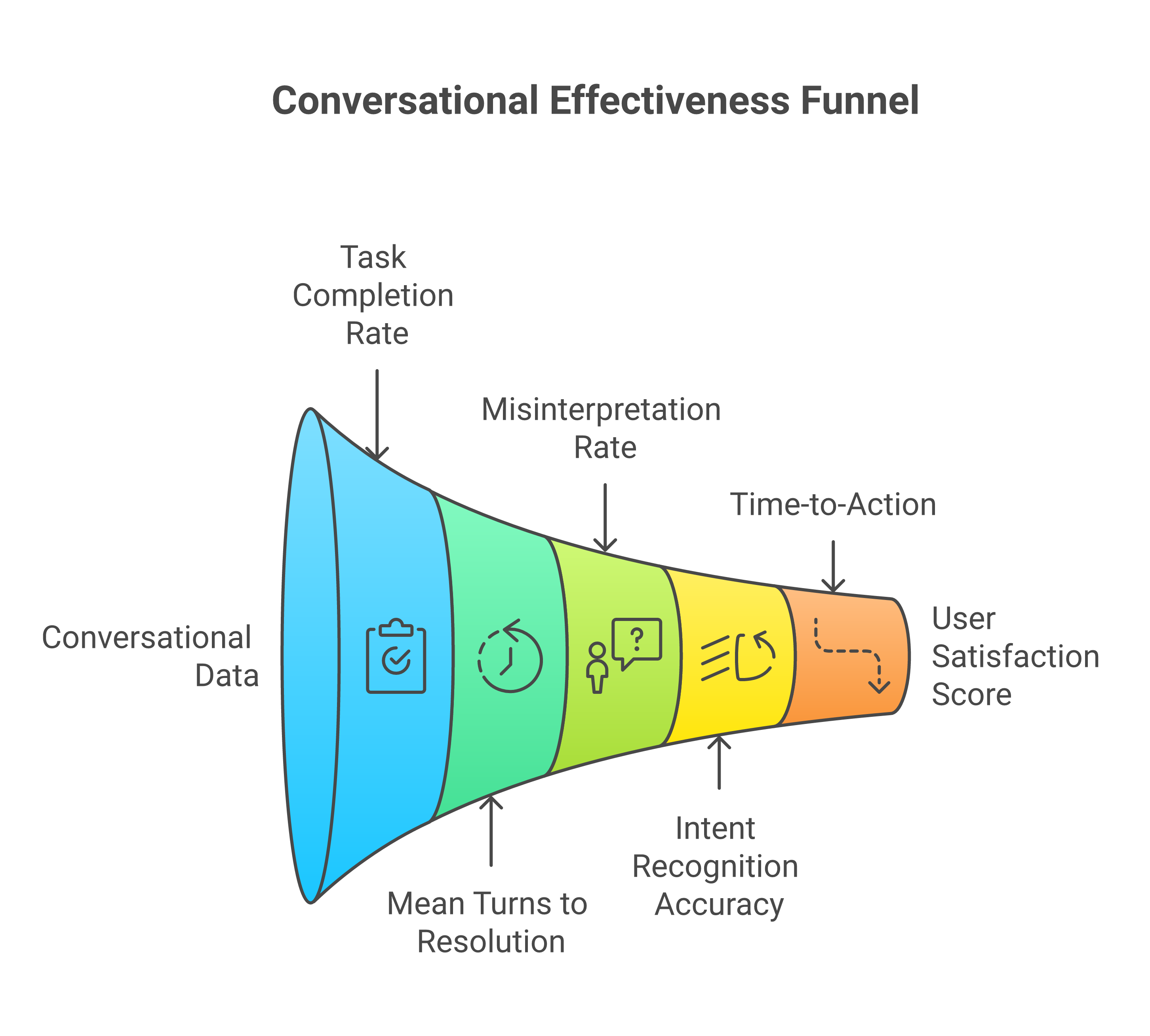
Escalation rate measures how often conversational interactions result in escalation to a human operator or a manual process. Some escalation is expected and healthy — complex situations that genuinely require human judgement should be escalated promptly rather than handled poorly by automation. The target escalation rate for routine operational tasks (queries, standard remediations, compliance checks) should be below 5 per cent. For complex diagnostic and provisioning tasks, an escalation rate of 10–15 per cent is acceptable in the first year of deployment, declining to below 8 per cent as tool descriptions and workflows mature. A rising escalation rate, or an escalation rate that is high for interaction categories that should be automatable, indicates that the conversational interface is not meeting its potential. Escalation events should be logged with sufficient context to enable root cause analysis: what was the operator’s request, what did the system attempt, and why was the attempt insufficient.
User satisfaction (USAT) is the qualitative complement to the quantitative metrics. It should be measured through two mechanisms: an optional post-interaction rating (a simple 1–5 scale offered at the end of each session, with a target response rate of at least 20 per cent to ensure statistical significance) and a quarterly structured survey covering trust, response quality, confirmation burden, and mental model alignment. The post-interaction rating provides a continuous signal; the quarterly survey provides diagnostic depth. A mean post-interaction USAT below 3.5 out of 5.0, or a quarter-over-quarter decline of more than 0.3 points, should trigger a UX review. Low satisfaction scores in the presence of good quantitative metrics suggest a design problem — the system is technically effective but experientially frustrating — which requires different remediation than low task completion rates. Conversely, high satisfaction with low TCR may indicate that operators enjoy the interface but do not trust it for consequential actions, a pattern that requires investigation into the confirmation gate and error-handling experience.
27.7.1 The metrics scorecard
The following scorecard consolidates the metrics into a single assessment framework that can be reviewed monthly. Each metric has a green (healthy), amber (investigate), and red (remediate) threshold:
| Metric | Green | Amber | Red |
|---|---|---|---|
| Task completion rate (aggregate) | ≥ 90% | 80–89% | < 80% |
| Mean turns to resolution (query) | ≤ 2 | 3–4 | ≥ 5 |
| Mean turns to resolution (remediate) | ≤ 4 | 5–6 | ≥ 7 |
| Intent recognition accuracy | ≥ 92% | 88–91% | < 88% |
| Misinterpretation rate | ≤ 8% | 9–14% | ≥ 15% |
| Escalation rate (routine tasks) | ≤ 5% | 6–10% | > 10% |
| User satisfaction (post-interaction) | ≥ 4.0 | 3.5–3.9 | < 3.5 |
| Grounding violation rate | ≤ 1% | 2–4% | ≥ 5% |
The grounding violation rate — the frequency with which the grounding verification step (Section 27.3.3) detects and blocks ungrounded assertions in the model’s proposed responses — is included because it is the most direct measure of hallucination risk. A rising grounding violation rate may indicate model drift, tool description degradation, or an expansion of operator query patterns beyond the coverage of the current tool registry.
Continuous improvement cycles close the feedback loop. The scorecard should feed a monthly review process in which the operations team and the conversational interface owners examine the data, identify the highest-impact improvement opportunities, and prioritise changes. Typical improvement actions include: refining tool descriptions to reduce ambiguity for frequently misinterpreted requests (addresses IRA and misinterpretation rate), adding entity aliases to improve recognition of colloquial service names (addresses MTTR-turns), creating new predefined workflows for interaction patterns that currently require ad hoc multi-step planning (addresses TCR and TTA), and adjusting confirmation patterns to reduce unnecessary friction for low-risk actions while maintaining rigour for high-risk ones (addresses USAT). The watsonx.governance integration described in Chapter 17 provides the model-level monitoring that complements these conversation-level metrics, identifying systematic patterns in the language model’s behaviour that may require intervention at the model configuration level rather than the tool description level [11].
The discipline of measuring and improving conversational effectiveness is, in essence, the operational equivalent of user experience research applied to an internal tool. The operators are the users; the conversational interface is the product; and the scorecard is the evidence that the product is serving its users well — or the basis for making it do so.
Key Takeaways
-
The conversational interface resolves the context-switching problem that plagues multi-tool operational environments by providing a single interaction surface through which operators can query, diagnose, remediate, and administer the entire estate, with the conversation itself serving as a continuous, auditable operational record.
-
Operational conversational UX must prioritise precision over fluency, progressive disclosure of technical detail, structured and scannable responses, actionable suggestions derived from operational context, and explicit confirmation patterns — following a standardised template that specifies action, target, zone, method, and impact — for any action that modifies production state.
-
The natural-language-to-action pipeline is a five-stage process — intent classification (with configurable confidence thresholds), entity extraction with canonical mapping against Concert’s entity model, slot filling against tool parameter schemas, action routing with plan presentation for multi-step requests, and confirmation gating — whose reliability is measurable and continuously improvable through tool description refinement, entity alias expansion, and conversation log analysis.
-
Error handling must address ambiguous intent (disambiguation prompts ranked by confidence), conflicting instructions (conflict detection and resolution options), unauthorised requests (refusal with access-request path), model uncertainty (grounding verification against tool outputs), and graceful degradation (partial results with disclosure, cached data with staleness warnings, capability disclosure, and fallback to read-only mode).
-
Multi-modal capabilities — inline visualisations, topology diagrams, voice interfaces, and mobile clients — extend the conversational paradigm beyond text to accommodate the full range of operational contexts, from desk-based incident management to hands-free data centre operations.
-
Sovereign-aware conversational boundaries must enforce user-scoped data visibility, zone boundary constraints on queries (with explicit disclosure of which data is restricted and why), classification-watermarked conversation histories, and comprehensive audit logging, ensuring that the conversational interface is trustworthy as a representation of the operator’s authorised operational world.
-
Collaborative operational chat — war room channels, shared investigation threads, shift handover summaries, and ITSM-integrated conversations — transforms the conversational interface from an individual productivity tool into a team coordination surface that maintains context across participants, shifts, and incident lifecycles.
-
Conversational effectiveness must be measured quantitatively through a scorecard of eight metrics — task completion rate (target: 90%+), mean turns to resolution, intent recognition accuracy (target: 92%+), misinterpretation rate (target: below 8%), time-to-action versus traditional interfaces, escalation rate, user satisfaction, and grounding violation rate — with green/amber/red thresholds driving monthly improvement cycles.
Bridge to Chapter 28 — Recommendation-Driven Operations
This chapter has examined the conversational interface as the primary interaction surface for sovereign cloud operations—the medium through which operators express intent, receive intelligence, and coordinate action. Throughout, the emphasis has been on the operator as the initiator: the operator asks a question, the system responds; the operator requests an action, the system executes it. This is the pull model of operational interaction, and it is the natural starting point for conversational operations.
Chapter 28 inverts this relationship. It examines the push model: recommendation-driven operations, in which the system—drawing on Concert’s continuous analysis of the estate, Orchestrate’s workflow capabilities, and the knowledge base described in Chapter 20—proactively surfaces recommendations to operators before they ask. The conversational interface remains the delivery mechanism, but the initiative shifts from the operator to the system. This inversion raises its own design challenges: when should the system interrupt? How should recommendations be prioritised and presented? How does the operator maintain agency when the system is actively suggesting what to do next? These questions define the territory of recommendation-driven operations, and they build directly on the conversational UX principles, sovereignty constraints, and measurement frameworks established in this chapter.
References
[1] C. Parnin and S. Rugaber, “Resumption strategies for interrupted programming tasks,” Software Quality Journal, vol. 19, no. 1, pp. 5–34, Mar. 2011. [Online]. Available: https://doi.org/10.1007/s11219-010-9104-9
[2] IBM Corporation, IBM watsonx Orchestrate Documentation, IBM Cloud Docs, 2025. [Online]. Available: https://cloud.ibm.com/docs/watson-orchestrate
[3] European Parliament and Council of the European Union, “Regulation (EU) 2022/2554 of the European Parliament and of the Council of 14 December 2022 on digital operational resilience for the financial sector (DORA),” Official Journal of the European Union, L 333, Dec. 2022. [Online]. Available: https://eur-lex.europa.eu/eli/reg/2022/2554
[4] J. Hand, ChatOps: Managing Operations in Group Chat, O’Reilly Media, 2016.
[5] B. Shneiderman, C. Plaisant, M. Cohen, S. Jacobs, N. Elmqvist, and N. Diakopoulos, Designing the User Interface: Strategies for Effective Human–Computer Interaction, 6th ed. Pearson, 2016.
[6] Nielsen Norman Group, “Proactive Suggestions in Conversational Interfaces,” NNGroup Articles, 2023. [Online]. Available: https://www.nngroup.com/articles/conversational-design/
[7] D. Jurafsky and J. H. Martin, Speech and Language Processing, 3rd ed. draft, Stanford University, 2024. [Online]. Available: https://web.stanford.edu/~jurafsky/slp3/
[8] IBM Corporation, IBM watsonx.ai Speech Services Documentation, IBM Cloud Docs, 2025. [Online]. Available: https://cloud.ibm.com/docs/watsonx-ai
[9] A. Hamilton, “The identity fabric: zero-trust authentication for cloud operations,” in Sovereign Cloud Operations, ch. 13, 2026.
[10] PagerDuty, Incident Response Guide, PagerDuty, 2024. [Online]. Available: https://response.pagerduty.com/
[11] IBM Corporation, IBM watsonx.governance Documentation, IBM Cloud Docs, 2025. [Online]. Available: https://cloud.ibm.com/docs/ai-openscale
[12] S. Amershi, D. Weld, M. Vorvoreanu, A. Fourney, B. Nushi, P. Collisson, J. Suh, S. Iqbal, P. N. Bennett, K. Inkpen, J. Teevan, R. Kikin-Gil, and E. Horvitz, “Guidelines for human-AI interaction,” in Proc. 2019 CHI Conf. Human Factors in Computing Systems, ACM, 2019, pp. 1–13. [Online]. Available: https://doi.org/10.1145/3290605.3300233
[13] P. Lewis, E. Perez, A. Piktus, F. Petroni, V. Karpukhin, N. Goyal, H. Küttler, M. Lewis, W.-t. Yih, T. Rocktäschel, S. Riedel, and D. Kiela, “Retrieval-augmented generation for knowledge-intensive NLP tasks,” in Advances in Neural Information Processing Systems, vol. 33, 2020, pp. 9459–9474. [Online]. Available: https://proceedings.neurips.cc/paper/2020/hash/6b493230205f780e1bc26945df7f3d0b-Abstract.html
[14] A. Sanh, A. Webson, C. Raffel, S. H. Bach, L. Sutawika, Z. Alyafeai, et al., “Multitask prompted training enables zero-shot task generalization,” in Proc. ICLR 2022, 2022. [Online]. Available: https://openreview.net/forum?id=9Vrb9D0WI4
[15] Google PAIR, People + AI Guidebook: Measuring Success, Google, 2024. [Online]. Available: https://pair.withgoogle.com/guidebook/
Sovereign Cloud Operations: AI-Driven Management of Sovereign Estates
© 2026 by Alan Hamilton
is licensed under CC BY-SA 4.0


