Chapter 29 — Autonomous Self-Healing Systems
Summary
This chapter maps the spectrum of operational autonomy from fully manual intervention through conditionally autonomous self-healing, and provides the architectural patterns, policy frameworks, and safety mechanisms required to operate responsibly at higher autonomy levels in sovereign estates. It examines the closed-loop remediation cycle — detect, diagnose, plan, execute, verify — and defines the autonomous action boundary through a classification matrix of reversibility, blast radius, and regulatory sensitivity, encoded as policy-as-code and evaluated at execution time. The chapter details agent-driven remediation workflows that integrate Concert’s recommendation engine, watsonx Orchestrate’s agentic reasoning, and Ansible Automation Platform’s controlled execution, alongside a progressive autonomy model with quantitative promotion criteria and asymmetric demotion triggers. Safety mechanisms including rate limiting, blast radius containment, automatic rollback, dead man’s switch patterns, and escalation cascades are presented as defence-in-depth layers, with zone-specific governance ensuring that self-healing in regulated sovereign zones satisfies DORA, NIS2, and comparable regulatory obligations. The chapter concludes with cyber-resilient recovery patterns — IBM Safeguarded Copy for immutable, zone-local snapshots; cyber vault architectures for isolated, hardened backup environments; and clean room recovery for restoring workloads into validated infrastructure when the production environment is compromised — integrated with agentic orchestration and aligned to DORA Article 12 backup and recovery requirements.
29.1 The spectrum of operational autonomy
Every operations team occupies a position on a spectrum. At one end, every action is manual: an engineer reads an alert, opens a terminal, diagnoses the problem, types commands, and verifies the outcome. At the other end, the system detects the anomaly, diagnoses the root cause, selects and executes a remediation, validates the result, and only afterwards informs the humans what happened and why. Most organisations sit somewhere in between, and where they sit is rarely the result of a deliberate architectural decision. It is the accumulated consequence of which problems were painful enough to automate, which automation was trusted enough to let run unsupervised, and which incidents were frightening enough to pull back to manual control.
A more disciplined approach to this positioning is necessary for sovereign operations, where the consequences of both inaction and inappropriate action are amplified by regulatory obligations, jurisdictional constraints, and the sheer complexity of multi-cloud estates. The autonomous driving analogy, while imperfect, provides a useful vocabulary. The SAE International standard for vehicle autonomy defines six levels, from Level 0 (no automation, full human control) through Level 5 (full automation, no human involvement under any conditions) [1]. Adapting this model to operational autonomy yields a similar taxonomy.
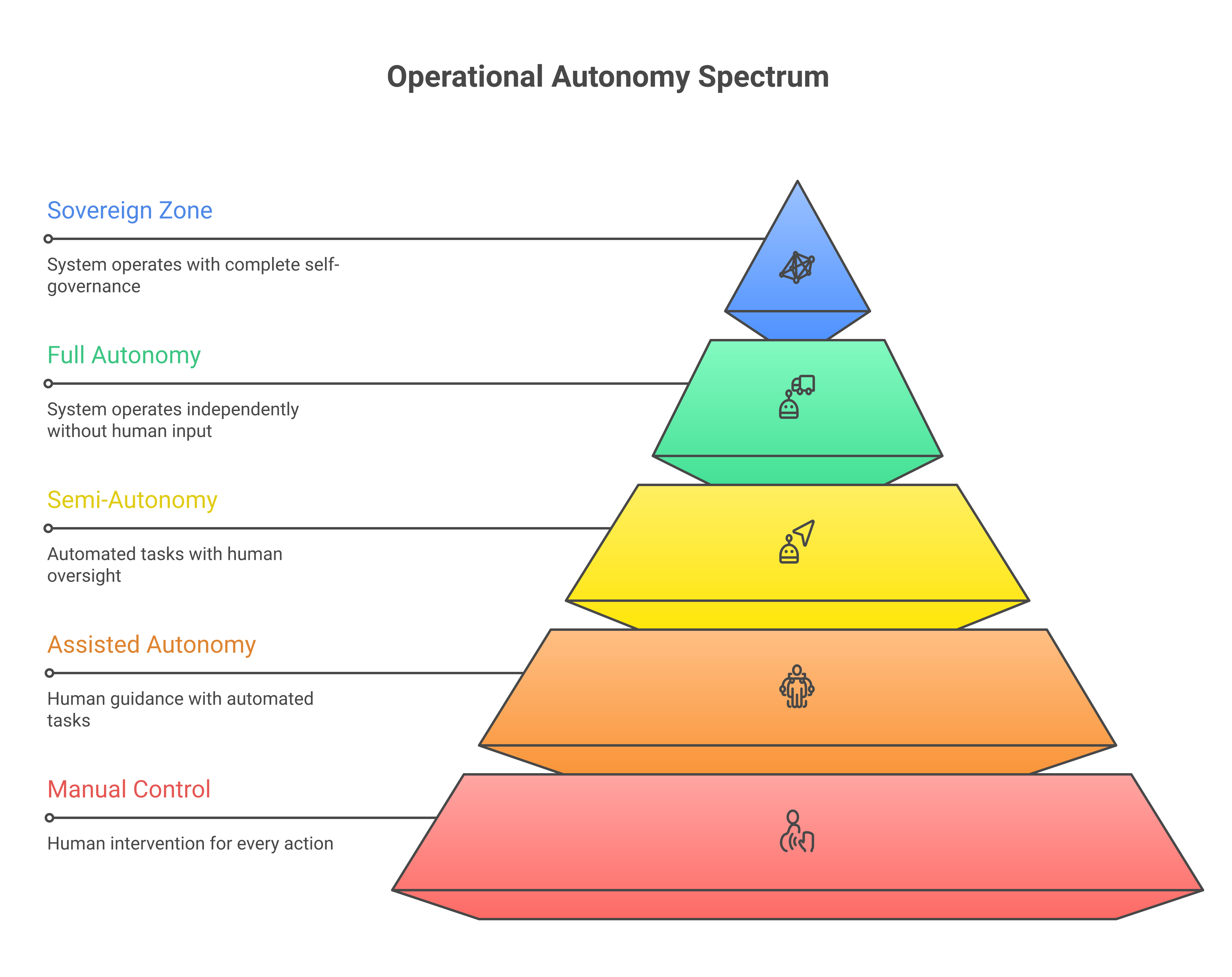
Level 0 — Fully manual. The operator performs every step: detection, diagnosis, remediation, and verification. Alerts may exist, but they serve only as signals to a human. There is no automated response capability. This is where most organisations began, and where some remain for their most sensitive systems.
Level 1 — Assisted operations. Automation handles individual, isolated tasks: health checks run on a schedule, log aggregation happens automatically, metrics are collected and presented on dashboards. The human remains fully in control of diagnosis and response, but the observability infrastructure reduces the cognitive load of information gathering. IBM Instana’s automatic discovery and dependency mapping operates at this level, continuously assembling the topology that humans need to reason about failures [2].
Level 2 — Partially automated. Specific, well-understood remediation actions are automated but require human approval before execution. An agent or workflow engine detects an anomaly, proposes a remediation, and waits for an operator to confirm. This is the model described in Chapter 12’s automation maturity ladder as “partially automated” and in Chapter 28 as the recommendation-driven paradigm. The human is the decision-maker; the system is the analyst and the executor.
Level 3 — Conditionally autonomous. The system detects, diagnoses, selects a remediation, and executes it without human pre-approval—but only for a defined set of conditions, action types, and environments. Outside those conditions, it reverts to Level 2 behaviour. This is the level at which self-healing, as commonly understood, begins to operate. The conditions under which autonomy is granted are specified in policy, not left to informal judgement.
Level 4 — Highly autonomous. The system handles the overwhelming majority of operational incidents autonomously, including novel combinations of known failure modes. Human involvement is reserved for genuinely unprecedented situations, strategic decisions, and periodic review of the system’s performance. The boundaries are still defined by policy, but they are broad enough that most operational events are handled without human intervention.
Level 5 — Fully autonomous. No human involvement in any operational decision. This level is largely theoretical for production systems operating under regulatory oversight, and is included here only for completeness. No responsible sovereign operations architecture should target Level 5 for regulated workloads, because regulatory frameworks universally require demonstrable human accountability for consequential operational decisions [3].
The critical insight is that an organisation does not occupy a single level across its entire estate. A given action type in a given environment may be at Level 3 while the same action type in a regulated sovereign zone is at Level 2. A routine pod restart may be at Level 4 while a database failover is at Level 1. The spectrum is not a ladder to climb uniformly but a landscape to map deliberately, with each cell in the matrix of action types and environments assigned a level based on explicit risk assessment, regulatory requirements, and demonstrated reliability.
For sovereign operations, the positioning decision is not merely technical. It carries regulatory weight. DORA requires that ICT risk management frameworks include “mechanisms and procedures to ensure that all ICT-related incidents are appropriately handled” and that “significant ICT-related incidents are communicated to senior management” [3]. NIS2 imposes similar obligations regarding incident handling and reporting [4]. These frameworks do not prohibit autonomous remediation, but they require that organisations can demonstrate accountability, traceability, and appropriateness of response. An autonomous action that cannot be explained, audited, or attributed is an autonomous action that creates regulatory exposure.
The rest of this chapter examines what it takes to operate responsibly at Levels 3 and 4—where genuine self-healing becomes possible—while maintaining the control, transparency, and accountability that sovereign operations demands.
29.2 Self-healing architecture patterns
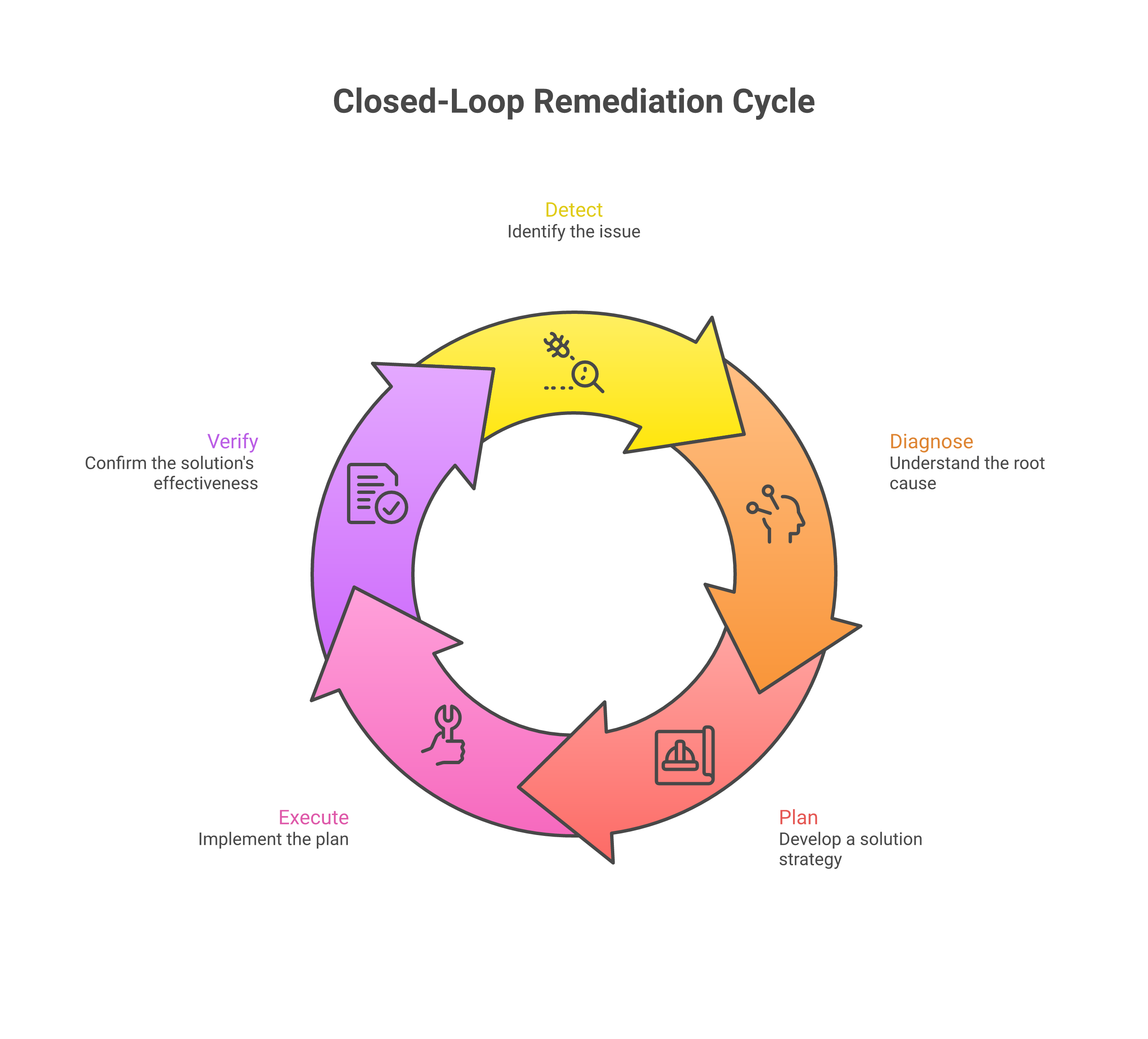
Self-healing is not a product feature; it is an architectural capability that emerges from the interaction of several systems: monitoring, diagnosis, planning, execution, and verification. The canonical pattern is the closed-loop remediation cycle: detect an anomaly, diagnose its cause, plan a remediation, execute the plan, and verify the outcome. If verification fails, the loop iterates—either retrying with adjusted parameters, escalating to a different remediation strategy, or escalating to a human operator.
This pattern is not new. Control theory has studied closed-loop feedback systems for over a century, and the application of control-theoretic principles to computing systems was well established by the early 2000s. Kephart and Chess’s seminal 2003 paper on autonomic computing articulated the MAPE-K (Monitor, Analyse, Plan, Execute, with shared Knowledge) reference architecture that remains the conceptual foundation for self-healing systems [5]. What has changed is not the pattern but the sophistication of its implementation: modern observability platforms, AI-driven diagnosis, and policy-aware execution engines make it possible to implement closed-loop remediation at a scale and reliability that was previously impractical.
Detection is the entry point. A self-healing system must detect anomalies with high precision and low latency. False positives are not merely annoying—they trigger remediation actions that consume resources, create audit trail noise, and erode trust in the system’s autonomy. IBM Instana’s real-time anomaly detection, operating on automatically discovered service topologies, provides the detection layer: it identifies deviations from learned baselines across latency, error rates, throughput, and resource utilisation, and correlates these deviations across dependent services to distinguish root causes from symptoms [2]. The quality of detection directly determines the quality of everything downstream.
Diagnosis translates a detected anomaly into an actionable understanding of what has gone wrong. In simple cases, the anomaly itself is diagnostic: a pod in CrashLoopBackOff is a pod that is failing its health checks. In complex cases, diagnosis requires reasoning across multiple signals, time windows, and dependency relationships. IBM Concert’s topology-aware correlation engine performs this reasoning at scale, linking observed symptoms to probable root causes by traversing the dependency graph and identifying the service or infrastructure component whose degradation best explains the observed pattern of failures [6]. The output of diagnosis is not a vague indication that something is wrong but a specific hypothesis: “the payments-db primary replica in zone-A has exhausted its connection pool, causing connection timeouts in the payment-gateway service and cascading latency increases in the order-processing pipeline.”
Planning selects a remediation strategy appropriate to the diagnosed cause. This is where the system must consult its knowledge base of available remediations—runbooks, playbooks, automated procedures—and match the diagnosis to the most appropriate response. The planning phase must also evaluate constraints: is the proposed remediation permitted in this sovereign zone? Does it require approval? Does it exceed the autonomous action boundary defined in policy? Is the system currently in a state where this remediation is safe to execute—for example, are there other remediations already in progress that might conflict? IBM Concert’s recommendation engine, discussed in Chapter 28, provides the matching function; the policy evaluation layer provides the constraint checking.
Execution carries out the planned remediation through a controlled pipeline. The remediation is not executed by the diagnostic system directly; it is delegated to an execution engine—Ansible Automation Platform, a Kubernetes operator, a cloud provider API—that has the appropriate credentials, access controls, and audit capabilities. This separation of concerns is architecturally essential: the system that decides what to do should not be the same system that has unconstrained ability to do it. The execution engine enforces its own pre-conditions, logs every action, and reports the outcome back to the control loop.
Verification confirms that the remediation achieved its intended effect. The system re-evaluates the same signals that triggered the original detection and confirms that they have returned to acceptable ranges. Verification must be patient: some remediations take time to propagate, and premature verification can produce false negatives (declaring success before the fix has fully taken effect) or false positives (declaring failure before the fix has had time to work). The verification window—how long to wait, what thresholds to apply, how to distinguish “improving” from “resolved”—must be specified as part of the remediation plan, not left to a generic default.
Kubernetes provides the most widely deployed example of self-healing primitives. Liveness probes detect when a container process has become unresponsive; the kubelet restarts it. Readiness probes detect when a container is not ready to serve traffic; the service mesh removes it from the load-balancing pool until it recovers. The Horizontal Pod Autoscaler (HPA) detects when resource utilisation exceeds thresholds and scales the number of replicas. Pod Disruption Budgets (PDBs) ensure that voluntary disruptions—such as node drains during maintenance—do not reduce availability below a defined minimum [7]. These primitives are effective within their scope, but their scope is limited to the container orchestration layer. They know nothing about application-level health, database state, network path quality, or cross-service dependency relationships. A liveness probe that checks whether a process is responding to TCP connections will not detect that the process is returning incorrect results due to a corrupted cache.
Extending self-healing beyond container orchestration to the full stack requires composing Kubernetes primitives with higher-level remediation logic. A service-level self-healing system might detect that a cache corruption pattern is causing incorrect responses, drain the affected pods gracefully (respecting PDBs), trigger a cache rebuild procedure, and then verify that response correctness metrics have recovered—all without human intervention, but all within a policy-defined boundary that specifies which services, which zones, and which conditions qualify for this level of autonomy.
29.3 Defining the autonomous action boundary
The most consequential design decision in a self-healing architecture is not which technology to use but which actions to permit without human approval. Get this wrong in one direction, and the system is toothless—every remediation waits for a human who may be asleep, in a meeting, or overwhelmed by other alerts. Get it wrong in the other direction, and the system becomes a hazard—executing actions whose consequences it cannot fully anticipate, in environments where errors carry regulatory or contractual penalties.
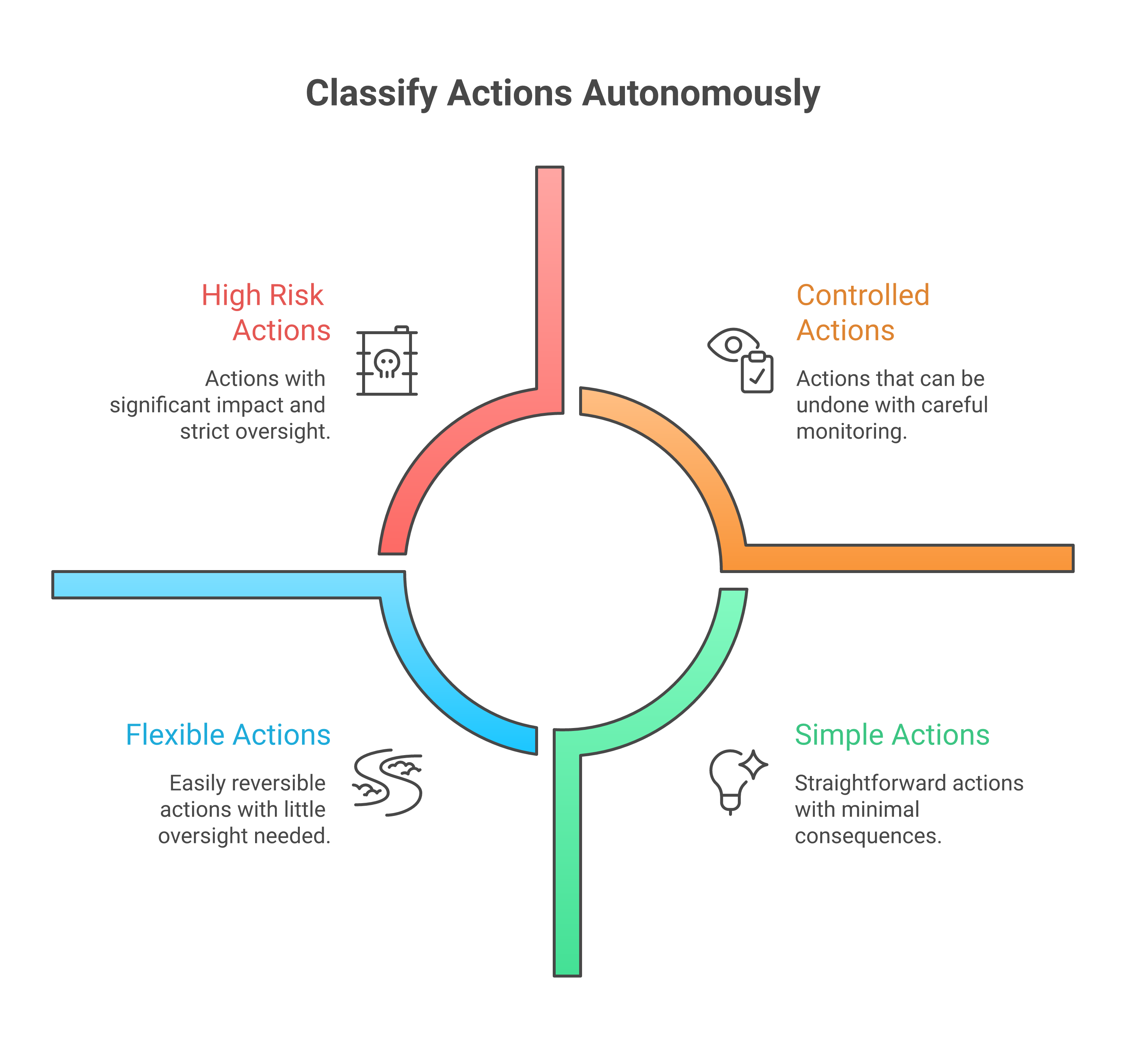
The autonomous action boundary is the line between actions the system may execute on its own authority and actions that require human confirmation. Drawing this line requires evaluating every candidate action along three dimensions: reversibility, blast radius, and regulatory sensitivity.
Reversibility asks: if this action produces an undesired outcome, can it be undone? Restarting a stateless pod is highly reversible; the worst case is a brief period of reduced capacity while the new pod starts. Executing a database schema migration is effectively irreversible in any timeframe relevant to incident response. Scaling a deployment from three replicas to ten is reversible; scaling it from ten to one may not be, if the reduced capacity causes cascading failures before the scale-up can be reversed. The reversibility assessment must consider not just whether an undo path exists in theory but whether it can be executed quickly enough to prevent consequential harm.
Blast radius asks: if this action goes wrong, how much of the system is affected? A remediation that operates on a single pod in a single namespace has a small blast radius. A remediation that modifies a network security group affecting an entire sovereign zone has a large one. A remediation that restarts a shared infrastructure component—a message broker, a DNS resolver, a certificate authority—has a blast radius that extends to every service depending on that component. Blast radius is not merely about the number of affected components; it is about the criticality of those components and the cascading effects that their disruption can trigger.
Regulatory sensitivity asks: does this action operate in a context where autonomous execution creates regulatory or contractual exposure? Actions that move or process data across jurisdictional boundaries, actions that modify access controls or encryption configurations, actions that affect services subject to specific regulatory oversight—all of these carry regulatory sensitivity that is independent of their technical reversibility or blast radius. A perfectly reversible, small-blast-radius action that happens to involve the processing of personal data in a regulated sovereign zone may still require human approval because the regulatory framework requires demonstrable human accountability for data-processing decisions.
The intersection of these three dimensions produces a classification matrix. Actions that are highly reversible, small in blast radius, and low in regulatory sensitivity are strong candidates for Level 3 or Level 4 autonomy. Actions that score poorly on any single dimension should default to Level 2 (human approval required). Actions that score poorly on two or more dimensions should remain at Level 1 or Level 0 until specific evidence justifies elevating them.
Safety-critical domains deserve particular attention because their regulatory frameworks impose additional constraints on autonomous action that may override what the technical classification would otherwise permit. The EU Medical Device Regulation (EU MDR) requires that changes affecting the safety or performance of software classified as a medical device (SaMD) be subject to the manufacturer’s quality management system, which in practice means that autonomous remediation of SaMD workloads must satisfy clinical risk management processes before execution [11]. EASA Part-IS requires that information security measures for aviation systems include incident response procedures with defined roles and accountabilities, creating an expectation of demonstrable human decision-making that is difficult to reconcile with fully autonomous remediation of safety-related network functions [12]. IEC 62443, the industrial automation and control systems security standard, defines security levels and zones whose integrity autonomous actions must not compromise; a self-healing action that reconfigures a conduit between an IEC 62443 zone and an external network, even if technically reversible, carries safety implications that place it firmly in the human-approval-required category [13]. Architects deploying self-healing capabilities in these domains should therefore calibrate the autonomous action boundary conservatively, setting higher human oversight thresholds than the general-purpose classification matrix would suggest (see Chapter 3 for the full regulatory landscape).
This classification must be encoded in policy-as-code, not documented in a wiki and enforced by convention. Open Policy Agent (OPA) or similar policy engines provide the mechanism: each candidate autonomous action is submitted to the policy engine with its parameters and context (target environment, sovereign zone, action type, affected resources), and the policy engine returns a decision—permit, deny, or require-approval—based on the encoded rules [8]. The policy evaluation happens at execution time, using actual parameters, not at design time using anticipated parameters. This is important because the same action type may be permitted in one context and denied in another: restarting a stateless service in a development environment is a different proposition from restarting the same service in a production regulated zone, even though the mechanical action is identical.
The policy definitions themselves must be version-controlled, reviewed, and tested with the same rigour applied to infrastructure code. A policy change that inadvertently widens the autonomous action boundary—permitting an action type that was previously gated—should be caught in code review, not discovered when the system autonomously executes an action that no one intended to authorise. Policy testing, using unit tests with realistic scenarios, is not optional; it is the verification mechanism that gives the autonomous action boundary its integrity.
29.4 Agent-driven remediation workflows
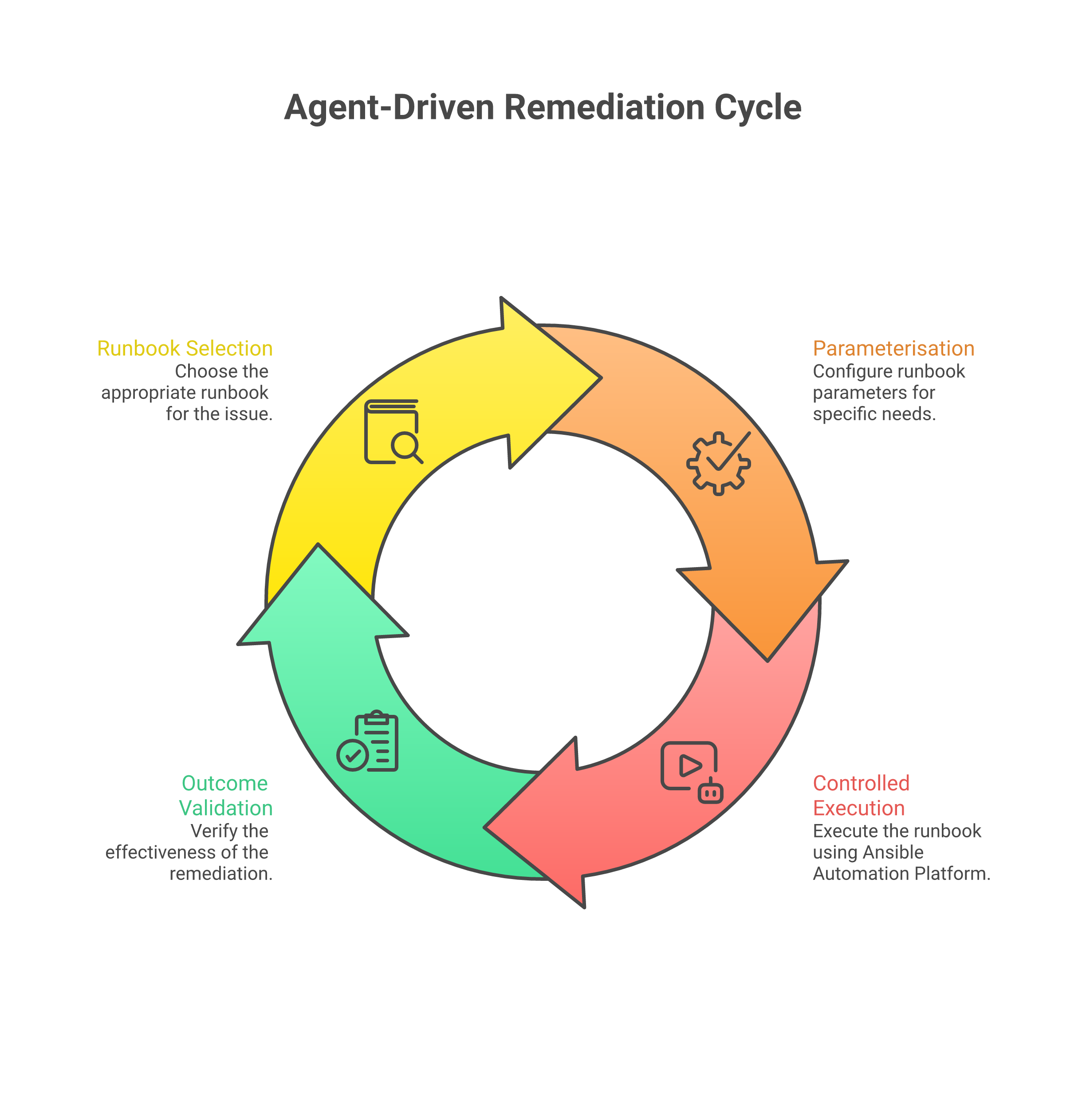
When a self-healing system determines that a remediation is needed and the autonomous action boundary permits execution, the actual work is performed by an agent-driven remediation workflow. The term “agent” here encompasses both AI agents—such as those orchestrated through watsonx Orchestrate—and non-AI automation agents such as Ansible playbooks triggered by event-driven automation. The distinction matters less than the common architecture: a workflow that selects a procedure, parameterises it for the specific context, executes it through a controlled pipeline, and validates the outcome.
The workflow begins with runbook selection. The diagnosis from the closed-loop cycle identifies a failure mode; the agent must match this to an appropriate runbook or playbook. IBM Concert’s recommendation engine scores candidate runbooks against the observed failure pattern, weighting matches by historical success rates for similar incidents, and presents the highest-scoring option [6]. In a fully autonomous context, the agent selects the top-scoring runbook without waiting for human confirmation—but only if the runbook is tagged as eligible for autonomous execution in the relevant sovereign zone. This tagging is part of the policy-as-code framework: each runbook carries metadata specifying the autonomy levels at which it may be invoked, the environments in which those levels apply, and any additional constraints.
Parameterisation adapts the generic runbook to the specific incident. A runbook for “restart degraded service” must be parameterised with the specific service name, namespace, cluster, sovereign zone, and any zone-specific configuration overrides. The agent assembles these parameters from the incident context—the topology data, the observability signals, the configuration management database—and validates them against the runbook’s parameter schema before proceeding. Incorrect parameterisation is a common source of remediation failures: a runbook executed against the wrong service, the wrong namespace, or the wrong cluster can cause precisely the kind of harm the autonomous action boundary is designed to prevent.
Execution proceeds through a controlled pipeline that enforces pre-conditions, logs every step, and respects zone-specific constraints. Integration with Ansible Automation Platform is the primary execution mechanism for infrastructure-level remediations. The agent triggers an Ansible playbook through the Automation Platform API, specifying the execution environment, the inventory (scoped to the affected resources), and the credentials (injected by the platform, never exposed to the agent). The Automation Platform’s execution environment ensures that the playbook runs with the exact collection versions, Python dependencies, and configuration that were validated during testing—eliminating the “works on my machine” class of execution failures [9].
For Kubernetes-level remediations, the agent may interact directly with the Kubernetes API through purpose-built operators or controllers. The distinction between Ansible-driven and Kubernetes-native remediation is not one of principle but of scope: Kubernetes operators are well suited to remediations that operate within the Kubernetes resource model (scaling, restarting, draining), while Ansible playbooks are necessary for remediations that span the infrastructure stack (network configuration, storage operations, cross-platform coordination).
Outcome validation closes the loop. The agent monitors the same signals that triggered the original detection and confirms that they have returned to acceptable ranges within the specified verification window. If they have, the incident is marked as auto-remediated, the full execution log is attached to the incident record, and a notification is sent to the responsible team for post-hoc review. If they have not, the agent must decide whether to retry (with the same or a modified strategy), escalate to an alternative remediation, or escalate to a human operator. The escalation decision itself is policy-governed: the maximum number of autonomous retry attempts, the conditions under which a different remediation may be attempted, and the threshold at which human escalation is mandatory are all specified in the remediation policy.
The integration between watsonx Orchestrate and Ansible Automation Platform deserves particular attention. Orchestrate provides the agentic reasoning layer: it interprets the incident context, selects the appropriate skill (backed by an Ansible playbook), and manages the conversational interface through which humans can monitor or intervene. Ansible Automation Platform provides the execution layer: it runs the playbook with enterprise-grade credential management, role-based access control, and comprehensive audit logging. This separation ensures that the intelligence that decides what to do and the mechanism that does it are independently governed, independently auditable, and independently constrained. An Orchestrate agent that has been granted permission to invoke a particular skill does not thereby gain unrestricted access to the underlying infrastructure; its access is mediated by the Automation Platform’s own access controls, applied at execution time [9].
29.5 Progressive autonomy and trust building
No self-healing system should begin at Level 3 or Level 4. Trust in autonomous remediation must be earned through a deliberate progression that builds confidence incrementally, measures reliability objectively, and rolls back autonomy when confidence is not justified.
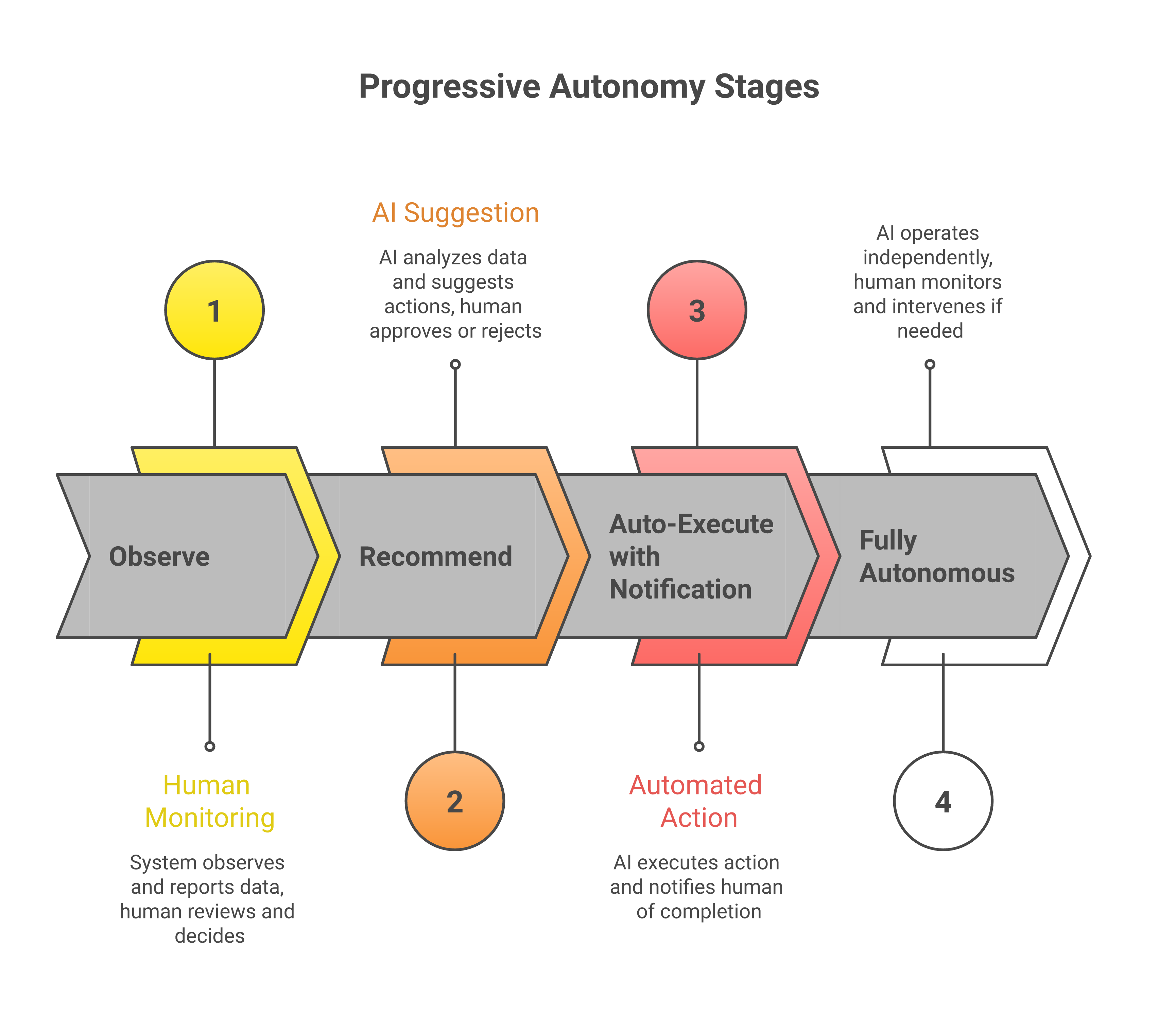
The progression follows a four-stage model that mirrors the apprentice model introduced in Chapter 12, extended to the specific requirements of autonomous operation.
Stage 1 — Observe only. The self-healing system detects anomalies and produces diagnoses, but takes no action. Its outputs are logged and presented to operators alongside the actions that operators actually take. The purpose of this stage is to measure the system’s diagnostic accuracy: how often does it correctly identify the root cause? How often does it recommend the same remediation that a human operator eventually selects? How often does it produce false positives? This stage generates the baseline data against which subsequent stages are evaluated.
Stage 2 — Recommend with tracking. The system presents recommended remediations to operators, who accept, modify, or reject them. Every decision is recorded: which recommendation was made, what the operator did, and what the outcome was. This is the recommendation-driven model of Chapter 28, applied specifically to self-healing. Over time, the acceptance rate and outcome data build a statistical profile of the system’s reliability. IBM Concert’s learning loop operates at this stage: human decisions calibrate the recommendation engine, improving its accuracy for future incidents [6].
Stage 3 — Auto-execute with notification. For action types and environments that have demonstrated sustained high accuracy at Stage 2—measured by acceptance rates above a defined threshold, outcome success rates above a defined threshold, and absence of consequential errors—the system is granted permission to execute autonomously while simultaneously notifying the responsible team. The team reviews the action post-hoc rather than pre-approving it. The notification is not a courtesy; it is a control mechanism. If the team observes that the system has taken an action they would not have approved, they can intervene, and the autonomy grant for that action type can be reviewed.
Stage 4 — Fully autonomous within policy bounds. For action types and environments that have demonstrated sustained reliability at Stage 3—where post-hoc reviews consistently confirm that the system’s actions were appropriate—the notification requirement is relaxed to periodic summary reports rather than real-time alerts. The system operates autonomously within its policy-defined boundary, and the responsible team monitors aggregate metrics (success rates, remediation times, escalation frequencies) rather than individual actions.
The progression between stages must be gated by quantitative criteria, not subjective confidence. A useful set of promotion criteria, adapted from reliability engineering practice, includes the following: diagnostic accuracy above 95 per cent (measured against human-validated ground truth) for at least 100 consecutive incidents; remediation success rate above 98 per cent for at least 50 consecutive autonomous or semi-autonomous executions; zero consequential errors (defined as errors that required human intervention to reverse or that violated policy constraints) over the measurement window; and a minimum measurement period of 30 days to account for temporal variation in incident patterns [10].
Demotion is equally important. If an action type at Stage 3 or Stage 4 produces a consequential error, it should be automatically demoted to Stage 2 until the error has been investigated, the root cause addressed, and the promotion criteria re-satisfied. This automatic demotion is a circuit breaker for trust: it prevents a single failure from being dismissed as an anomaly while the system continues to operate autonomously. The demotion criteria should be asymmetric with the promotion criteria—easier to demote than to promote—because the cost of inappropriate autonomous action is typically higher than the cost of unnecessary human review.
Rollback capability is a prerequisite for every stage beyond Stage 1. An autonomous remediation that cannot be rolled back if it produces an undesired outcome is an autonomous remediation that should not exist. The rollback procedure must be tested with the same rigour as the forward procedure, and its execution must be automated—relying on a human to manually reverse an action that was autonomously executed is a design failure that introduces exactly the latency and error risk that autonomy was intended to eliminate.
Learning from failures is the mechanism that makes progressive autonomy a genuine improvement cycle rather than a static configuration. Every remediation—successful or not—generates data: what was detected, what was diagnosed, what was planned, what was executed, what was the outcome, and how did the outcome compare to the expectation. This data feeds back into the diagnostic models, the runbook selection algorithms, and the policy definitions. An autonomous remediation that succeeded but took longer than expected might suggest that the verification window should be adjusted. One that failed because the parameterisation was incorrect might suggest that the parameter validation schema needs refinement. One that succeeded technically but was demoted because post-hoc review identified a policy concern might suggest that the policy definition needs clarification. The learning loop is what distinguishes a self-healing system that improves over time from one that merely repeats its initial configuration.
29.6 Safety mechanisms and circuit breakers
Autonomous systems that can modify production infrastructure must be designed with the assumption that they will occasionally act incorrectly. The question is not whether failures will occur but how the system constrains their impact. Safety mechanisms and circuit breakers are the architectural elements that transform a potentially dangerous autonomous system into one whose failure modes are bounded and recoverable.
Rate limiting is the first line of defence. An autonomous system that can execute remediations without human approval must be constrained in how many remediations it can execute within a given time window. Without rate limiting, a feedback loop—where a remediation causes a new anomaly that triggers another remediation that causes another anomaly—can escalate into a cascade of automated actions that degrades the system far more rapidly and thoroughly than the original problem would have. Rate limits should be specified per action type, per environment, and per sovereign zone. A reasonable starting point is to permit no more than one autonomous remediation per service per hour, with escalation to human review if the rate limit is reached. The specific limits will vary by context, but the principle is universal: unbounded autonomous action is not autonomy, it is abdication.
Blast radius containment limits the scope of any single autonomous action. Even within the autonomous action boundary, the system should be constrained from affecting too many resources simultaneously. If a remediation involves restarting pods, it should restart them in rolling fashion, not all at once. If it involves scaling, it should scale incrementally, verifying stability at each step. If it involves configuration changes, it should apply them to a canary subset before rolling out to the full population. These are the same deployment safety practices that Chapter 25 describes for CI/CD pipelines, applied to operational remediation. The Kubernetes PDB mechanism provides a built-in blast radius constraint for pod-level operations, ensuring that a minimum number of replicas remain available during any voluntary disruption [7].
Automatic rollback triggers define the conditions under which a remediation is automatically reversed. If a service’s error rate increases after a remediation is applied, the remediation should be rolled back without waiting for a human to notice and intervene. The trigger conditions must be specific and measurable: “error rate exceeds 5 per cent within 10 minutes of remediation execution” is a valid rollback trigger; “things seem worse” is not. Rollback triggers should be defined as part of the remediation plan, alongside the forward procedure, so that every autonomous action has a corresponding automatic reversal path.
Dead man’s switch patterns provide a failsafe for cases where the autonomous system itself becomes unavailable or unresponsive. The metaphor comes from railway engineering: a switch that must be actively held in position and that reverts to a safe default if released. In the self-healing context, this means that autonomous remediations should be designed so that if the orchestration system fails mid-execution, the partial state is safe. A remediation that takes a resource out of service, applies a fix, and then returns it to service should be designed so that if the orchestration system fails between the first and third steps, the resource remains out of service (a safe, degraded state) rather than being left in an undefined intermediate state. Idempotent playbook design—a core Ansible principle—supports this pattern: a playbook that can be safely re-run from any point in its execution without producing unintended side effects makes recovery from partial execution straightforward [9].
Escalation cascades define a structured path from autonomous operation to human involvement. The cascade is not a single binary switch between “autonomous” and “human”; it is a graduated sequence. The first level might be a notification to the team channel. The second might be a page to the on-call engineer. The third might be a page to the on-call manager with a summary of what has been attempted and what has failed. The fourth might be an automatic freeze of all autonomous actions in the affected zone, pending human review. Each level in the cascade should have a defined trigger condition and a defined timeout: if the situation is not resolved within a specified period at one level, it automatically escalates to the next. Escalation fatigue—where repeated escalations for non-critical issues cause operators to ignore or delay response—is a real risk that must be managed through careful calibration of trigger thresholds and through regular review of escalation patterns in retrospectives.
Conflict detection prevents multiple autonomous remediations from interfering with each other. If one workflow is scaling a service up while another is restarting its pods, the interaction may produce outcomes that neither workflow anticipated. A remediation coordination layer—which may be as simple as a distributed lock on the target resource or as sophisticated as a scheduling system that evaluates the compatibility of concurrent remediations—is necessary to prevent these conflicts. The coordination layer must be aware of the dependency graph: remediations targeting services that are upstream or downstream of each other in the call graph should be treated as potentially conflicting, even if they target different specific resources.
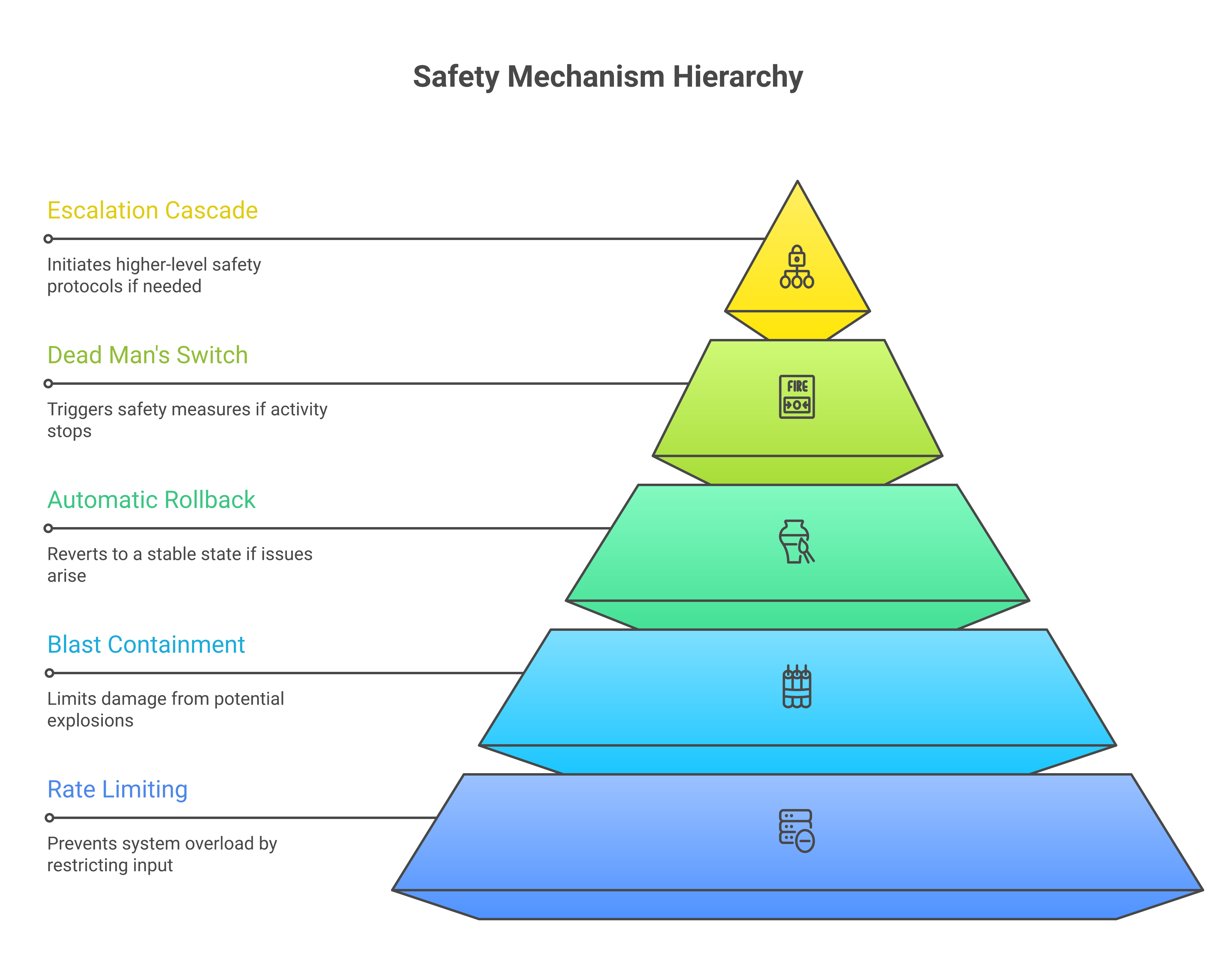
The overall design philosophy for safety mechanisms is defence in depth. No single mechanism is sufficient; each addresses a different failure mode. Rate limiting prevents cascading feedback loops. Blast radius containment limits the scope of individual errors. Automatic rollback triggers reverse actions that make things worse. Dead man’s switch patterns ensure safe states during system failures. Escalation cascades ensure human involvement when automated responses are insufficient. Conflict detection prevents interference between concurrent remediations. Together, they create an environment in which autonomous operation is bounded, observable, and recoverable—which is the precondition for it being trustworthy.
29.7 Self-healing in sovereign zones
Sovereign zones introduce constraints that fundamentally shape what self-healing can do, how it can do it, and who must be accountable for the result. A self-healing architecture that works effectively in an unregulated environment may be entirely inappropriate in a regulated sovereign zone—not because the technology is different, but because the governance requirements are different.
The first and most fundamental constraint is that autonomy policies must be zone-specific. The autonomous action boundary defined in Section 29.3 cannot be applied uniformly across all environments. A regulated sovereign zone operating under DORA, sector-specific supervisory expectations, or national data protection law will typically require a more conservative autonomy posture than a development environment or an unregulated workload. This does not mean that self-healing is impossible in regulated zones; it means that the set of actions eligible for autonomous execution is narrower, the promotion criteria for progressive autonomy are more stringent, and the audit requirements are more comprehensive.
Zone-specific autonomy policies must address several specific concerns. Data residency is the most obvious: any remediation action that involves data movement—failover to a different region, backup to a different storage tier, log shipping to a centralised analysis platform—must be evaluated against the zone’s data residency constraints before execution. A self-healing system that automatically fails over a workload to a different region to maintain availability may be doing exactly the right thing in a zone without residency constraints and exactly the wrong thing in a zone where data must remain within national boundaries. The policy engine must evaluate residency constraints at execution time, using the actual target location, not at design time using assumed configurations.
Access constraints are equally critical. A remediation workflow that operates in a sovereign zone must authenticate with credentials that are scoped to that zone and must not use credentials that grant access to resources outside the zone. This is not merely a best practice; it is a structural requirement in architectures where sovereign zones are isolated by design. IBM Ansible Automation Platform’s credential management model supports this: credentials are associated with specific inventories and execution environments, and the platform enforces that a playbook invocation cannot access credentials outside its authorised scope [9]. A self-healing agent that operates across multiple sovereign zones must maintain separate credential contexts for each zone and must not allow a remediation in one zone to inadvertently use credentials from another.
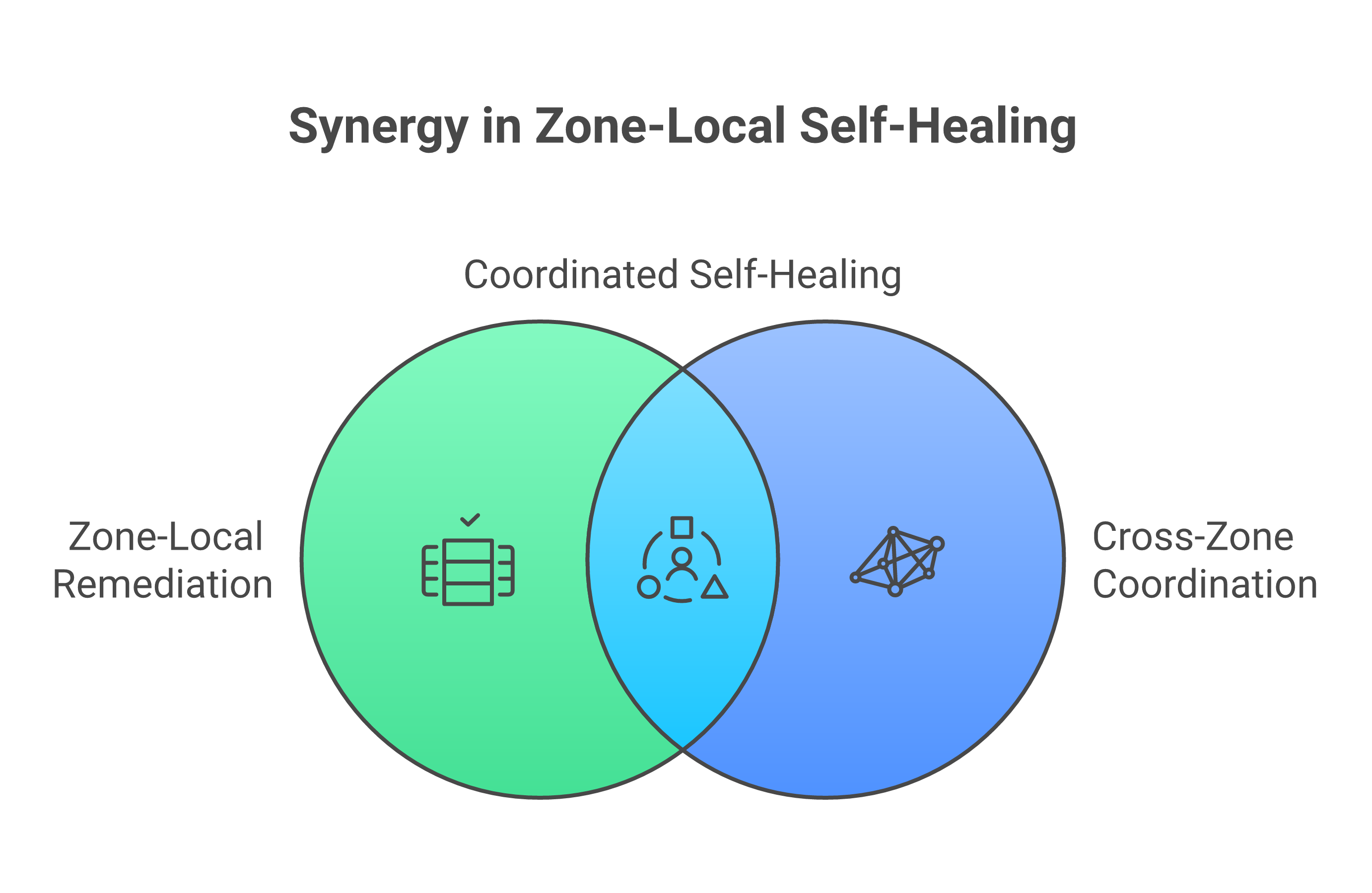
Cross-zone incident handling presents a particular challenge. When an incident spans multiple sovereign zones—a shared infrastructure component fails, or a network partition disrupts connectivity between zones—the self-healing system must coordinate remediation across zones while respecting each zone’s individual constraints. The architecture for this is zone-local remediation with cross-zone coordination. Each zone’s self-healing system executes remediations within its own boundary, using its own credentials, respecting its own autonomy policy. A coordination layer—which may be implemented through IBM Concert’s cross-environment visibility or through a purpose-built event bus—shares situational awareness between zones so that each zone’s remediation decisions are informed by the global picture, but each zone’s actions are locally authorised and locally executed.
This architecture prevents several failure modes that would arise from a centralised cross-zone remediation capability. A centralised system would need credentials for all zones, creating a single point of compromise. It would need to evaluate the policies of all zones simultaneously, creating complexity that is difficult to verify and audit. And it would create a jurisdictional ambiguity: if a remediation is planned centrally and executed locally, which jurisdiction’s rules govern the decision? The zone-local model eliminates this ambiguity: the decision is made and executed within the zone, by a system operating under that zone’s governance, with that zone’s credentials, and subject to that zone’s audit requirements.
Regulatory considerations for autonomous action in regulated environments require explicit attention. Financial regulators under DORA expect organisations to maintain “ICT risk management frameworks” that include procedures for incident detection, classification, and response [3]. The framework must be documented, tested, and subject to periodic review. Autonomous self-healing systems are a valid component of this framework, provided that their behaviour is documented in the ICT risk management procedures, their decision logic is explainable, their actions are auditable, and their boundaries are defined in policy that has been reviewed and approved through the organisation’s governance process. The risk of autonomous action in a regulated environment is not that regulators prohibit it—they generally do not—but that organisations deploy it without the governance infrastructure to demonstrate that it is controlled, bounded, and accountable.
NIS2 adds a further dimension: the requirement to report significant incidents to national authorities within defined timeframes [4]. A self-healing system that resolves an incident autonomously, before any human is aware of it, must still generate the reporting data that would be required if the incident meets the significance threshold. This means that the incident record must capture the full remediation timeline—detection, diagnosis, action taken, outcome—in a form suitable for regulatory reporting, regardless of whether a human was involved. The reporting obligation exists independently of the remediation mechanism.
IBM Concert’s role in sovereign self-healing is to provide the cross-zone visibility and topology awareness that enables zone-local remediation systems to make well-informed decisions. Concert aggregates observability data from across the estate, builds a unified topology model, and identifies cross-zone dependencies—but it does not execute remediations. The execution remains zone-local, performed by the zone’s own automation infrastructure (Ansible Automation Platform, Kubernetes operators, cloud provider APIs) with the zone’s own credentials and under the zone’s own policy. Concert provides the intelligence; the zone provides the authority and the enforcement [6].
29.8 Cyber-resilient recovery: safeguarded copies, cyber vaults, and clean rooms
Self-healing as described in the preceding sections addresses operational failures whose symptoms are observable and whose remediations preserve the current state of the system. A fundamentally different class of threat — ransomware, destructive malware, supply chain compromise — demands a fundamentally different recovery posture. When the production environment itself is the adversary’s territory, restoring a workload into that environment is not recovery; it is reinfection. Cyber-resilient recovery requires architectures that guarantee the integrity and availability of recovery data independently of the production infrastructure, and that provide a validated environment into which that data can be restored.
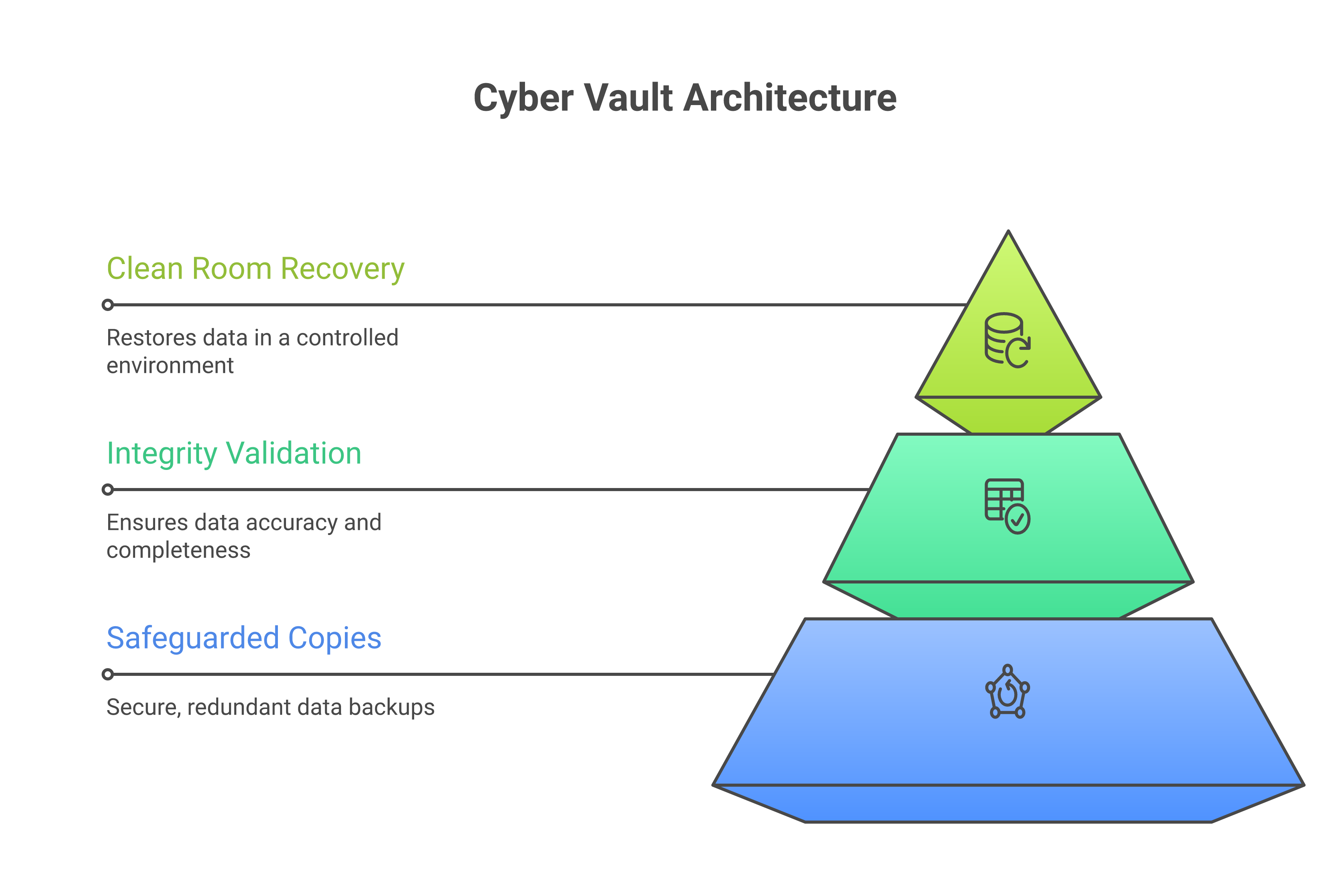
Safeguarded Copy is IBM’s implementation of this principle at the storage layer. Available on FlashSystem and DS8000 storage platforms, Safeguarded Copy creates point-in-time immutable snapshots of volumes that are logically air-gapped from the production environment [14]. These snapshots cannot be modified, encrypted by ransomware, or deleted before their administrator-defined retention period expires. The mechanism operates below the file system layer: even an attacker with root access to the application host cannot reach the safeguarded copies through the normal data path. Snapshots are created on a policy-driven schedule — typically every few hours for critical workloads — and retained for a configurable window, providing a series of known-good recovery points that bracket any potential compromise event. For sovereign operations, the critical property is locality: safeguarded copies reside on the same storage system within the same sovereign zone, ensuring that recovery data never traverses jurisdictional boundaries.
The cyber vault pattern extends this principle from individual snapshots to a complete architectural posture. A cyber vault is an isolated, hardened recovery environment designed to survive the compromise of every other component in the estate. Its defining characteristics are immutability, isolation, validation, and minimal access. Storage within the vault uses write-once-read-many (WORM) semantics or safeguarded copy technology to prevent alteration after creation. Network connectivity is either physically air-gapped or restricted to a tightly controlled, uni-directional replication channel that permits data inflow but no outbound access or management-plane connectivity from the production network [15]. Automated integrity validation scans every copy entering the vault for indicators of encryption, corruption, or embedded malware before admission to the retention pool — copies that fail validation are quarantined, preventing the vault from accumulating compromised recovery points. Access is governed by break-glass procedures: no standing credentials exist, administrative access requires multi-party authorisation through an out-of-band channel, and every access event is logged to a tamper-evident audit trail. Regular recovery testing — at least quarterly, and ideally monthly — validates that the vault’s contents can actually be restored to a functional state. A vault that has never been tested is not a recovery capability; it is an assumption.
IBM Cloud Cyber Recovery [17] provides a managed service that automates the cyber vault pattern, orchestrating the creation of isolated recovery environments, the replication of safeguarded copies into those environments, and the execution of automated integrity validation and recovery testing on a policy-driven schedule. By codifying the vault lifecycle — provisioning, replication, scanning, testing and teardown — as an automated workflow rather than a manual run-book, Cloud Cyber Recovery reduces the operational burden of maintaining a credible cyber vault posture and produces machine-generated evidence of regular recovery testing that satisfies DORA Article 12 obligations without relying on periodic manual exercises.
Clean room recovery addresses the question of where to restore when the production environment cannot be trusted. The conventional disaster recovery pattern — restore backups into the existing infrastructure — presupposes that the infrastructure itself is sound. In a ransomware or supply chain compromise scenario, that presupposition fails: the attacker may retain access through compromised credentials, implanted backdoors, or manipulated configuration that survives a simple data restoration. The clean room pattern breaks this assumption by provisioning a fresh, validated environment from trusted infrastructure-as-code definitions, restoring data from verified safeguarded copies, validating the restored workload against known-good baselines, and only then cutting over production traffic. The clean room is ephemeral: built for the recovery event, promoted to production once validated, with the compromised original environment decommissioned rather than remediated. This approach is costlier than in-place restoration but provides assurance against persistent threats that in-place restoration cannot match.
Agent-assisted recovery integrates these capabilities into the agentic operations model. Automated detection of data corruption or encryption patterns — sudden entropy increases across file systems, anomalous write amplification, mass file-extension changes — can trigger pre-emptive safeguarded copy creation, capturing a known-good snapshot before the compromise propagates further [14]. Agentic workflows orchestrated through watsonx Orchestrate can then automate the clean room provisioning sequence: selecting infrastructure-as-code templates, provisioning compute and network resources within the sovereign zone, identifying the most recent verified safeguarded copy, initiating restoration, and executing post-restoration validation checks. The agent manages the traffic switchover through progressive shifting — directing an increasing percentage of requests to the clean room while monitoring error rates — and coordinates decommissioning of the compromised environment once the switchover is confirmed stable. Guardrails are critical: recovery actions must respect the same sovereign zone constraints as normal operations, safeguarded copies must not be restored across zone boundaries, and clean room environments must be provisioned within the same jurisdictional perimeter. The autonomous action boundary defined in Section 29.3 applies with full force — and given the irreversibility and large blast radius of recovery operations, the classification matrix will typically place these actions at Level 2 (human approval required) or at most Level 3 with mandatory notification.
DORA alignment provides the regulatory imperative. Article 12 of the Digital Operational Resilience Act requires financial entities to maintain ICT backup policies specifying scope, frequency, and retention; to ensure that restoration does not jeopardise system security or integrity; and to regularly test recovery capabilities [3][16]. Safeguarded copies and cyber vault architectures directly address these requirements: immutability and retention guarantees satisfy the backup integrity obligation, integrity validation scanning satisfies the security-of-restoration obligation, and regular clean room recovery testing provides the demonstrable evidence of recovery capability that supervisory authorities expect. For organisations in sovereign zones under DORA supervision, the combination of safeguarded copies, cyber vault isolation, clean room recovery, and agent-assisted orchestration represents a defensible, auditable approach to the regulation’s backup and recovery provisions.
Key takeaways
-
Operational autonomy is a spectrum, not a binary switch. Organisations must deliberately position each action type and environment on the spectrum based on reversibility, blast radius, regulatory sensitivity, and demonstrated reliability—not drift into a position through accumulated ad hoc decisions.
-
The closed-loop remediation cycle—detect, diagnose, plan, execute, verify—is the foundational pattern for self-healing. Each phase must be independently capable, independently auditable, and connected through well-defined interfaces.
-
The autonomous action boundary must be encoded in policy-as-code, evaluated at execution time using actual parameters and context, and version-controlled with the same rigour as infrastructure code. Actions are classified by reversibility, blast radius, and regulatory sensitivity; those scoring poorly on any dimension default to human approval.
-
Agent-driven remediation workflows integrate IBM Concert’s recommendation engine for runbook selection, watsonx Orchestrate for agentic reasoning, and Ansible Automation Platform for controlled execution—maintaining separation between the intelligence that decides what to do and the mechanism that does it.
-
Progressive autonomy follows a four-stage model—observe, recommend, auto-execute with notification, fully autonomous—with quantitative promotion criteria and asymmetric demotion triggers that make it easier to reduce autonomy than to increase it.
-
Safety mechanisms operate in depth: rate limiting prevents cascading feedback loops, blast radius containment limits individual error scope, automatic rollback triggers reverse harmful actions, dead man’s switch patterns ensure safe states during system failures, and escalation cascades guarantee human involvement when automation is insufficient.
-
Self-healing in sovereign zones requires zone-specific autonomy policies, zone-local execution with zone-scoped credentials, and cross-zone coordination through shared situational awareness rather than centralised control. Regulatory frameworks such as DORA and NIS2 do not prohibit autonomous remediation but require that it is documented, explainable, auditable, and governed.
-
Cyber-resilient recovery extends self-healing to adversarial scenarios through three complementary patterns: IBM Safeguarded Copy provides immutable, logically air-gapped snapshots that cannot be encrypted, modified, or deleted by compromised systems; cyber vault architectures isolate and validate backup copies in hardened environments with break-glass access controls; and clean room recovery provisions fresh, trusted infrastructure for restoration when the production environment cannot be trusted. Agent-assisted orchestration automates detection, pre-emptive snapshot creation, clean room provisioning, and validated switchover — all within sovereign zone boundaries and subject to the autonomous action boundary. DORA Article 12 directly requires the backup integrity, tested recovery, and security-of-restoration capabilities that these patterns deliver.
Bridge to Chapter 30 — Agent-Assisted Incident Management
Autonomous self-healing addresses the operational incidents whose patterns are known, whose remediations are established, and whose boundaries can be defined in policy. But not every incident fits this profile. Novel failures, cascading outages that cross multiple domains, and incidents that require judgement calls about business priorities rather than technical procedures—these demand human involvement, augmented by AI rather than replaced by it. Chapter 30 examines agent-assisted incident management: the architecture and practices for incidents where humans and agents collaborate in real time, with agents providing context assembly, option analysis, and execution support while humans provide the strategic judgement, stakeholder communication, and accountability that no autonomous system can supply.
References
[1] SAE International, “Taxonomy and Definitions for Terms Related to Driving Automation Systems for On-Road Motor Vehicles,” SAE Standard J3016_202104, Apr. 2021. [Online]. Available: https://www.sae.org/standards/content/j3016_202104/
[2] IBM, “IBM Instana Observability: Automatic Infrastructure and Application Monitoring,” IBM Documentation, 2024. [Online]. Available: https://www.ibm.com/docs/en/instana-observability
[3] European Parliament and Council, “Regulation (EU) 2022/2554 on Digital Operational Resilience for the Financial Sector (DORA),” Official Journal of the European Union, L 333, pp. 1–79, Dec. 2022. [Online]. Available: https://eur-lex.europa.eu/legal-content/EN/TXT/?uri=CELEX:32022R2554
[4] European Parliament and Council, “Directive (EU) 2022/2555 on Measures for a High Common Level of Cybersecurity across the Union (NIS2),” Official Journal of the European Union, L 333, pp. 80–152, Dec. 2022. [Online]. Available: https://eur-lex.europa.eu/legal-content/EN/TXT/?uri=CELEX:32022L2555
[5] J. O. Kephart and D. M. Chess, “The Vision of Autonomic Computing,” IEEE Computer, vol. 36, no. 1, pp. 41–50, Jan. 2003. [Online]. Available: https://doi.org/10.1109/MC.2003.1160055
[6] IBM, “IBM Concert: Product Documentation and Architecture Overview,” IBM Corporation, Armonk, NY, 2024. [Online]. Available: https://www.ibm.com/products/concert
[7] The Kubernetes Authors, “Pod Lifecycle,” Kubernetes Documentation, 2024. [Online]. Available: https://kubernetes.io/docs/concepts/workloads/pods/pod-lifecycle/
[8] Open Policy Agent Contributors, “Open Policy Agent: Policy-based Control for Cloud Native Environments,” 2024. [Online]. Available: https://www.openpolicyagent.org/docs/latest/
[9] IBM, “Red Hat Ansible Automation Platform on IBM Cloud,” IBM Documentation, 2024. [Online]. Available: https://www.ibm.com/products/ansible
[10] B. Beyer, C. Jones, J. Petoff, and N. R. Murphy, Eds., Site Reliability Engineering: How Google Runs Production Systems. Sebastopol, CA: O’Reilly Media, 2016. [Online]. Available: https://sre.google/sre-book/table-of-contents/
[11] European Parliament and Council of the European Union, “Regulation (EU) 2017/745 on medical devices (EU MDR),” Official Journal of the European Union, vol. L 117, pp. 1–175, May 2017. [Art. 10(9): Quality management system requirements for software changes.] [Online]. Available: https://eur-lex.europa.eu/legal-content/EN/TXT/?uri=CELEX:32017R0745
[12] European Union Aviation Safety Agency, “Implementing Regulation (EU) 2023/203 — Information Security (Part-IS),” EASA, Cologne, Germany, 2023. [Online]. Available: https://www.easa.europa.eu/en/document-library/easy-access-rules/easy-access-rules-information-security
[13] International Electrotechnical Commission, “IEC 62443: Industrial Communication Networks — Network and System Security,” IEC, Geneva, Switzerland, 2018–2024 (multi-part standard). [Online]. Available: https://www.iec.ch/cyber-security
[14] IBM, “IBM Safeguarded Copy,” IBM Documentation, 2024. [Online]. Available: https://www.ibm.com/docs/en/flashsystem-5x00/8.6.x?topic=volumes-safeguarded-copy
[15] NIST, “Data Integrity: Detecting and Responding to Ransomware and Other Destructive Events,” NIST Special Publication 1800-26, National Institute of Standards and Technology, Gaithersburg, MD, 2020. [Online]. Available: https://www.nist.gov/publications/data-integrity-detecting-and-responding-ransomware-and-other-destructive-events
[16] European Parliament and Council, “Regulation (EU) 2022/2554 on Digital Operational Resilience for the Financial Sector (DORA),” Official Journal of the European Union, L 333, Art. 12 (ICT-related backup policies and recovery), Dec. 2022. [Online]. Available: https://eur-lex.europa.eu/legal-content/EN/TXT/?uri=CELEX:32022R2554
[17] IBM Corporation, “IBM Cloud Cyber Recovery: Managed Cyber Vault and Recovery Testing,” IBM Documentation, Armonk, NY, USA, 2024. [Online]. Available: https://www.ibm.com/products/cloud-cyber-recovery
Sovereign Cloud Operations: AI-Driven Management of Sovereign Estates
© 2026 by Alan Hamilton
is licensed under CC BY-SA 4.0


