Chapter 32 — Skills, Culture and Human Factors
Summary
This chapter addresses the human dimension of sovereign cloud operations: the skills, cultural shifts and organisational practices without which even the most sophisticated architecture will underperform. It examines the compound skills gap facing operations teams — spanning policy-as-code fluency, agent supervision, sovereignty engineering and AI governance — and proposes the T-shaped engineer model as the development target. The chapter traces the cultural transformation from gatekeeping to enabling, arguing that controls must be encoded in the platform rather than enforced through manual gates, and draws on Westrum’s generative culture typology to connect culture to operational performance. Practical guidance covers training pathways, trust calibration between human operators and AI agents, cognitive load management, and the knowledge management practices that sustain institutional memory in an estate where both people and agents depend on current, retrievable operational knowledge. A dedicated section addresses the re-skilling wall facing hyperscaler-native teams, proposing a phased bridge model that meets engineers where they are, builds capability through daily use rather than big-bang retraining, and confronts the career portability and legacy perception concerns with evidence rather than marketing.
32.1 The skills gap in sovereign operations
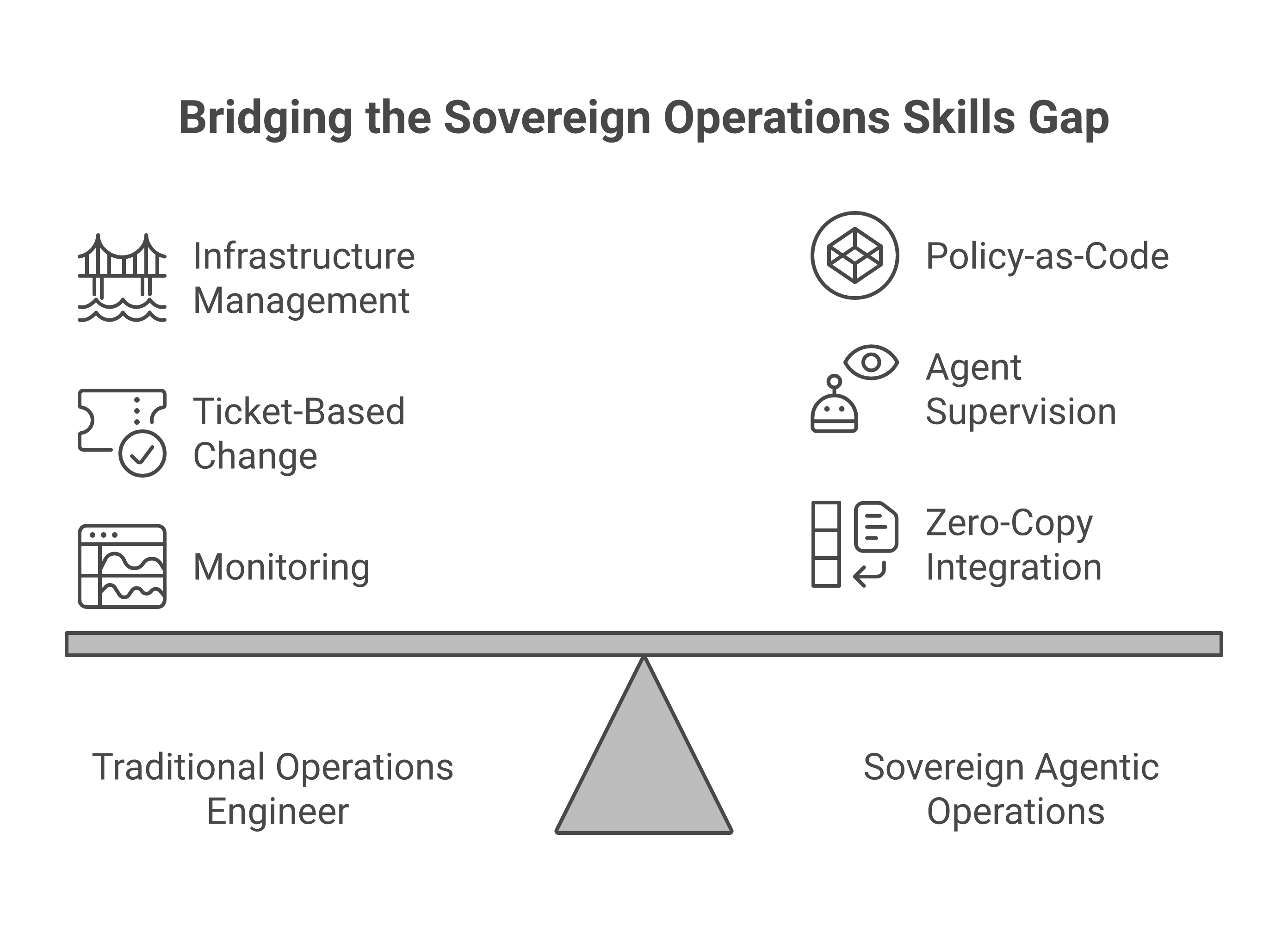
There is a moment, usually about six months into a sovereign cloud transformation programme, when the technology components are becoming clear—the zones are drawn, the observability plane is taking shape, the first agents are under test—and someone asks the question that should have been asked at the beginning: “Who is going to run all this?” The answer, in most organisations, is unsettling. The existing operations workforce was hired and trained for a different world: a world of manually provisioned infrastructure, ticket-driven change management, siloed monitoring tools, and compliance obligations met through periodic audit exercises rather than continuous, codified enforcement. The new world demands skills that most of those teams do not yet possess, in combinations that most training programmes do not yet offer.
The skills gap in sovereign operations is not a single deficit but a cluster of overlapping shortfalls. The most immediate is policy-as-code fluency. Sovereign operations depend on policies expressed in machine-readable form—Open Policy Agent Rego policies, HashiCorp Sentinel rules, Ansible compliance playbooks—that are evaluated continuously rather than reviewed periodically. Writing, testing and maintaining these policies requires a combination of regulatory understanding and software engineering skill that is rare. Most compliance professionals cannot write Rego. Most software engineers cannot interpret a regulatory obligation with enough precision to codify it. The intersection is thin, and the labour market for people who sit in it is fiercely competitive [1].
The second shortfall is in agent supervision. As Chapters 18 and 19 described, agentic operations introduce AI-driven actors that observe, plan and—within bounded authority—execute operational tasks. Supervising these agents is not the same skill as supervising junior engineers. It requires understanding what the agent can perceive, what it cannot, where its reasoning is likely to be reliable and where it is likely to hallucinate or over-generalise. It also requires the ability to read and interpret agent reasoning traces, audit logs and confidence indicators. This is a new discipline, closer to the work of an air-traffic controller than to traditional system administration: the operator is not performing the task but overseeing an actor that performs it, intervening only when the actor’s behaviour departs from acceptable bounds.
Third, there is a deficit in sovereignty engineering itself. Designing and operating sovereign zones—defining data residency boundaries, implementing zero-copy integration patterns, configuring cross-zone connectivity with appropriate controls, and ensuring that observability pipelines do not inadvertently leak data across jurisdictions—requires a form of infrastructure engineering that did not exist five years ago. It draws on networking, security, data architecture and regulatory knowledge simultaneously, and it must be applied not once, during design, but continuously, as the estate evolves. The practitioners who can do this well are rare enough that some organisations have resorted to building the capability in-house from first principles, which is expensive and slow.
Fourth, and cutting across all the others, is AI governance. Sovereign operations increasingly rely on AI models for anomaly detection, remediation recommendation, knowledge retrieval and conversational interaction. Governing these models—understanding their training data provenance, their performance characteristics across different operational domains, their failure modes, and their compliance with regulatory expectations around explainability and bias—is a discipline that most operations teams have never encountered. The European Union’s AI Act, which entered into force in 2024 and whose operational requirements are progressively taking effect, makes AI governance an explicit regulatory obligation for organisations deploying AI in high-risk contexts, including critical infrastructure operations [2]. The skills to meet this obligation are in short supply.
The labour market reality compounds all of these shortfalls. Cloud-native engineering skills were already scarce before sovereignty and agentic operations added new requirements. The 2024 State of DevOps Report found that organisations identifying skills gaps as a primary constraint on their transformation efforts had increased year-on-year for the fourth consecutive year [3]. Sovereign operations skills are a strict superset of cloud-native skills—they require everything cloud-native engineering requires, plus regulatory fluency, plus sovereignty-specific design patterns, plus agent supervision capability—which means the talent pool is smaller still. Hiring alone will not close this gap. Organisations that depend entirely on external recruitment for sovereign operations skills will find themselves competing for a pool of candidates that is, at present, too small to serve the demand. The alternative—and, for most organisations, the necessity—is to grow these skills internally, which brings us to the question of what the target profile looks like and how to develop it.
32.2 Building T-shaped sovereign engineers
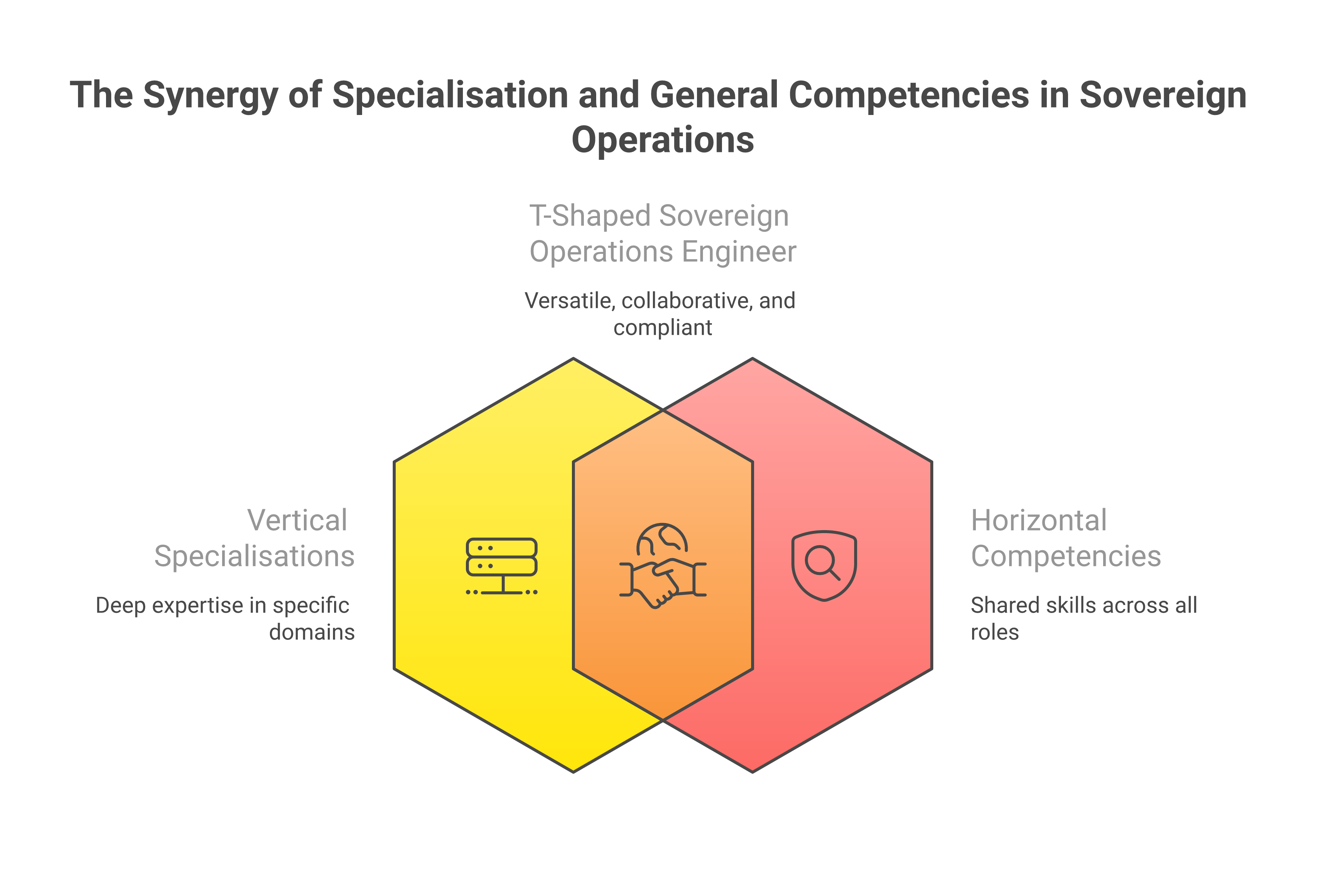
The concept of the T-shaped professional—deep expertise in one domain combined with broad working knowledge across adjacent domains—has been a recurring theme in technology workforce discussions since at least the early 2000s. Tim Brown, then CEO of IDEO, popularised the term in the context of design thinking, arguing that the most effective contributors are those who can go deep in their specialisation while also collaborating meaningfully with specialists in other fields [4]. The concept translates directly to sovereign operations, where the breadth of required knowledge is too great for any individual to master entirely, but where narrow specialism without contextual awareness produces dangerous blind spots.
The sovereign operations engineer is, in this framing, a T-shaped role. The vertical stroke of the T—the deep expertise—might be in infrastructure engineering, in security and compliance, in data architecture, in AI and machine learning operations, or in network engineering. Different individuals will bring different depths. What distinguishes the sovereign operations engineer from a traditional specialist is the horizontal stroke: a working understanding of how all of these domains interact in a sovereign, agentic context.
An infrastructure engineer working in sovereign operations needs more than the ability to provision and manage cloud resources. They need to understand why a particular workload must remain in a specific jurisdiction, what the compliance implications of a cross-zone network route are, how the observability pipeline handles telemetry from their infrastructure, and how an agentic workflow might interact with the resources they manage. They do not need to be a compliance expert, but they need enough regulatory literacy to recognise when a proposed infrastructure change might have compliance implications and to engage meaningfully with compliance colleagues about the specifics.
Similarly, a security engineer in this context needs to understand not only identity management, encryption and access control, but also how zero-copy integration patterns affect data protection posture, how agent authority boundaries are enforced, and how sovereignty zones map to security domains. A data engineer needs to understand why data residency is not merely a storage location question but also a processing and transit question, and how the zero-copy patterns described in Chapter 6 change the architecture of data pipelines.
The horizontal knowledge that all sovereign operations engineers share, regardless of their vertical specialisation, includes several elements. Sovereignty concepts: what sovereign zones are, how they are defined and enforced, what operational sovereignty means in practice, and how regulatory frameworks such as GDPR, DORA and the AI Act create obligations that shape operational decisions [2]. Agentic operations literacy: what agents are, how they are bounded, how they interact with human operators, how their authority is governed, and how to read and interpret their outputs—even if the engineer is not personally responsible for building or training the agents. Observability plane awareness: how telemetry flows through the estate, where sovereignty boundaries affect that flow, and how to use observability tools to diagnose issues that span zones and providers. Infrastructure-as-code proficiency: the ability to work with codified infrastructure definitions, review proposed changes, and understand the pipeline from code commit to deployed state—because in a sovereign estate, manual infrastructure changes are not merely discouraged but are treated as policy violations.
The practical challenge is that T-shaped development does not happen by accident. It requires deliberate investment in cross-training, rotation programmes, and collaborative working structures. Team Topologies, the influential model proposed by Skelton and Pais, provides a useful framework here. Their taxonomy of team types—stream-aligned teams, enabling teams, complicated-subsystem teams and platform teams—offers a structure within which T-shaped development can occur naturally [5]. An enabling team focused on sovereignty, for example, might work alongside stream-aligned delivery teams to help them understand and apply sovereignty patterns, simultaneously deepening their own understanding of application-level concerns while broadening the delivery team’s sovereignty awareness. A platform team providing shared infrastructure services develops deep expertise in infrastructure and platform engineering while needing broad awareness of the sovereignty, compliance and observability requirements that their platform must satisfy.
The Team Topologies model also highlights the importance of interaction modes. The three modes—collaboration, X-as-a-service, and facilitating—describe how teams work together, and each mode develops different aspects of the T-shape. Collaboration mode, where two teams work closely together on a shared problem for a defined period, is the most effective for cross-domain knowledge transfer. It is also the most expensive in coordination cost, which is why Skelton and Pais recommend it as a time-limited mode, not a permanent arrangement. X-as-a-service mode, where one team consumes another team’s capability through a well-defined interface, is efficient but transfers little knowledge. Facilitating mode, where an enabling team helps another team learn a new capability, is explicitly designed for knowledge transfer and is the natural mode for building the horizontal stroke of the T [5].
Organisations building sovereign operations capability should expect to invest in all three modes deliberately, matching the mode to the knowledge transfer need. New sovereignty patterns might be introduced through facilitation; a complex cross-zone incident might be resolved through time-limited collaboration between infrastructure, security and compliance teams; and mature, well-understood platform capabilities might be consumed as a service by teams that need the capability but not the underlying expertise.
32.3 Training and certification pathways
Knowing the target profile is necessary but not sufficient. The question that training managers, team leads and individuals themselves face is practical: how does a competent traditional operations engineer become a competent sovereign operations engineer, and what does the pathway look like?
The honest answer is that no single training programme covers the full scope. The field is too new, too cross-disciplinary, and too fast-moving for any vendor, academic institution or professional body to have assembled a complete curriculum. What exists is a patchwork of partial pathways that, combined with deliberate on-the-job learning, can develop the required capability over a period of twelve to twenty-four months for an engineer with a solid foundation in at least one of the vertical specialisations described above.
Vendor certification programmes provide the most structured entry points for specific technology competencies. IBM’s certification paths for watsonx, Cloud Pak for Watson AIOps (now Instana and related products), and Red Hat OpenShift cover the platform layer on which many sovereign operations capabilities are built. Red Hat’s certification hierarchy—from Red Hat Certified System Administrator through Red Hat Certified Engineer to Red Hat Certified Architect—provides a well-tested progression model for infrastructure skills, and Red Hat’s Ansible automation certifications address the automation layer directly [6]. HashiCorp’s certifications for Terraform and Vault cover infrastructure-as-code and secrets management, both of which are foundational for sovereign operations as described in Chapters 11 and 13 respectively. These certifications are valuable but inherently scoped to their vendor’s technology; they develop the vertical stroke of the T within a specific toolchain, not the horizontal breadth.
Cloud provider certifications from IBM Cloud, AWS, Azure and Google Cloud cover cloud architecture and operations within their respective platforms. For sovereign operations engineers, the relevant certifications are those that address networking, security, identity and compliance features—the capabilities that underpin sovereign zone implementation. The limitation is that each provider’s certification addresses only that provider’s environment, and sovereign operations by definition span providers and on-premises infrastructure. An engineer with deep certification in one cloud provider still needs working knowledge of the others.
Security and compliance certifications such as CISSP, CISM and the newer cloud-security-specific credentials (CCSP, for example) provide the security dimension that sovereign operations demands. For engineers coming from a pure infrastructure background, these certifications build the security literacy that is otherwise a significant gap. For the regulatory dimension specifically, there are fewer formal certifications, but organisations such as ISACA offer training in IT governance and risk management (through the CRISC and CGEIT credentials) that develops the regulatory awareness component.
What is largely missing from the certification landscape is training that integrates these domains—that teaches engineers how sovereignty, security, infrastructure and AI governance interact in practice. This is where internal training programmes become essential. Organisations building sovereign operations capability should invest in developing internal curricula that address the specific patterns, tools and policies of their own environment. A training module that walks engineers through the organisation’s own sovereign zone architecture, shows them how policies are codified and enforced in their specific toolchain, demonstrates how agents operate in their environment, and lets them practice incident response in a simulated sovereign estate is worth more than any number of generic certifications.
Simulation environments and hands-on labs are particularly important for developing agent supervision skills and sovereignty engineering judgement. Reading about agent behaviour is not the same as observing an agent make a borderline decision in a realistic scenario and having to decide whether to intervene. Reading about cross-zone data flow constraints is not the same as diagnosing a connectivity issue that turns out to be caused by a sovereignty policy blocking an unexpected data path. These skills develop through practice, and practice requires environments that are realistic enough to generate the right kinds of challenges without the consequences of getting it wrong in production.
Several approaches to simulation have proven effective. Chaos engineering exercises, adapted for sovereign operations, deliberately inject failures that test both technical resilience and sovereignty compliance—a simulated data leak across zone boundaries, for example, or an agent that exceeds its authority during an incident response. Game days, in the tradition described by the Google SRE books, bring cross-functional teams together to work through realistic incident scenarios in a time-pressured environment, building both technical skill and the collaborative reflexes that sovereign operations require [7]. Tabletop exercises focused on sovereignty incidents—a regulator demanding evidence of data residency compliance during an active incident, for example, or a vendor access breach that requires real-time assessment of sovereignty impact—develop the judgement and communication skills that no purely technical training can address.
Academic partnerships offer a longer-term pathway. Several universities have begun offering modules in cloud-native operations, AI governance and digital sovereignty, though comprehensive programmes remain rare. Organisations that engage with academic institutions—through guest lectures, sponsored research projects, or co-designed curricula—can influence the pipeline of future talent while also creating learning opportunities for their existing staff. The partnership model is particularly valuable for AI governance, where the academic research community is significantly ahead of industry practice in understanding bias, explainability and the sociotechnical dimensions of AI deployment.
The overarching principle is that training for sovereign operations must be continuous, not episodic. The field is evolving rapidly—regulatory frameworks are being refined, new agent capabilities are emerging, and the patterns described in this book are themselves being tested and iterated in production environments worldwide. An engineer who completes a training programme and then does not engage in further learning for two years will find their knowledge materially out of date. Organisations should build learning into the rhythm of operations: post-incident reviews that identify knowledge gaps and feed them into training priorities; quarterly skills assessments that track individual and team development against the target profile; and protected time for engineers to experiment, read and learn. The Accelerate State of DevOps research found a strong positive correlation between organisations that invest in continuous learning and those that achieve elite operational performance, reinforcing that training is not a cost centre but a performance driver [3].
32.4 Cultural transformation: from gatekeeping to enabling
Technology and skills are necessary but not sufficient conditions for successful sovereign operations. The third dimension—and, in many organisations, the most difficult one to address—is culture. The patterns described throughout this book assume a cultural context in which teams collaborate across traditional boundaries, in which automation is trusted rather than feared, in which failure is treated as a learning opportunity rather than a basis for blame, and in which sovereignty obligations are embedded in everyday practice rather than delegated to a separate compliance function. In many organisations, the prevailing culture is some distance from this ideal.
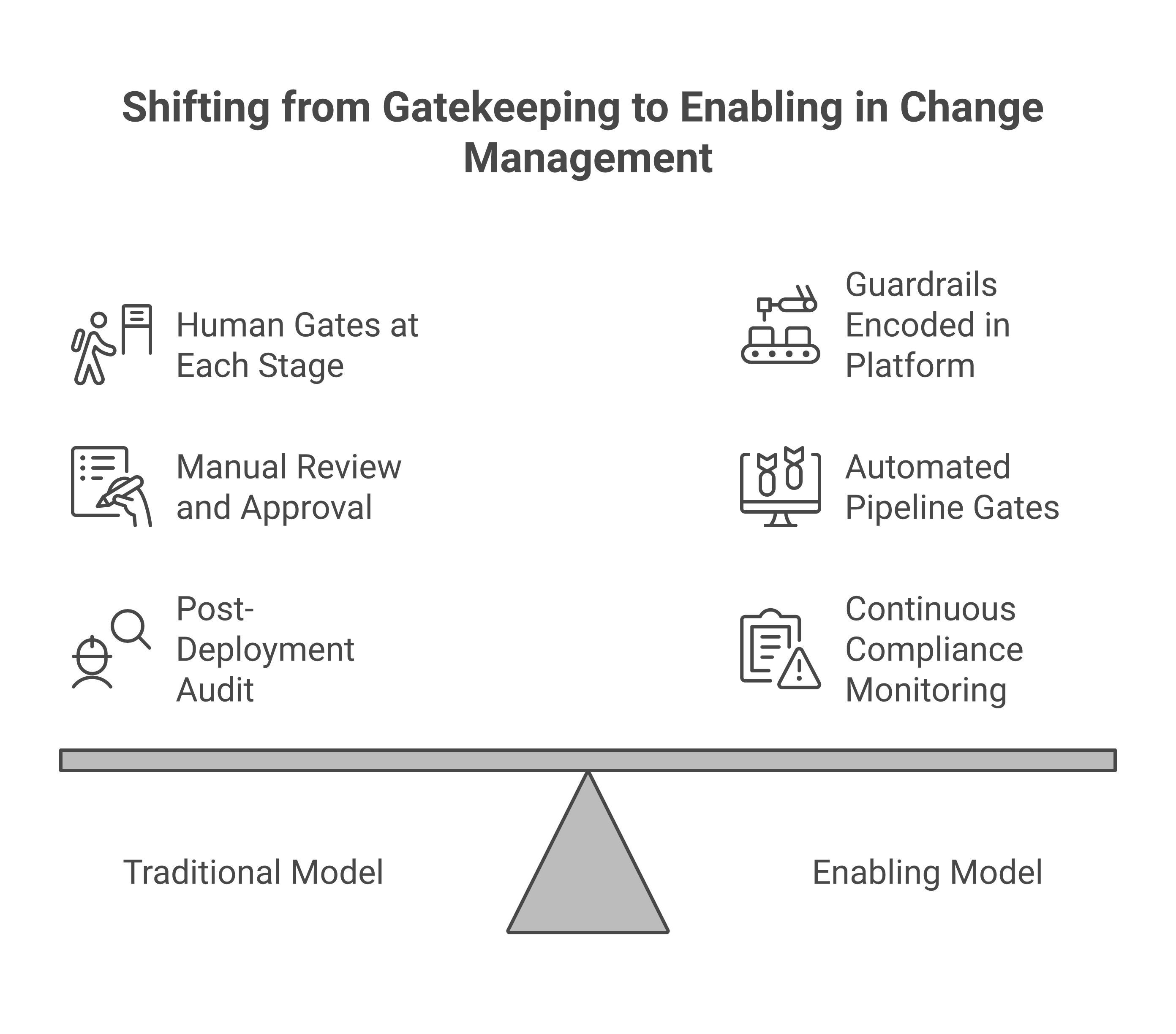
The cultural transformation required for sovereign operations is, at its core, a shift from gatekeeping to enabling. In the traditional operating model, control is exercised through human gates: a Change Advisory Board that reviews and approves or rejects every change; a security team that must sign off on every architecture decision; a compliance function that conducts periodic audits and issues findings. These gates served a legitimate purpose in an era when changes were infrequent, large and difficult to reverse. They are, however, fundamentally incompatible with an operating model that expects continuous delivery, codified policies, and automated enforcement. A Change Advisory Board that meets weekly cannot govern an estate in which hundreds of changes are deployed daily through automated pipelines. A security review process that takes three weeks cannot keep pace with infrastructure that is provisioned, modified and deprovisioned in minutes.
The alternative is not to abandon control but to encode it in the platform. This is the essence of the shift-left operations model described in Chapter 31: controls that were previously exercised by human reviewers at deployment time are moved earlier in the lifecycle—into policy-as-code that is evaluated at commit time, into pipeline gates that enforce compliance automatically, into guardrails that prevent non-compliant configurations from being expressible in the first place. The human role shifts from approving individual changes to designing, maintaining and improving the guardrails within which changes flow safely. This is not less control; it is more control, applied more consistently and at greater scale. But it requires a fundamentally different relationship between the people who define controls and the people who make changes.
Ron Westrum’s typology of organisational cultures, widely cited in the DevOps and safety literature, provides a useful lens for understanding this shift [8]. Westrum identified three cultural types: pathological (power-oriented, characterised by low cooperation, messengers being shot, and failure being covered up), bureaucratic (rule-oriented, characterised by modest cooperation, messengers being tolerated, and failure leading to justice-seeking), and generative (performance-oriented, characterised by high cooperation, messengers being trained, and failure leading to inquiry). The Accelerate research by Forsgren, Humble and Kim demonstrated empirically that generative culture, as measured by Westrum’s typology, is a statistically significant predictor of both software delivery performance and organisational performance [1]. Sovereign operations demands generative culture because the alternative—bureaucratic gatekeeping—cannot scale to the speed, complexity and cross-domain nature of the work.
The practical implications of this cultural shift are felt in several areas. Incident response is perhaps the most visible. In a pathological or bureaucratic culture, incidents are followed by blame: who made the mistake, who approved the change, who was on call and failed to catch the problem. In a generative culture, incidents are followed by blameless post-incident reviews that focus on systemic causes rather than individual fault. The difference is not merely philosophical; it directly affects the quality of information available for learning. Engineers who fear blame will conceal errors, under-report near-misses, and avoid documenting the exploratory steps they took during incident response—precisely the information that is most valuable for improving the system. Sidney Dekker’s work on just culture in safety-critical industries makes this point forcefully: systems that punish individuals for errors create incentives that make the system less safe, because the information needed to identify and address systemic vulnerabilities is suppressed [9].
Cross-functional collaboration is the second area. Sovereign operations inherently requires collaboration between teams that, in many organisations, have historically operated in silos: infrastructure, security, compliance, data engineering, application development and AI/ML teams. The Team Topologies model described in Section 32.2 provides structural mechanisms for this collaboration, but structure alone is insufficient. The teams must also share a common understanding of what they are trying to achieve, a common language for discussing trade-offs, and a willingness to engage with each other’s constraints rather than simply defending their own territory. In a sovereign context, this means that infrastructure engineers must care about compliance, compliance professionals must understand infrastructure, and both must be able to discuss sovereignty trade-offs with data architects and AI engineers in terms that all parties find meaningful.
Attitude to automation and AI is the third area. In organisations where automation is viewed as a threat to jobs, the introduction of agentic operations will be resisted—subtly, through finding reasons why the agent’s recommendations are wrong, or overtly, through refusing to grant agents the access they need to function. In organisations where automation is viewed as a tool that handles toil so that humans can focus on more valuable work, the introduction of agents is more likely to be welcomed and supported. Building the latter attitude requires honest communication about the purpose of automation, genuine investment in developing new skills for people whose roles are changing, and visible demonstration that automation is creating better outcomes rather than simply reducing headcount.
The cultural transformation does not happen through a memo or a presentation. It happens through sustained, consistent action by leaders at every level—from the CTO who publicly celebrates a blameless post-incident review, to the team lead who pairs a junior engineer with a compliance specialist to work through a sovereignty problem together, to the platform engineer who designs a self-service interface that makes the secure path the easy path. Culture is, as the saying goes, what people do when nobody is watching. Changing it requires changing the incentive structures, the working practices, the feedback mechanisms and the leadership behaviours that together constitute the organisational environment.
32.5 Trust calibration: working alongside AI agents
The introduction of AI agents into operational workflows creates a specific human-factors challenge that deserves dedicated attention: the problem of trust calibration. Humans working alongside AI systems must develop an accurate model of when the system is likely to be correct and when it is likely to be wrong. Getting this calibration right is essential for effective human-agent collaboration; getting it wrong—in either direction—creates operational risk.
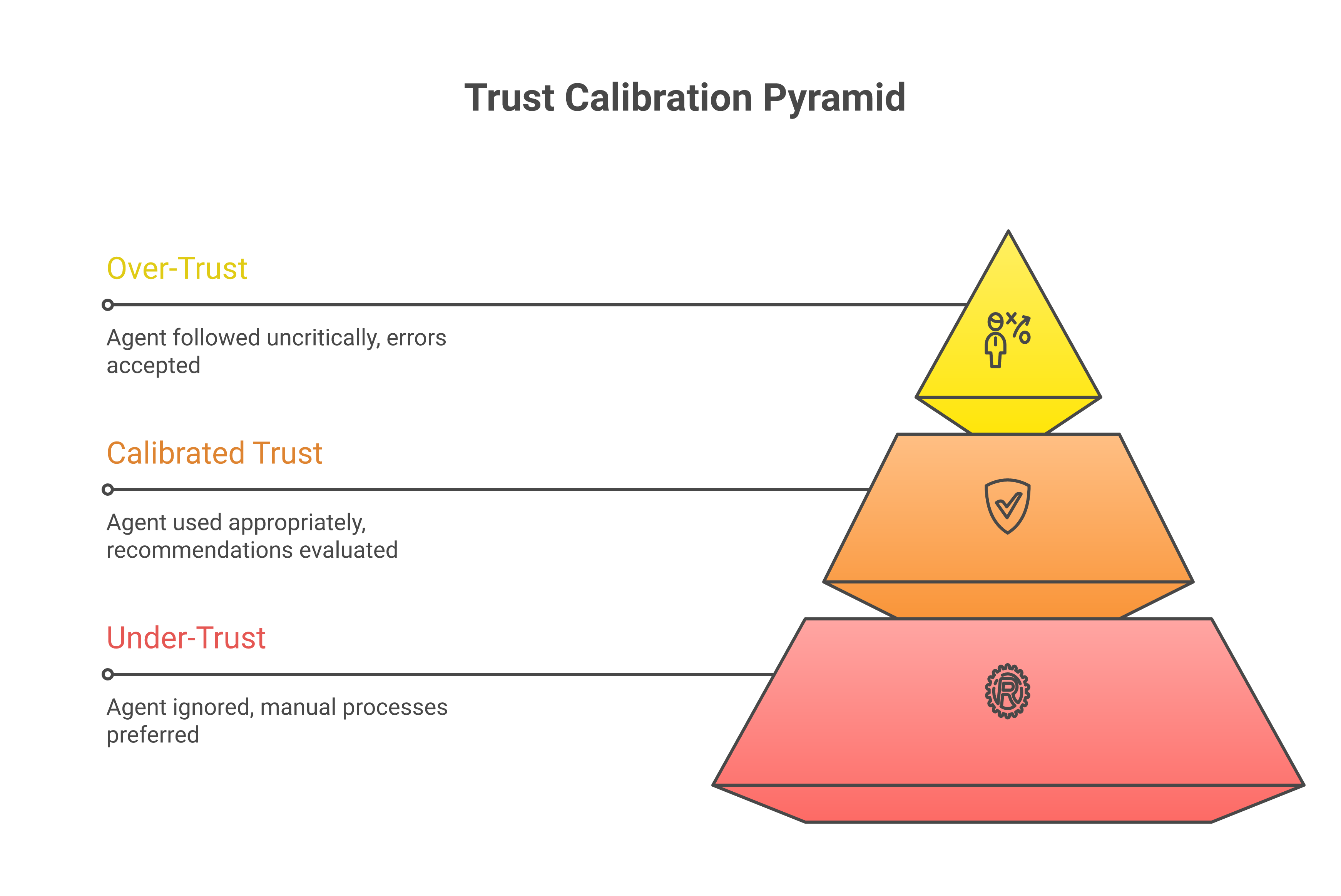
Over-trust occurs when operators assume that the agent’s recommendations are correct without adequate scrutiny. The risk is that errors in the agent’s reasoning—hallucinated facts, misapplied patterns, failures to account for context that was not in the agent’s training data or retrieval scope—are accepted and acted upon. In the context of sovereign operations, over-trust is particularly dangerous because the consequences of an incorrect action may include sovereignty violations, regulatory non-compliance or data breaches that are difficult or impossible to reverse. The automation bias literature in human factors research has documented this tendency extensively: humans presented with an automated recommendation tend to accept it even when contradictory evidence is available, particularly under time pressure [10].
Under-trust is the opposite failure. Operators who do not trust the agent’s recommendations will ignore them, override them reflexively, or avoid using the agent at all. This negates the value of the agent investment and, paradoxically, may increase operational risk by reverting to purely manual processes that are slower, less consistent and more prone to human error. Under-trust is common in the early stages of agent deployment, particularly among experienced operators who have developed strong intuitions through years of manual practice and are sceptical of a system that claims to replicate or augment their judgement.
Neither over-trust nor under-trust is the right posture. What is needed is calibrated trust: a nuanced, context-dependent assessment of when the agent is likely to be reliable and when additional scrutiny is warranted. Calibrated trust is not blind faith in the technology; it is an informed judgement, continuously updated, about the agent’s capabilities and limitations in specific contexts.
Several mechanisms support the development of calibrated trust. Transparency of reasoning is the most fundamental. An agent that presents a recommendation without explanation invites either blind acceptance or blind rejection. An agent that shows its reasoning—the observations it considered, the patterns it matched, the knowledge base documents it retrieved, the policy checks it performed—enables the operator to evaluate the recommendation on its merits. This is why the agent architectures described in Chapter 18 emphasise reasoning traces and why the knowledge-augmented operations model in Chapter 20 emphasises source attribution: these are not debugging conveniences but trust calibration mechanisms.
Confidence indicators complement reasoning traces by giving operators a quantitative signal about the agent’s own assessment of its reliability. An agent that reports high confidence in a recommendation it has made many times before, for a well-understood failure mode with strong knowledge base support, sends a different signal from one that reports low confidence because the current situation is unlike anything in its training or retrieval history. Confidence indicators must themselves be calibrated—an agent that always reports high confidence regardless of the situation is useless as a trust signal—but when they are well-calibrated, they provide a valuable input to the operator’s judgement.
Track records build trust over time. An operator who has seen the agent make correct recommendations in fifty consecutive incidents develops a justified confidence in the agent’s reliability for the kinds of incidents they have observed. Organisations should make these track records visible: dashboards that show agent recommendation accuracy over time, broken down by incident type, severity and sovereign zone, provide an empirical basis for trust calibration that goes beyond individual anecdote. The track record should include failures as well as successes—not to undermine trust but to help operators develop an accurate model of where the agent is and is not reliable.
Feedback mechanisms close the loop. When an operator overrides an agent’s recommendation, the system should capture the reason for the override and feed it back into the agent’s improvement process. When an agent’s recommendation is followed and the outcome is positive, that too should be recorded. Over time, these feedback loops improve both the agent’s performance and the operator’s calibration. They also create a body of evidence—retrievable through the knowledge base described in Chapter 20—that new operators can consult when developing their own trust calibration as they join the team.
There is also a team dimension to trust calibration. In well-functioning teams, trust in the agent is not purely individual; it is a shared, discussed, socially constructed judgement. Teams that regularly discuss agent performance—during post-incident reviews, during shift handovers, during team retrospectives—develop a collective calibration that is more robust than any individual’s assessment. A team member who notices that the agent consistently struggles with a particular class of incident can share that observation, and the whole team benefits. This social dimension of trust calibration is one of the reasons why the cultural factors described in Section 32.4 matter: in a generative culture, these discussions happen naturally and constructively; in a pathological or bureaucratic culture, they are suppressed or formalised into ineffective processes.
32.6 Cognitive load and operator wellbeing
There is a persistent and seductive assumption in technology-driven transformation programmes: that adding more capable tools reduces the burden on the people who use them. The assumption is sometimes true but frequently false. More capable tools can expand the scope of what an operator is expected to manage, increase the volume and variety of information they must process, and introduce new categories of decision that were not previously part of their role. The result can be a net increase in cognitive load even as the tools become individually more powerful.
Cognitive load theory, originally developed by John Sweller in the context of instructional design, distinguishes three types of load: intrinsic load, which arises from the inherent complexity of the task; extraneous load, which arises from how information is presented and how the work environment is structured; and germane load, which arises from the mental effort required to integrate new information into existing mental models [11]. Well-designed systems reduce extraneous load—the unnecessary complexity created by poor interfaces, fragmented information and redundant steps—while managing intrinsic load and supporting germane load. Poorly designed systems increase extraneous load by adding tools, dashboards and alert channels without integrating them, forcing the operator to perform the integration in their own working memory.
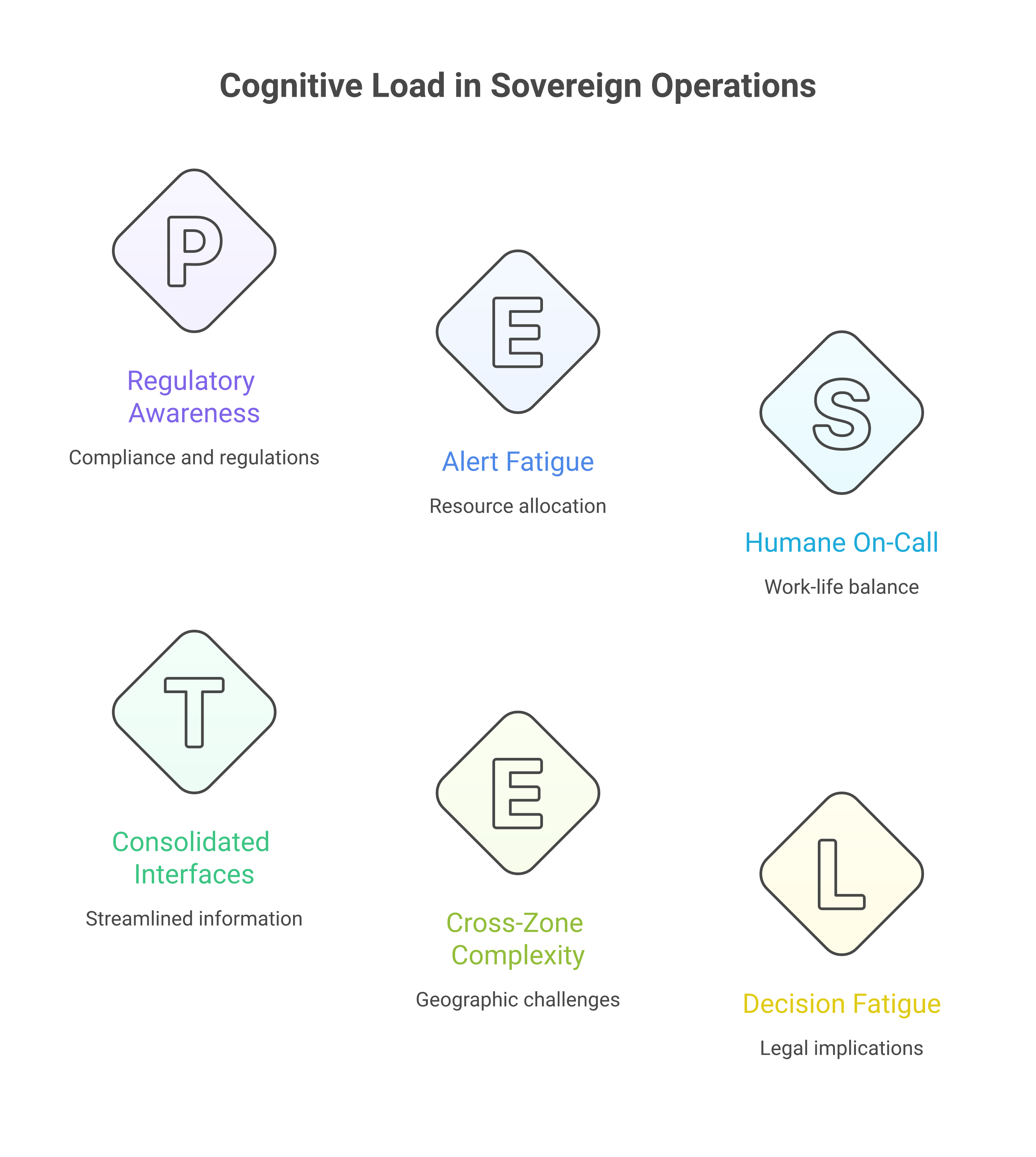
In sovereign operations, the cognitive load challenge manifests in several specific ways.
Alert fatigue is the most widely recognised. Modern observability systems generate vast volumes of alerts, many of which are redundant, transient or low-severity. An operator who receives hundreds of alerts per shift cannot evaluate each one individually; they develop coping strategies—filtering by severity, ignoring certain alert categories, or simply muting channels—that reduce the volume but also reduce the probability of catching the alert that matters. The research on alarm fatigue in healthcare, where the same phenomenon has been studied extensively in the context of clinical monitoring systems, is directly relevant: Sendelbach and Funk found that between eighty and ninety-nine percent of clinical alarms were false or non-actionable, and that the resulting fatigue was a contributing factor in patient safety incidents [12]. The parallel to operations is exact. The sovereign dimension adds another layer: sovereignty-related alerts—a potential data residency violation, an agent authority boundary event, a cross-zone connectivity anomaly—are precisely the alerts that matter most and are most likely to be lost in a flood of routine infrastructure noise.
Decision fatigue compounds alert fatigue. Every alert that requires a decision—investigate or ignore, escalate or resolve, override the agent or accept the recommendation—consumes a finite cognitive resource. The practical experience of operations teams is consistent: decisions made at the end of a long shift are qualitatively different from decisions made at the beginning. They are faster, less considered and more likely to rely on defaults and heuristics rather than deliberate analysis. In a sovereign context, where a single poorly considered decision can have regulatory consequences, this degradation is operationally significant.
The paradox of increased capability is less obvious but equally real. Sovereign, agentic operations make it possible for a single operator to oversee a larger, more complex estate than was previously feasible. An agent handles routine diagnostics; automated pipelines deploy changes without manual intervention; the knowledge base provides answers that would previously have required consulting three colleagues. The temptation is to use these capabilities to reduce the operations team rather than to reduce the per-person burden. The result is that each remaining operator is responsible for a larger scope, with more potential failure modes, more regulatory obligations and more agent interactions to supervise. The cognitive load has not decreased; it has been redistributed and, in some cases, increased.
Designing for manageable cognitive load requires deliberate effort at several levels. At the tooling level, this means consolidating interfaces rather than multiplying them, ensuring that the information an operator needs for a specific context is presented together rather than scattered across dashboards, and designing alert systems that suppress noise and surface signal. The observability architecture described in Chapter 7, with its emphasis on contextual, topology-aware alerting, is a cognitive load management strategy as much as a technical architecture decision. IBM Concert’s unified topology views, described in Chapter 14, serve the same purpose: they reduce the extraneous load of assembling a picture of the estate from fragments in different tools.
At the process level, managing cognitive load means designing on-call rotas that are humane, with adequate rest between shifts, clear escalation paths so that no individual feels solely responsible for the entire estate, and protected time for recovery after major incidents. It means structuring agent supervision so that the agent handles routine decisions autonomously and surfaces only the decisions that genuinely require human judgement—rather than presenting every recommendation for approval, which defeats the purpose of the agent while still consuming the operator’s attention.
At the organisational level, it means resisting the temptation to reduce team sizes simply because automation has increased per-person capacity. The appropriate response to increased automation capability is not fewer people doing the same work but the same number of people doing better work: spending more time on proactive improvement, on learning, on refining policies and guardrails, and on the kind of deep diagnosis that prevents incidents rather than merely responding to them. This is the “eliminate toil” philosophy described in the Google SRE literature, applied at the organisational rather than the individual level [7].
Operator wellbeing is not a soft concern separate from operational performance; it is a direct determinant of it. Fatigued, overloaded operators make worse decisions, miss more signals, and are more likely to accept agent recommendations uncritically—precisely the over-trust failure described in Section 32.5. Investing in cognitive load management is investing in operational quality.
32.7 Knowledge management and institutional memory
Sovereign operations depend on accumulated knowledge to a degree that is easy to underestimate. The policies that govern sovereign zones were developed through months of regulatory analysis and architectural deliberation. The runbooks that handle cross-zone incidents encode hard-won experience from previous failures. The trust calibration that operators have developed with AI agents reflects hundreds of observed interactions. The design decisions that shaped the observability pipeline were informed by specific constraints that may no longer be obvious from the architecture alone. All of this knowledge is at risk—at risk of being lost when people leave, at risk of becoming stale as systems evolve, and at risk of being inaccessible at the moment it is most needed.
Chapter 20 described the technical architecture for knowledge-augmented operations: the RAG-enabled knowledge base that makes operational knowledge retrievable by both humans and agents. This section addresses the human and organisational practices that determine whether that knowledge base contains anything worth retrieving.
The first practice is systematic knowledge capture. Every significant operational event—incident, change, design decision, regulatory interaction—should produce a knowledge artefact that is indexed and retrievable. For incidents, this means blameless post-incident reviews written with enough depth to be useful to a future reader who was not present. For changes, it means architecture decision records that capture not just the decision but the context, the alternatives considered, and the reasoning for the choice made. For regulatory interactions, it means documenting the specific regulatory guidance received, the interpretation applied, and the operational changes that resulted. None of this is new advice; organisations have been told to document their decisions for decades. What is different in a sovereign, agentic context is that the knowledge is consumed not only by humans but by agents, which means it must be structured, current and machine-retrievable—not buried in email threads or filed in document management systems that no one searches.
The second practice is knowledge currency. A knowledge base full of outdated information is worse than no knowledge base at all, because it actively misleads. Chapter 20 described technical mechanisms for detecting staleness—the retrieval-then-override pattern, the age-in-the-presence-of-change signal—but these mechanisms only flag potential staleness. Someone must then review and update the flagged content. This requires assigning knowledge ownership: for every category of operational knowledge, a named team or individual is responsible for keeping it current. Runbook ownership was discussed in Chapter 12; the same principle applies to architecture decision records, to sovereignty policy documentation, to agent authority boundary specifications, and to every other category of content in the operational knowledge base.
The third practice is knowledge transfer. In every organisation, there are individuals whose departure would create a significant knowledge gap—people who understand why a particular sovereign zone is configured the way it is, or who know the history of a particular vendor relationship, or who carry the context for a regulatory commitment that was made three years ago. Identifying these individuals and systematically transferring their knowledge into the organisational knowledge base is a risk management activity, not an administrative one. The transfer mechanisms include pair working (where the knowledgeable individual works alongside a colleague who is learning the domain), structured knowledge interviews (where a facilitator guides the individual through a systematic extraction of their operational knowledge), and shadow shifts (where a less experienced operator observes and learns from a more experienced one during live operations). None of these mechanisms is perfectly efficient, but all are better than the alternative: discovering the knowledge gap after the person has left.
Communities of practice provide an ongoing mechanism for knowledge sharing that complements formal documentation. A community of practice for sovereign operations—bringing together engineers, security specialists, compliance professionals and data architects who work across different sovereign zones and different parts of the organisation—creates a forum for sharing patterns, discussing challenges and developing shared understanding. The concept, introduced by Wenger in the late 1990s, has been applied effectively in technology organisations as a mechanism for knowledge sharing across team boundaries [13]. In a sovereign operations context, communities of practice serve an additional purpose: they build the cross-functional relationships that are needed during incidents, when rapid collaboration between people who understand each other’s domains and constraints is essential.
The knowledge management challenge is compounded in sovereign operations by regulatory knowledge, which has several distinctive characteristics. It is externally sourced, which means the organisation does not control its production schedule or format. It is subject to interpretation, which means that two competent professionals may derive different operational implications from the same regulatory text. It changes over time, sometimes significantly, as regulations are revised or as supervisory guidance evolves. And it has direct operational consequences: a misinterpretation of a data residency requirement can result in a sovereignty violation with regulatory sanctions. Managing regulatory knowledge requires specific practices: tracking regulatory publications systematically, maintaining interpretation records that document how the organisation has chosen to apply ambiguous requirements, and ensuring that regulatory updates trigger reviews of the operational policies and procedures they affect.
Institutional memory, in the end, is not a technology problem. It is a discipline: the discipline of writing things down, keeping them current, making them findable, and creating the organisational habits that sustain these practices over time. The technology described in Chapter 20—the vector stores, the embedding models, the retrieval pipelines—makes accumulated knowledge more accessible than ever before. But the technology is only as good as the knowledge it contains, and the knowledge is only as good as the organisational practices that produce and maintain it.
32.8 Crossing the re-skilling wall: a bridge model for hyperscaler-native teams
There is a specific objection that arises with striking regularity when sovereign agentic operations are introduced to teams whose background is in one of the major hyperscaler platforms. The objection runs roughly as follows: “I spent three years earning my AWS Solutions Architect Professional certification, I think in CloudFormation and CDK, my muscle memory is tuned to the AWS console, and now you want me to learn watsonx Orchestrate, Terraform for IBM Cloud, Ansible-driven remediation, Concert dashboards, OPA policies and an entirely new mental model for agentic workflows—all at once. This is not a skills gap. This is a wall.”
The objection is reasonable. It deserves a serious answer, not a dismissive one, because it reflects a genuine cognitive and career concern that, if left unaddressed, will generate passive resistance, attrition and ultimately programme failure. The engineers raising this concern are not being difficult. They are performing a rational cost-benefit analysis: the cost of abandoning hard-won expertise is high, the benefit of the new toolset is unproven in their direct experience, and the risk that they are being asked to trade portable, market-valued skills for vendor-specific knowledge that may narrow their career options is not imaginary. Any adoption strategy that ignores this calculus will fail.
The bridge model
The architecture described in this book is not designed to replace hyperscaler-native expertise. It is designed to sit above it. The distinction matters. An SRE whose deep knowledge is in AWS networking, or Azure identity, or GCP data services retains that knowledge and continues to use it for platform-specific work. The AWS console, the Azure portal, the GCP Cloud Shell—these remain the primary deep-dive interfaces for the platform-specific engineering that constitutes the majority of day-to-day operational work. Nothing in the sovereign agentic architecture demands that these tools be abandoned.
What the agentic layer adds is a higher-level interface for cross-cloud and cross-zone operations: the tasks that today require an engineer to log into three different consoles, correlate information manually across incompatible dashboards, and coordinate changes across platforms through tickets and chat messages. For these tasks—and only these tasks—the conversational interface provided by watsonx Orchestrate and the unified topology views in Concert offer a genuine reduction in effort. The engineer is not learning a replacement for their platform expertise; they are learning a coordination layer that sits above it.
This framing changes the adoption conversation fundamentally. The question is no longer “When will you learn the new stack?” but “Would you like a tool that handles the cross-platform coordination you currently do manually?” The former feels like a mandate; the latter feels like an offer.
Existing infrastructure-as-code skills coexist with the new toolchain rather than being replaced by it. An organisation whose estate includes AWS workloads managed through CloudFormation or CDK, Azure resources managed through ARM templates or Bicep, and IBM Cloud resources managed through Terraform is not required to converge on a single IaC language overnight. The sovereign operations architecture accommodates heterogeneous IaC through pipeline abstraction: each platform’s native IaC tooling feeds into a common policy evaluation and deployment governance layer. Migration towards a more unified IaC approach—Terraform and Ansible being the natural convergence point for multi-cloud estates—happens gradually, driven by practical benefit rather than architectural diktat. An engineer who authors their first Terraform module because it was the easiest way to solve a cross-cloud provisioning problem has learned more, and learned it more durably, than one who was sent on a five-day Terraform course because the transformation roadmap said so.
Meet them where they are
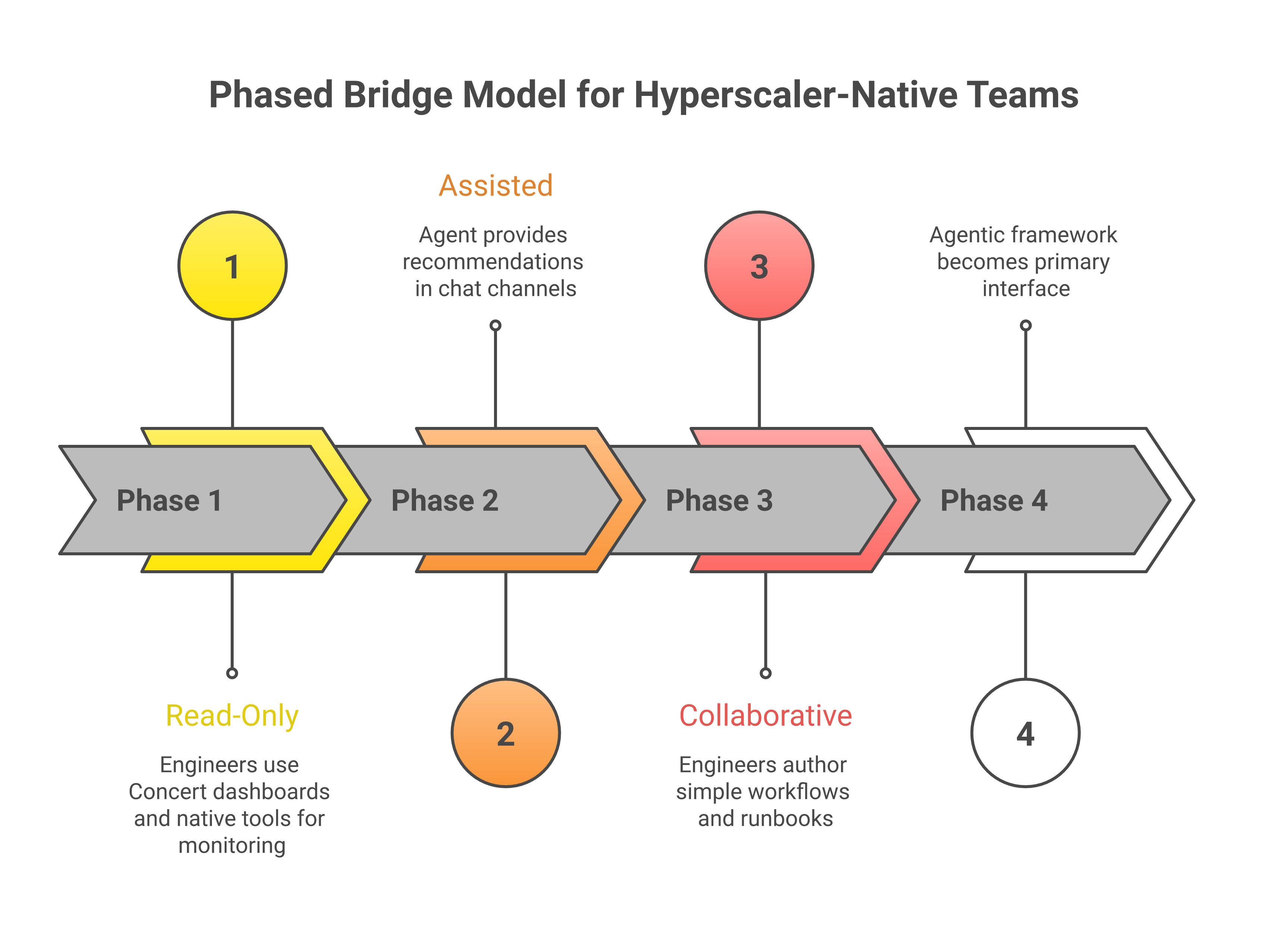
The most effective adoption programmes follow a phased model that respects the engineer’s existing competence and builds new capability incrementally through use rather than through instruction.
Phase 1: Read-only. Engineers use Concert dashboards and cross-cloud observability views alongside their existing tools. No new operational skills are required. The engineer continues to work in their native platform console for all actions; the new tooling provides supplementary visibility across the estate. The value proposition at this stage is simple: you can now see what is happening in the zones you do not directly manage, without asking a colleague. This phase typically runs for four to eight weeks and succeeds or fails based on whether the cross-cloud visibility is genuinely useful. If it is, engineers begin consulting it habitually. If it is not, no amount of mandating will make them use it.
Phase 2: Assisted. Agents begin surfacing recommendations in the engineer’s existing communication channels—Slack, Microsoft Teams, or whatever the team uses. A recommendation might be: “Latency anomaly detected in the EU-sovereign zone; correlated with a configuration change in the shared services zone forty minutes ago; recommend reviewing the change.” The engineer evaluates the recommendation using their own judgement and either acts on it or dismisses it. Learning happens through interaction: each recommendation is an implicit micro-lesson in how the agentic layer reasons about cross-cloud operations. The engineer is not sitting in a classroom; they are doing their job with an increasingly useful assistant. Over the course of this phase, which typically spans two to four months, the engineer develops the trust calibration described in Section 32.5—not through training but through repeated observation of the agent being right, wrong and uncertain.
Phase 3: Collaborative. Engineers who have spent months observing agent behaviour begin to see opportunities to author simple agent workflows and runbooks themselves. An SRE who has noticed that they perform the same cross-zone diagnostic sequence every time a particular alert fires is a natural candidate to codify that sequence as an Ansible playbook or an Orchestrate skill. At this point, the engineer is not learning Ansible in the abstract; they are automating a specific task they have performed manually dozens of times. The learning is contextualised, motivated and immediately applicable. This phase has no fixed duration; some engineers reach it in three months, others in six, and some—particularly those whose role is genuinely platform-specific—may never need to progress beyond Phase 2, which is a legitimate outcome, not a failure.
Phase 4: Native. A subset of engineers—typically those with the strongest cross-functional instincts and the greatest appetite for abstraction—begin to think in terms of the agentic framework as their primary interface for operational work, dropping into platform-specific consoles only when deep-dive investigation requires it. These are the engineers who become the enabling team described in Section 32.2: the internal champions who help their colleagues progress through the earlier phases. Not every engineer will reach Phase 4, and no adoption plan should assume or require that they will. The goal is a team in which enough members operate at Phase 3 or 4 to sustain the agentic operating model, while others contribute their deep platform expertise at Phase 2 or below.
Cognitive load as the success metric
Every new tool in the operational stack adds cognitive load. This is not a controversial observation; it is a lived reality for every SRE who has watched their browser tab count grow from ten to thirty over the course of a platform modernisation programme. The agentic architecture described in this book must be held to a strict standard: it must reduce net cognitive load, not increase it. If an engineer’s daily experience after adopting the agentic layer is that they have more dashboards to check, more alerts to triage, more tools to context-switch between and more concepts to hold in working memory, then the architecture has failed—regardless of how elegant it is on a whiteboard.
The reduction comes from specific, measurable sources: fewer manual correlation steps during cross-zone incident diagnosis, fewer context switches between platform consoles, fewer routine tasks that require human attention, and fewer hours spent assembling compliance evidence that the system now collects continuously. These reductions must be tracked and demonstrated, not asserted. An adoption programme that cannot show, with data, that engineers are spending less time on toil after six months has a credibility problem that no amount of executive sponsorship will overcome.
Certification, career paths and the portability concern
SREs worry, with justification, that investing in IBM-specific tooling narrows their market value. The concern is particularly acute for engineers in the early and middle stages of their careers, for whom portability of skills is a material factor in career planning. This concern must be addressed with honesty, not with marketing.
The honest answer is that the skills the sovereign agentic model actually develops are overwhelmingly open-source and transferable. The observability layer is built on OpenTelemetry—an open standard with adoption across every major platform. The infrastructure-as-code layer uses Terraform and Ansible—tools with enormous market demand that are not IBM-specific. The policy layer uses Open Policy Agent—a CNCF graduated project used across the industry. The container orchestration layer is Kubernetes, which needs no justification as a portable skill. The AI patterns—retrieval-augmented generation, agentic workflows, tool-calling architectures—are architectural concepts that transfer directly to any vendor’s implementation. An engineer who has spent two years in a sovereign agentic operations environment has a CV that reads: OpenTelemetry, Terraform, Ansible, OPA, Kubernetes, Python, agentic AI architecture. These are among the most marketable skills in infrastructure engineering today.
The IBM-specific layer—Concert, Orchestrate, Instana—sits on top of these foundations. Learning these tools is not wasted effort, but it is also not where the bulk of the skill development occurs. An engineer who understands observability architecture deeply and happens to have used Instana as the implementation can move to Datadog, Grafana or any other observability platform with modest adjustment. The conceptual knowledge transfers; only the interface-specific muscle memory does not. Organisations should make this architecture of skills explicit in their career development frameworks: the foundational, transferable skills are the primary development target, and the vendor-specific tools are the current implementation of those skills. This framing converts the re-skilling investment from a career risk into a career accelerator.
Confronting the legacy perception
There is an elephant in the room, and pretending it is not there serves no one. For a significant proportion of engineers under forty, IBM is associated with mainframes, CICS transactions, green-screen terminals and enterprise software that belongs to a previous era. The suggestion that they should adopt IBM tooling triggers a visceral reaction that has nothing to do with the technical merits of the specific products and everything to do with brand perception. Dismissing this reaction as uninformed is unhelpful. The perception exists, it is widespread, and it must be addressed with evidence rather than indignation.
The evidence is straightforward. The tooling described in this book—Concert, Orchestrate, Instana, the watsonx AI platform—is built on Kubernetes, runs in containers, exposes REST APIs, is scriptable in Python, and follows modern UX conventions. It is not your predecessor’s WebSphere. But stating this is not sufficient; it must be demonstrated. The most effective way to counter the legacy perception is to put the tools in front of sceptical engineers and let them form their own assessment. A hands-on lab in which an experienced AWS SRE uses Concert to diagnose a cross-cloud incident faster than they could with their existing tools does more to shift perception than any number of slide decks. Equally, if the tools do not deliver that experience—if they are slow, clunky or require arcane configuration—then the perception is not wrong, and the problem is with the product, not with the engineer’s attitude.
IBM has to earn the trust of these teams, and earning trust takes time. It requires products that work reliably, documentation that is accurate and current, APIs that behave as specified, and a support experience that meets the standards set by the hyperscaler platforms these engineers are accustomed to. It also requires a willingness to acknowledge the gap openly: yes, the mainframe heritage is real; no, it does not define the current toolset; and here is the evidence. Organisations adopting the sovereign agentic model should create space for this conversation rather than suppressing it, because engineers who harbour private doubts about the tooling are less likely to invest in learning it than engineers whose concerns have been heard and addressed.
Key Takeaways
-
The skills gap in sovereign operations spans policy-as-code fluency, agent supervision, sovereignty engineering and AI governance. Hiring alone will not close it; organisations must invest in growing these capabilities internally.
-
T-shaped sovereign operations engineers combine deep expertise in one domain with broad working knowledge across infrastructure, security, compliance, data and AI. Team Topologies interaction modes provide structural mechanisms for developing this breadth.
-
Training pathways combine vendor certifications, internal curricula, simulation environments and academic partnerships. Continuous learning is essential in a rapidly evolving field; episodic training programmes are insufficient.
-
Cultural transformation from gatekeeping to enabling is a prerequisite for sovereign operations at scale. Generative culture, as described by Westrum, is empirically associated with superior operational performance and is necessary for the trust, collaboration and learning that sovereign operations demand.
-
Trust calibration—neither over-trust nor under-trust of AI agents—is a specific human-factors challenge that requires transparency of reasoning, confidence indicators, track records, feedback mechanisms and team discussion.
-
Cognitive load management is an operational quality concern. Alert fatigue, decision fatigue and the paradox of increased capability must be addressed through thoughtful tooling design, humane processes and organisational restraint in reducing team sizes.
-
Knowledge management and institutional memory depend on systematic capture, currency maintenance, deliberate transfer and communities of practice. The RAG-enabled knowledge base from Chapter 20 is only as valuable as the organisational practices that populate and maintain it.
-
The re-skilling wall is real and must be addressed through a phased bridge model that meets hyperscaler-native engineers where they are. The agentic layer sits above existing platform expertise, not in place of it. Adoption succeeds when it demonstrably reduces cognitive load, when the skills it develops are transferable and open-source-grounded, and when the legacy perception is confronted with evidence rather than marketing.
Bridge to Chapter 33 — Maturity Model
Skills, culture and human factors determine whether the technical architecture described in the preceding chapters is operated effectively or merely deployed. But how does an organisation know where it stands? How does it measure progress from ad-hoc, reactive operations towards the mature, sovereign, agentic model this book describes? Chapter 33 introduces a maturity model for sovereign cloud operations—a structured framework for assessing current capability, identifying the most productive next investments, and tracking progress along a defined path from initial adoption to optimised, continuously improving operations.
References
[1] N. Forsgren, J. Humble, and G. Kim, Accelerate: The Science of Lean Software and DevOps, Portland, OR, USA: IT Revolution Press, 2018. [Online]. Available: https://itrevolution.com/product/accelerate/
[2] European Parliament and Council of the European Union, “Regulation (EU) 2024/1689 laying down harmonised rules on artificial intelligence (Artificial Intelligence Act),” Official Journal of the European Union, L series, 2024. [Online]. Available: https://eur-lex.europa.eu/legal-content/EN/TXT/?uri=CELEX:32024R1689
[3] DORA Team, “2024 State of DevOps Report,” Google Cloud, 2024. [Online]. Available: https://dora.dev
[4] T. Brown, “Design thinking,” Harvard Business Review, vol. 86, no. 6, pp. 84–92, Jun. 2008. [Online]. Available: https://hbr.org/2008/06/design-thinking
[5] M. Skelton and M. Pais, Team Topologies: Organizing Business and Technology Teams for Fast Flow, Portland, OR, USA: IT Revolution Press, 2019. [Online]. Available: https://teamtopologies.com/book
[6] Red Hat, Inc., “Red Hat Training and Certification,” 2025. [Online]. Available: https://www.redhat.com/en/services/training-and-certification
[7] B. Beyer, C. Jones, J. Petoff, and N. R. Murphy, Eds., Site Reliability Engineering: How Google Runs Production Systems, Sebastopol, CA, USA: O’Reilly Media, 2016. [Online]. Available: https://sre.google/sre-book/table-of-contents/
[8] R. Westrum, “A typology of organisational cultures,” BMJ Quality and Safety, vol. 13, suppl. 2, pp. ii22–ii27, Dec. 2004. [Online]. Available: https://doi.org/10.1136/qshc.2003.009522
[9] S. Dekker, Just Culture: Restoring Trust and Accountability in Your Organization, 3rd ed., Boca Raton, FL, USA: CRC Press, 2017. [Online]. Available: https://doi.org/10.1201/9781315251271
[10] R. Parasuraman and V. Riley, “Humans and automation: Use, misuse, disuse, abuse,” Human Factors, vol. 39, no. 2, pp. 230–253, Jun. 1997. [Online]. Available: https://doi.org/10.1518/001872097778543886
[11] J. Sweller, “Cognitive load theory, learning difficulty, and instructional design,” Learning and Instruction, vol. 4, no. 4, pp. 295–312, 1994. [Online]. Available: https://doi.org/10.1016/0959-4752(94)90003-5
[12] S. Sendelbach and M. Funk, “Alarm fatigue: A patient safety concern,” AACN Advanced Critical Care, vol. 24, no. 4, pp. 378–386, Oct. 2013. [Online]. Available: https://doi.org/10.4037/NCI.0b013e3182a903f9
[13] E. Wenger, Communities of Practice: Learning, Meaning, and Identity, Cambridge, UK: Cambridge University Press, 1998. [Online]. Available: https://doi.org/10.1017/CBO9780511803932
Sovereign Cloud Operations: AI-Driven Management of Sovereign Estates
© 2026 by Alan Hamilton
is licensed under CC BY-SA 4.0


