Chapter 37 — The Generative AI Horizon
Summary
This chapter surveys the generative AI landscape from the vantage point of the sovereign operations architect, identifying the directional trends — open-weight and specialised foundation models, the agentic progression from assistants to autonomous operators, sovereign AI infrastructure, and an intensifying regulatory environment — that are structurally stable enough to warrant architectural planning. It examines the practical requirements for running capable models within sovereign boundaries, including GPU capacity, inference serving, model registries and training pipelines, and maps the emerging regulatory obligations under the EU AI Act and sector-specific frameworks onto the operational foundations described throughout this book. The chapter also addresses the quantum computing threat to classical cryptography, the sovereign imperative for early post-quantum migration, and the convergence of immutable storage, safeguarded copies, confidential computing and autonomous recovery into continuous cyber-resilient architectures. It argues that designing for uncertainty — through model abstraction layers, composable agent architectures, cryptographic agility and feedback loops that accelerate learning — is more resilient than attempting to predict a future that is changing faster than any committee can convene.
37.1 The pace of change
In late 2022, the release of ChatGPT introduced hundreds of millions of people to large language models in the space of a few weeks. Within eighteen months, every major technology vendor had repositioned its product portfolio around generative AI, dozens of open-weight foundation models had been published, and regulatory bodies on multiple continents had begun drafting rules for a technology whose capabilities were changing faster than any committee could convene. By early 2026, the landscape has shifted again: agentic frameworks are maturing, multimodal models process text, images, audio and structured data in a single pass, and specialised small models trained on domain-specific corpora are challenging the assumption that only the largest models are useful. The pace is, by any historical measure, extraordinary.
For practitioners responsible for sovereign cloud operations, this velocity creates a distinctive problem. Enterprise technology decisions are measured in years—procurement cycles, regulatory approvals, staff training, integration work, deprecation schedules—while the generative AI frontier moves in months. A model that represents the state of the art at the time a project is approved may be two generations old by the time it reaches production. A regulatory framework drafted around one set of capabilities may encounter an entirely different set by the time it is enforced.
This chapter does not attempt to predict the future. Prediction, at the current rate of change, is an exercise in overconfidence. What it does instead is identify the directions that appear structurally stable—trends supported by converging technical, economic and regulatory forces—and consider their implications for sovereign operations. The goal is not to tell the reader what will happen, but to equip them to think clearly about what might happen and to design systems that remain useful regardless.
Three observations frame the discussion. First, the gap between research capabilities and enterprise readiness is persistent and significant. A capability demonstrated in a research paper or a controlled benchmark does not translate directly into a capability that can be deployed safely in a regulated production environment. The journey from “this model can do X on a benchmark” to “this model reliably does X in our production environment, within our sovereign zone, under our governance framework, at acceptable cost” is measured in months or years of engineering, validation and organisational change. That gap will not close; as the research frontier advances, the enterprise readiness frontier advances too, but always at a slower pace dictated by the realities of procurement, integration, regulation and trust.
Second, the cost of inference and the hardware required to run capable models are declining but remain material, particularly for organisations that must keep computation within sovereign boundaries. A sovereign zone that previously needed only conventional compute, storage and networking must now accommodate GPU clusters, model-serving infrastructure, vector databases for retrieval-augmented generation, and the cooling and power capacity that AI accelerators demand. These are not marginal additions to the infrastructure bill; they are step-function increases that require planning, capital and often physical data-centre modifications.
Third, regulatory attention to AI is intensifying, not receding, and the organisations that will navigate this attention most successfully are those that have already built the operational foundations—observability, traceability, policy-as-code, bounded autonomy—described throughout this book. The regulators are not going to ask “do you use AI?” and accept a yes or no. They are going to ask how, where, under what governance, with what oversight, and with what evidence. The technical substrate for answering those questions is the same substrate that supports good operations in general.
37.2 Foundation model evolution and sovereign implications
The evolution of foundation models since 2020 has followed several trajectories simultaneously, each with distinct implications for sovereign deployment.
Scale continues to increase, but with diminishing exclusivity. The earliest large language models—GPT-3, PaLM—were trained by a handful of organisations with access to enormous compute budgets. That exclusivity has eroded. The Llama family of models from Meta, released under permissive licences, demonstrated that open-weight models could approach or match proprietary performance on many tasks [1]. Mistral, Falcon, and other open-weight initiatives have broadened the field further. IBM’s Granite models, designed explicitly for enterprise use with transparent training data provenance and permissive licensing, represent a deliberate attempt to provide foundation models that organisations can deploy, fine-tune and govern within their own infrastructure without dependency on an external inference API [2]. The Granite 3.0 family, released in late 2024, includes models ranging from compact 1-billion-parameter variants suitable for edge and on-premises deployment to larger models competitive with proprietary alternatives on coding, reasoning and enterprise language tasks [2].
The sovereign implication is significant. If the only capable models were those accessible exclusively through a handful of US-headquartered cloud providers, sovereign deployment would require either accepting that dependency or settling for materially inferior capabilities. The proliferation of open-weight models changes the calculus. An organisation operating a sovereign zone in Frankfurt, São Paulo or Singapore can now obtain a capable foundation model, deploy it on infrastructure under its own operational control, fine-tune it on domain-specific data that never leaves the zone, and run inference without any data transiting to an external provider. This does not eliminate all dependency—model weights were trained somewhere, on someone’s hardware, using someone’s data pipeline—but it shifts the locus of operational control decisively toward the deploying organisation.
Multimodal capabilities are expanding the operational surface. Models that process only text are useful for log analysis, documentation generation and conversational interfaces. Models that also process images, diagrams, structured data and code open a wider operational repertoire. A multimodal model can interpret a network topology diagram, read a screenshot of an error console, parse a structured incident report and correlate all three. For operations, this means that the boundary between “what an agent can perceive” and “what requires a human to look at” is shifting. Consider an incident in which the primary evidence is a screenshot of a dashboard anomaly shared in a chat channel, a PDF of a vendor advisory and a JSON payload from a webhook. A text-only model cannot process the first two; a multimodal model can ingest all three and reason across them. The sovereign implication is that multimodal inference demands more compute—image and audio processing are more resource-intensive than text—placing additional pressure on the economics of sovereign AI infrastructure discussed in section 37.4. Organisations planning sovereign AI deployments must account for the likelihood that operational AI will be multimodal within a few years, even if current deployments are text-only.
Smaller, specialised models are proving their worth. The assumption that bigger is always better has been challenged by research demonstrating that smaller models, carefully trained or fine-tuned on domain-specific data, can outperform much larger general-purpose models on tasks within their domain [3]. For sovereign operations, this is encouraging. A 3-billion-parameter model fine-tuned on an organisation’s incident history, runbook corpus and infrastructure telemetry may be more useful for operational diagnostics than a 70-billion-parameter general model—and it can run on a fraction of the hardware. IBM’s Granite family includes models at multiple scales precisely to support this pattern: organisations can select the smallest model that meets their accuracy requirements and deploy it within their sovereign zone at lower cost and lower latency than routing requests to a remote large-model endpoint [2].
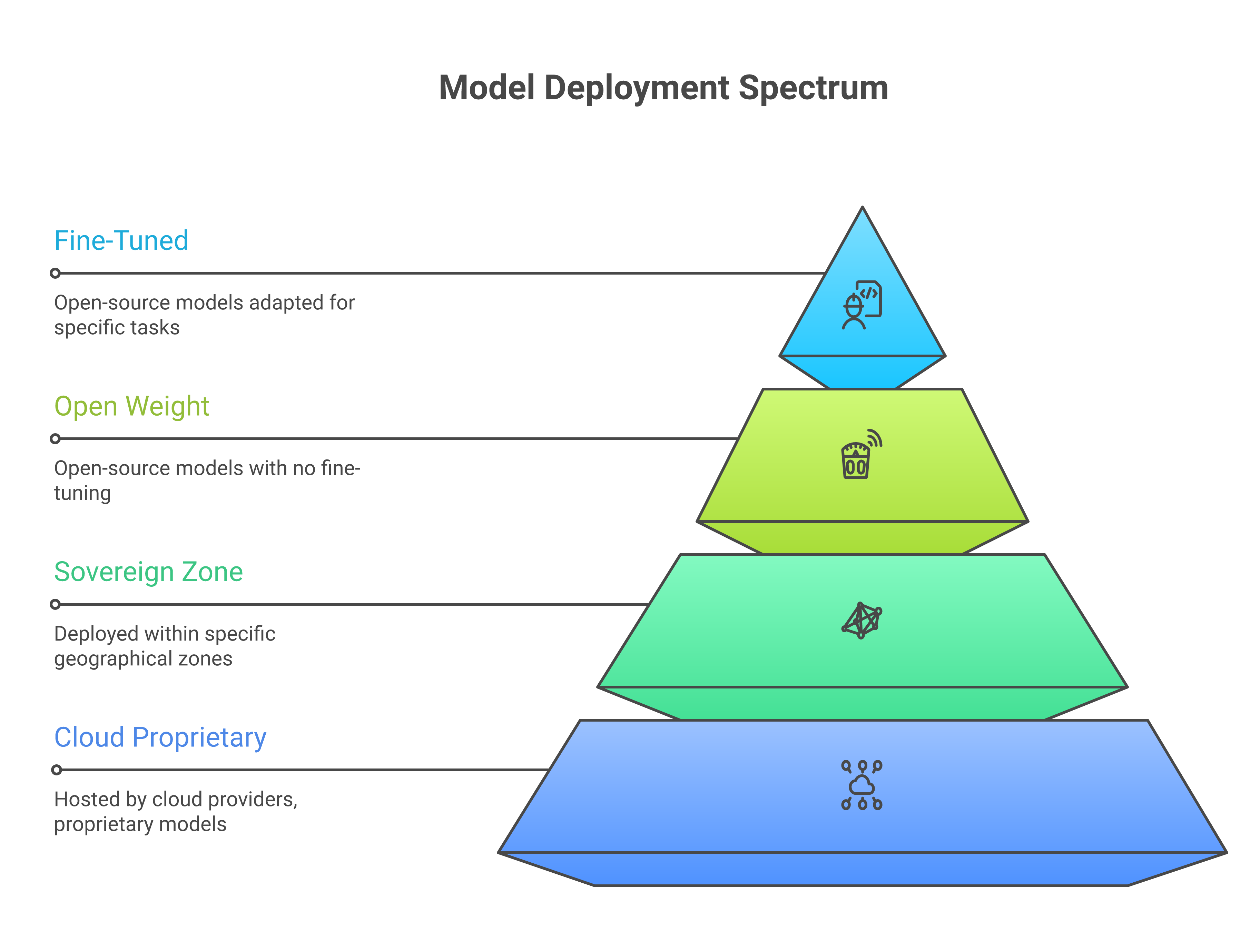
The trajectory, then, is toward a landscape in which organisations have genuine choice: proprietary models accessed via API for tasks where data sensitivity permits, open-weight models deployed within sovereign zones for tasks where it does not, and specialised fine-tuned models for high-value operational domains. The architectural challenge is to build an inference layer that can route requests to the appropriate model based on data classification, latency requirements and cost constraints—a pattern that IBM watsonx.ai’s model serving infrastructure is designed to support [4].
37.3 Agentic AI: from assistants to autonomous operators
The progression from generative AI as a conversational tool to generative AI as an operational agent is perhaps the most consequential trend for sovereign cloud operations. It is also the trend most susceptible to hype, which makes it worth examining carefully.
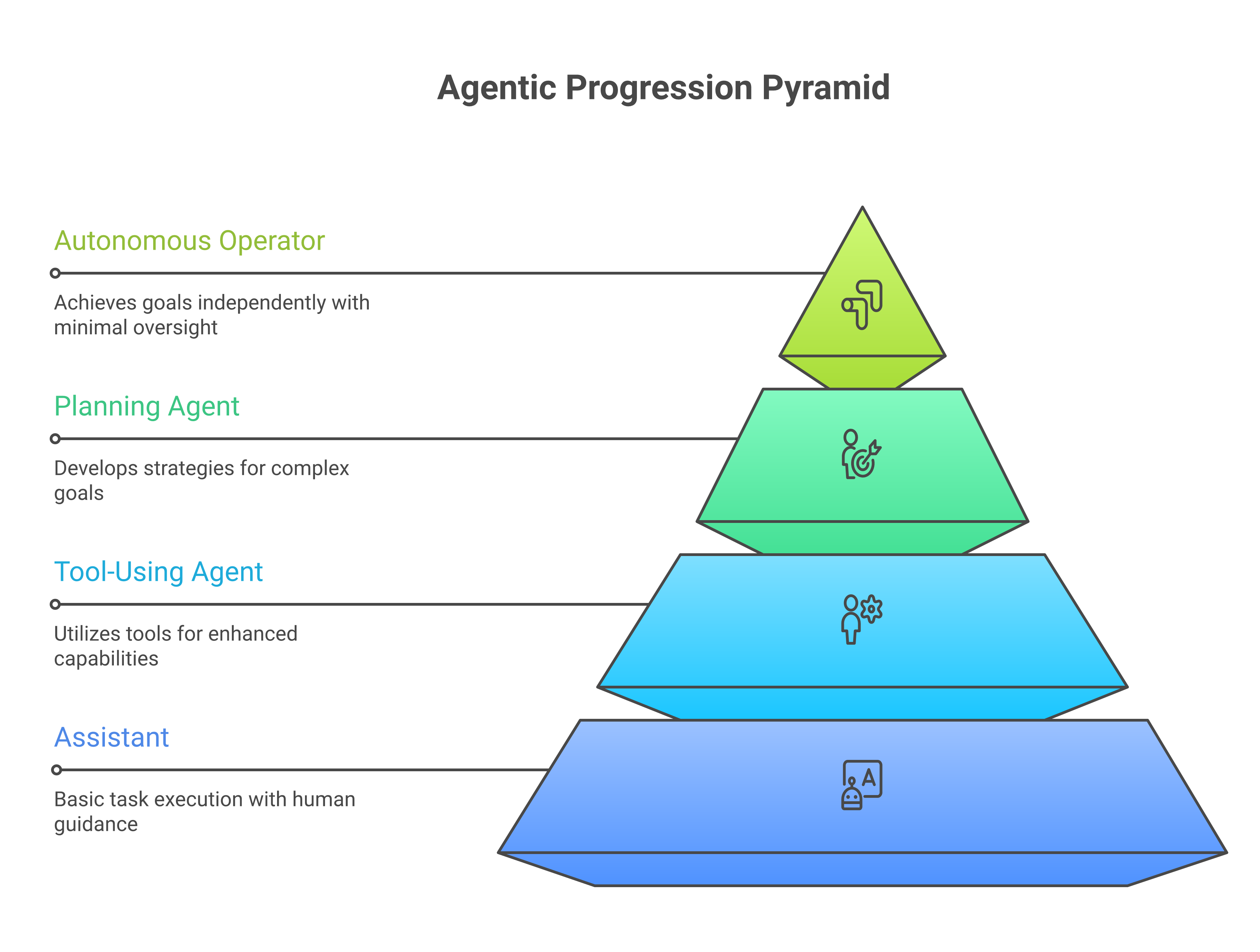
The assistant phase is already well established. Large language models integrated into operational consoles, chat platforms and documentation systems can answer questions about the estate, summarise incidents, explain log entries and suggest diagnostic steps. These assistants are valuable but fundamentally reactive: they respond when asked, they have no persistent state, and they take no action. Their failure mode is providing a wrong answer, which a human operator must recognise and discard. The guardrail requirements are modest: input filtering, output review, and access controls on the data the model can query.
The tool-using agent phase represents a qualitative shift. An agent that can not only reason about a situation but also invoke tools—querying a monitoring API, running a diagnostic script, opening a ticket, modifying a configuration—moves from advisory to consequential. The ReAct pattern, in which models interleave reasoning and action steps, has become the dominant framework for tool-using agents [5]. IBM watsonx Orchestrate implements this pattern for enterprise workflows, providing a controlled environment in which agents can discover, invoke and chain tool actions within policy-defined boundaries [6]. The failure mode is no longer just a wrong answer; it is a wrong action. Guardrail requirements correspondingly increase: the agent must operate within a defined scope, its tool invocations must be auditable, and its authority to act must be bounded by policy-as-code that the agent cannot modify.
The planning agent phase adds long-horizon reasoning. Rather than responding to a single prompt with a single chain of actions, a planning agent decomposes a complex objective into sub-goals, executes them across multiple steps, monitors intermediate outcomes, and adjusts its plan when results differ from expectations. This is the pattern required for tasks such as “investigate why deployment latency has increased by 40 per cent this week, identify root causes, propose remediation options, and prepare an implementation plan for the preferred option.” Each sub-step may involve different tools, different data sources and different time horizons. The architectural requirements are substantial: the agent needs persistent memory across steps, access to a broad set of tools, the ability to pause and resume, and—critically—checkpoints at which human oversight can intervene. The failure mode of a planning agent is not a single bad action but a compounding sequence of plausible but misguided steps that, individually, each pass policy checks but collectively move the system in the wrong direction.
The autonomous operator phase is the horizon toward which current research is moving, though it remains aspirational for most production environments. An autonomous operator would continuously monitor a domain of the estate, detect anomalies, diagnose causes, plan and execute remediations, and learn from outcomes—all without human initiation. This is the fully agentic operations model described in Chapter 38. The technical prerequisites are formidable: highly reliable reasoning, robust tool integration, comprehensive observability, provably bounded authority, and a human oversight model that can intervene efficiently without being overwhelmed by routine decisions. The sovereign implications are equally formidable: an autonomous agent operating within a sovereign zone must itself be sovereign—its model weights, its reasoning traces, its memory and its tool access must all reside within the zone and be subject to the zone’s governance.
Trust calibration across the progression. Each phase of the agentic progression demands a different trust model. In the assistant phase, trust is simple: the human decides whether to act on the advice. In the tool-using phase, trust must be codified: the agent’s scope is defined in policy-as-code, its actions are logged and auditable, and the blast radius of a mistake is bounded by the tools it can access. In the planning phase, trust becomes more nuanced: the agent’s plan must be reviewable at checkpoints, and the human must be able to understand not just what the agent proposes to do but why it believes that plan is correct. In the autonomous phase, trust must be systemic: the entire operational environment—observability, policy enforcement, circuit breakers, escalation paths—must be designed to contain and correct agent errors without human initiation. This is not a matter of making the model smarter; it is a matter of making the surrounding system robust enough to tolerate the model’s inevitable mistakes.
The honest assessment is that production environments in 2026 are primarily in the assistant and early tool-using agent phases, with planning agents emerging in controlled domains. The progression to autonomous operators will be gradual, domain-specific and heavily dependent on the maturity of the guardrail infrastructure. Organisations that have invested in the foundations described in this book—rich observability, topology-aware operations, runbooks-as-code, policy-as-code, bounded agent frameworks—are better positioned to move along this progression safely, because each step builds on those foundations rather than requiring them to be invented ad hoc. The operational substrate is the rate-limiting factor, not the model capability.
37.4 Sovereign AI infrastructure
Running capable AI within sovereign boundaries is not merely a matter of downloading model weights and deploying them on an existing cluster. It requires purpose-built infrastructure that is often materially different from the compute, storage and networking that supports conventional cloud workloads.
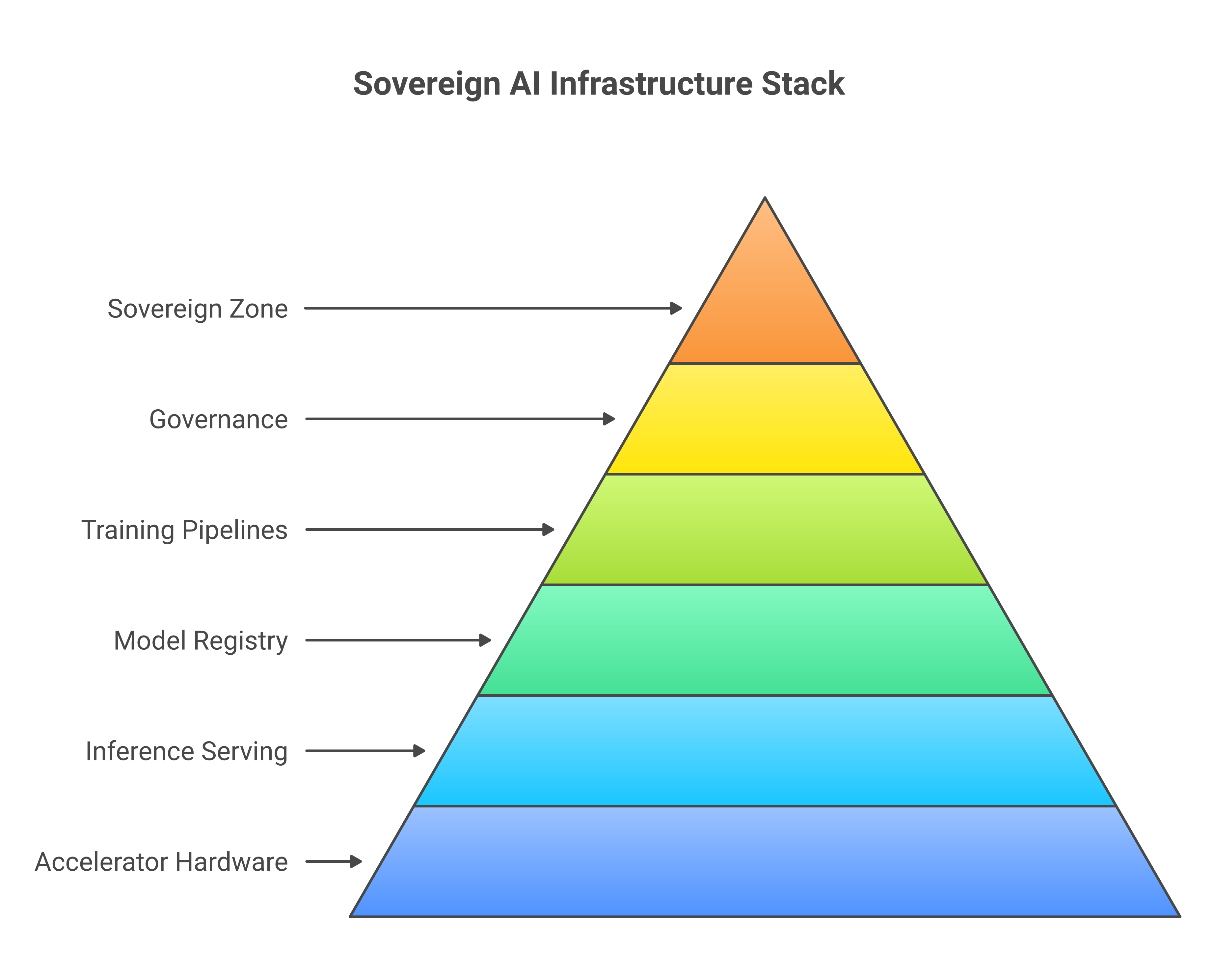
GPU and accelerator capacity is the most visible requirement. Foundation model inference—particularly for larger models and multimodal inputs—demands hardware accelerators (GPUs, TPUs or purpose-built AI chips) in quantities and configurations that many sovereign zones do not yet possess. Training and fine-tuning demand even more. The global supply of AI accelerators has been constrained since 2023, and geopolitical considerations—including US export controls on advanced chips to certain jurisdictions—have made sovereign AI compute a strategic concern for governments and regulated industries alike [7]. The economics are stark: a single high-end GPU node capable of serving a 70-billion-parameter model at acceptable latency can cost tens of thousands of dollars per month; a training cluster for fine-tuning can cost orders of magnitude more.
Inference infrastructure within a sovereign zone must provide model serving with predictable latency, request routing, load balancing, autoscaling and version management. This is not a trivial engineering task. Model inference has different scaling characteristics from conventional web services: GPU memory is the primary bottleneck rather than CPU or network bandwidth; batching strategies significantly affect both throughput and latency; and model loading times mean that cold-start penalties are measured in minutes, not milliseconds. IBM watsonx.ai provides a managed inference layer that can be deployed on Red Hat OpenShift within a sovereign zone, offering model serving endpoints that respect zone boundaries while providing the operational characteristics—health monitoring, throughput metrics, latency SLOs—that production workloads require [4]. The platform handles model loading, request batching, GPU memory management and horizontal scaling, allowing operations teams to treat model endpoints with the same operational rigour applied to any other production service.
For organisations that cannot justify dedicated GPU clusters, shared sovereign AI platforms—operated by a trusted provider within the jurisdiction—offer a middle path: the inference runs within the sovereign boundary, but the infrastructure cost is amortised across multiple tenants. Several European cloud providers have begun offering sovereign AI inference services that guarantee data residency and operational control while providing access to GPU capacity that individual organisations could not economically maintain. The governance challenge is ensuring that multi-tenant inference platforms provide adequate isolation—not just at the data level but at the model level, ensuring that one tenant’s fine-tuned model weights and inference logs are not accessible to another.
Model registries and lifecycle management are governance necessities. A sovereign zone that deploys AI models must track which models are deployed, which versions are in production, what training data was used, what evaluation results were obtained, and what approval processes were followed. This is not optional in a regulated environment; it is the AI equivalent of the software bill of materials. IBM watsonx.governance provides model lifecycle tracking, bias and drift monitoring, and approval workflow capabilities that integrate with the broader governance plane described in Chapter 10 [8]. Deploying these capabilities within the sovereign zone means that the governance record itself—which may contain sensitive information about model performance on regulated data—does not need to leave the zone.
Training and fine-tuning pipelines present the most demanding infrastructure requirements. Organisations that wish to fine-tune open-weight models on proprietary data—incident histories, runbook corpora, domain-specific documents—need not only the GPU capacity to run training jobs but also the data pipelines, experiment tracking and model evaluation infrastructure to do so safely. The sovereign constraint adds complexity: training data must remain within the zone, training jobs must run on zone-local compute, and the resulting model artefacts must be stored and governed within the zone. For many organisations, this argues for a phased approach: begin with pre-trained open-weight models deployed as-is, progress to retrieval-augmented generation (RAG) patterns that keep proprietary data in zone-local vector stores, and invest in fine-tuning only when the use case justifies the infrastructure cost.
The broader trajectory is toward sovereign AI infrastructure becoming a standard component of the sovereign zone, just as sovereign identity management and sovereign key management are today. Governments and industry consortia in the EU, the Gulf states and parts of Asia are already investing in shared sovereign AI compute facilities designed to provide foundation model capabilities within jurisdictional boundaries [7]. For the enterprise architect, the planning implication is clear: sovereign AI infrastructure should be part of the zone design, not an afterthought bolted on when the first AI use case demands it.
37.5 Evolving regulatory landscape
The regulatory landscape for AI is developing rapidly, and its intersection with sovereignty requirements creates a compound challenge for operational architects. Understanding the direction of travel—if not the precise destination—is essential for building systems that will remain compliant as rules tighten.
The EU AI Act, which entered into force in August 2024 with a phased implementation schedule extending to 2027, is the most comprehensive AI-specific legislation enacted to date [9]. It classifies AI systems by risk level—unacceptable, high, limited and minimal—and imposes progressively stringent requirements on higher-risk systems, including conformity assessments, technical documentation, human oversight, accuracy and robustness standards, and post-market monitoring. For sovereign cloud operations, the Act’s implications are substantial. AI systems used in critical infrastructure management—which plausibly includes agentic operations tools managing regulated workloads—may fall within the high-risk category, triggering requirements for risk management systems, data governance, technical documentation, record-keeping, transparency, human oversight and cybersecurity measures. The Act also establishes requirements for general-purpose AI models, including transparency obligations and, for models deemed to pose systemic risk, additional evaluation and incident reporting requirements [9].
Sector-specific AI regulations are layering on top of horizontal frameworks. Financial services regulators, building on existing frameworks such as DORA, are developing expectations for how AI is used in operational risk management, fraud detection and customer interaction. The European Banking Authority and national competent authorities are expected to issue guidance on AI model risk management that extends established principles of model validation and governance to foundation models and agentic systems. Health regulators are tightening requirements for AI in clinical decision support and operational management, with the EU’s Medical Device Regulation already capturing certain AI-based diagnostic tools and likely to expand its reach to operational AI that affects patient safety. Public sector bodies are establishing AI ethics frameworks that constrain how AI can be used in citizen-facing services, often with specific requirements around transparency, non-discrimination and human override. The cumulative effect is that an organisation operating across sectors and jurisdictions may face a matrix of AI-related obligations that differ by domain, geography and risk level. Managing that matrix manually is impractical; it must be codified in policy-as-code and enforced by the governance plane.
The regulatory pressure on operational AI will intensify further as obligations from outside the AI-specific domain converge on the same systems. The Corporate Sustainability Reporting Directive (CSRD) [11] will require organisations to disclose the energy consumption and carbon footprint of their AI infrastructure alongside other digital operations, creating a sustainability reporting obligation that attaches to the very GPU clusters and inference pipelines described in section 37.4. The Cyber Resilience Act (CRA) [12] imposes supply-chain security obligations — including SBOM maintenance and coordinated vulnerability disclosure — on products with digital elements, which will encompass AI-enabled operational tools shipped to customers or embedded in connected products. Sector-specific AI rules are already emerging: the EU Medical Device Regulation captures AI-based clinical decision support as a regulated medical device, EASA is developing guidance on AI in aviation safety systems, and financial regulators are extending model risk management expectations to foundation models and agentic systems. The cumulative effect is that operational AI in sovereign estates will sit at the intersection of horizontal AI regulation, sector-specific safety rules and cross-cutting sustainability and supply-chain obligations — a matrix that reinforces the case for the policy-as-code and continuous compliance architecture described in Chapter 10.
International AI governance frameworks remain fragmented but are converging on common principles. The OECD AI Principles, the G7 Hiroshima AI Process, the Council of Europe Framework Convention on AI, and bilateral agreements between major AI-producing nations all emphasise transparency, accountability, human oversight and safety [10]. While these frameworks lack the binding force of legislation, they influence national regulators and create normative expectations that organisations operating internationally must consider. The direction is consistent: AI systems that affect people or critical infrastructure must be explainable, auditable and subject to human control.
For sovereign cloud operations, the regulatory trajectory has several practical implications. First, the AI systems used to operate the estate—not just the AI systems the estate delivers to end users—will increasingly fall within regulatory scope. An agentic operations platform that makes decisions about incident remediation, capacity management or security response is itself an AI system with operational consequences, and regulators will expect it to be governed accordingly. Second, the evidence requirements will be substantial: not just documentation of what the AI system is designed to do, but operational records of what it actually did, what decisions it made, what data it used, and what outcomes resulted. The observability and traceability infrastructure described throughout this book is not merely good engineering; it is the technical substrate on which regulatory compliance for operational AI will be built. Third, the pace of regulatory change means that compliance is not a one-time achievement but an ongoing operational concern. Policy-as-code, continuous compliance monitoring and automated evidence generation—patterns already established for infrastructure and data governance—must be extended to cover AI governance as well.
37.6 What regulators will ask next
Looking beyond the regulations already enacted, it is possible to sketch the kinds of questions that regulators and supervisory bodies will increasingly ask. These questions are extensions of the themes already visible in DORA, the EU AI Act and sector-specific guidance, projected forward along their natural trajectories.
“Show us your sovereign topology.” Regulators will want to see not just declarations that critical services run within certain jurisdictions, but architectural evidence: topology maps showing where services are deployed, how they are connected, where data flows and what happens if a provider or region fails. The expectation will be for this evidence to be machine-generated from the live estate—derived from tools like Concert’s topology discovery—rather than manually maintained diagrams that may not reflect reality. Organisations that have invested in infrastructure-as-code and continuous topology discovery will be able to produce this evidence routinely; those that have not will face expensive remediation programmes.
“Demonstrate your continuous compliance.” The shift from point-in-time audits to continuous compliance evidence is already underway in financial services under DORA. It will extend to AI governance. Regulators will expect to see not just policies, but evidence that those policies are enforced and monitored over time: policy-as-code definitions, automated compliance checks running against the live estate, dashboards showing compliance posture, and alerting for policy violations. The Open Policy Agent and its successors, integrated into the deployment pipeline and the operational control plane, provide the technical mechanism; the challenge is making the output legible to regulators who are accustomed to narrative reports rather than code repositories.
“Explain your use of AI in operations.” Regulators are beginning to ask about AI as a product feature; they will increasingly ask about AI as an operational actor. The questions will include: what can your agents do? What authority do they have? What guardrails constrain them? How do you supervise them? How do you detect when they malfunction? How do you ensure that their decisions are traceable and reviewable? Organisations that have implemented the bounded-agent patterns described in Chapters 19 through 22—with explicit scopes, policy-enforced guardrails, comprehensive logging and human oversight mechanisms—will have answers. Those that have deployed AI capabilities in an ad hoc fashion will find the questions uncomfortable.
“Provide a trace of this incident.” Incident tracing requirements will extend from “show us the timeline” to “show us the full causal chain, including any automated actions and their justifications.” When an agent participates in incident response—running diagnostics, proposing remediations, executing approved actions—the expectation will be that every step is recorded: what the agent perceived, what it reasoned, what it proposed, what was approved, what it executed, and what the outcome was. This is the operational equivalent of an audit trail, and it must be immutable, complete and accessible. The agentic tracing patterns described in Chapter 22 are designed precisely for this purpose. The practical implication is that agent observability is not a “nice to have” that can be added later; it must be built into the agent framework from the start, because retroactively instrumenting agent reasoning is substantially harder than instrumenting it at design time.
“Demonstrate AI supervision and human oversight.” The EU AI Act’s human oversight requirements for high-risk systems will be interpreted by supervisory bodies into specific expectations for how operational AI is supervised. Regulators will want to see not just that a human can intervene but that the system is designed to ensure that human oversight is effective—that the human receives timely, comprehensible information about what the agent is doing, that override mechanisms are accessible and functional, and that the system degrades gracefully when human oversight is exercised. This means that agent dashboards, escalation paths and manual override procedures must be designed, tested and documented with the same rigour as the agent’s autonomous capabilities.
“Show us your exit strategy.” Sovereignty has always implied the ability to change course. Regulators will increasingly ask organisations to demonstrate—not just assert—that they can exit a provider, migrate a sovereign zone or replace an AI model without losing control of their data and operations. This means maintaining portable infrastructure definitions, avoiding deep lock-in to proprietary model APIs, and ensuring that operational knowledge is codified in transferable artefacts (runbooks-as-code, policy-as-code, IaC) rather than trapped in vendor-specific configurations.
The common thread across all these questions is a shift from paper-based assurance to system-based evidence. Regulators will not be satisfied with policy documents that describe what should happen; they will want to see operational telemetry, compliance dashboards and audit trails that show what actually happens. The architectural patterns described in this book—sovereign zones, zero-copy integration, observability planes, governance planes, agentic operations with guardrails—are the building blocks of a compliance posture that can withstand this level of scrutiny.
37.7 Designing for uncertainty
There is a temptation, when facing an uncertain future, to wait for clarity before committing to architectural decisions. In practice, clarity rarely arrives on schedule. The generative AI landscape will continue to evolve in ways that are difficult to predict; regulatory requirements will tighten in directions that are not yet fully specified; new capabilities will emerge that change the operational art of the possible. The more resilient strategy is not to predict the future but to design systems that accommodate it.
Optionality as an architectural principle. The patterns explored throughout this book are, at their core, patterns for preserving optionality. Zero-copy integration and clear data lineage make it easier to redirect data flows or change where computation happens without creating yet another uncontrolled copy. Infrastructure-as-code and GitOps make it easier to move services between environments, providers and zones—or to reconstruct them from declarative definitions when circumstances demand. Policy-as-code makes it easier to adapt to new regulatory requirements without rewriting application logic. Agentic operations built on these foundations make it easier to evolve how the estate is managed without manually retraining every human operator. Each of these patterns reduces the cost of change, and in an environment where change is the only constant, that reduction compounds.
Abstraction layers for model independence. As foundation models evolve, the specific model powering a given operational capability will change—perhaps multiple times. Systems designed around a direct integration with a single model’s API will face migration costs every time. Systems designed with an abstraction layer—a model-serving interface that decouples the consuming application from the specific model behind it—can swap models with a configuration change rather than a code change. IBM watsonx.ai’s model serving architecture supports this pattern, allowing organisations to route inference requests to different models based on task, data classification and deployment context [4]. The practical advice is straightforward: never hard-code a model dependency into an operational workflow. Treat the model as a pluggable component, governed by the same lifecycle management applied to any other infrastructure dependency.
Composable agent architectures. The agentic capabilities described in Chapters 19 through 22 are designed as composable components—scouts, planners, executors, auditors—rather than monolithic agents. This composability is itself a hedge against uncertainty. If a new model architecture proves superior for planning tasks, the planning component can be updated without rebuilding the entire agent framework. If regulatory requirements mandate human approval at a different point in the workflow, the approval checkpoint can be moved without redesigning the agent’s reasoning logic. If a new tool or data source becomes available, it can be registered in the agent’s tool catalogue without modifying the agent’s core architecture. Composability preserves optionality at the agent level, just as IaC and policy-as-code preserve it at the infrastructure and governance levels.
Irreversibility as a design smell. Not all architectural choices are equally reversible. Some—adopting a standard event format, defining sovereign zone boundaries in code, codifying runbooks as executable artefacts—create options for the future. Others—deep entanglement with a single proprietary inference API, opaque control planes operated by a single vendor, unchecked sprawl of uncontrolled data copies—foreclose options. The design heuristic is simple: when evaluating an architectural decision, ask not only “does this solve today’s problem?” but “does this make tomorrow’s problems harder or easier to solve?” Choices that increase reversibility and composability are preferable to choices that optimise for today’s constraints at the expense of tomorrow’s adaptability.
Consider a concrete example. An organisation building an agentic incident-response capability faces a choice: integrate directly with a specific foundation model’s API, using its proprietary function-calling format and prompt conventions, or build against a model-agnostic interface that abstracts the model interaction behind a standard contract. The first approach is faster to implement and may deliver slightly better performance with the chosen model. The second requires more upfront design work. But when—not if—the organisation wants to switch to a newer, more capable or more cost-effective model, the first approach demands rewriting the agent’s interaction logic, retesting all prompts and tool integrations, and validating that the new model’s idiosyncrasies do not break existing workflows. The second approach requires updating a configuration and running the existing test suite against the new model. Over a five-year horizon, the second approach will almost certainly prove less expensive, and it will certainly prove less disruptive. This is what optionality looks like in practice: a modest upfront investment that pays dividends every time conditions change.
Feedback loops that accelerate learning. Designing for uncertainty also means building systems that learn from their own operation. The observability plane described in Chapter 7 and Chapter 8 provides the raw material: metrics, traces, logs and events that describe how the estate is behaving. When this material is fed back into model fine-tuning, agent evaluation and policy refinement, the estate becomes a learning system—one that improves its own operation over time. The sovereign constraint is that this feedback loop must be contained within the zone: operational data used to improve models must not leave the zone, and the improved models must be governed with the same rigour as the originals. But the principle is sound and powerful: the sovereign estate generates the data from which it can improve itself, and the faster that feedback loop turns, the more adaptable the estate becomes.
The sovereign estate as a platform for adaptation. Viewed through this lens, the sovereign estate described in this book is not a fixed target architecture but a platform for continuous adaptation. The sovereign zone provides the jurisdictional and operational boundary within which capabilities can evolve. The observability plane provides the feedback loop that reveals how the estate is actually behaving. The governance plane provides the policy framework that constrains evolution within acceptable bounds. The agentic operations layer provides the mechanism through which operational improvements are implemented. Together, these layers create a system that is designed not to be right forever but to be correctable quickly—to detect when conditions have changed, to propose adaptations, and to implement them within governed boundaries.
This is, ultimately, the argument of this book applied to the future: sovereignty is not a constraint that limits what you can do; it is the foundation that enables you to change what you do. An organisation that has built a well-governed, observable, codified, sovereign estate is better positioned to adopt new AI capabilities, comply with new regulations, respond to new threats and seize new opportunities than one that has optimised for a single set of assumptions that will inevitably prove incomplete.
37.8 Quantum threats and cyber-resilient architectures
Among the structural uncertainties that sovereign operations architects must confront, the advance of quantum computing occupies a singular position: it is simultaneously a capability frontier being actively pursued and a threat vector that demands defensive preparation years before the threat fully materialises.
The cryptographic transition. The timeline for cryptographically relevant quantum computers — machines capable of breaking RSA-2048 and elliptic-curve cryptography in practical time — remains a matter of debate. Estimates range from the late 2020s to the mid-2030s, depending on assumptions about qubit quality, error correction and engineering progress [13]. What is not debatable is that the threat is sufficiently credible to have driven concrete action. In August 2024, the US National Institute of Standards and Technology (NIST) finalised its first three post-quantum cryptography (PQC) standards: ML-KEM (formerly CRYSTALS-Kyber) for key encapsulation, and ML-DSA and SLH-DSA (formerly CRYSTALS-Dilithium and SPHINCS+) for digital signatures [14]. These standards provide the algorithmic foundation for a cryptographic transition that will, in practice, be one of the largest coordinated infrastructure changes the industry has ever undertaken.
The operational scale of that transition is easily underestimated. A sovereign zone of any complexity contains millions of cryptographic artefacts: TLS certificates on every service endpoint, API keys governing inter-service communication, encrypted data stores, signed software artefacts, VPN tunnels, mutual-TLS meshes between microservices, hardware security module key hierarchies and certificate chains anchoring trust across the estate. Migrating these artefacts to quantum-safe algorithms is not a single project; it is a multi-year programme that touches every layer of the stack and every team that operates it. Hybrid approaches — in which classical and post-quantum algorithms are combined during the transition period — add further complexity, requiring infrastructure that can negotiate and maintain dual cryptographic parameters without breaking backward compatibility [13].
The architectural response is cryptographic agility: designing systems so that the algorithms, key lengths and protocol parameters used for encryption, signing and key exchange can be changed without rewriting application logic or re-architecting infrastructure. Cryptographic agility has been discussed as a best practice for years; the quantum threat transforms it from a best practice into an operational imperative. In practical terms, this means externalising cryptographic operations behind abstraction layers, maintaining inventories of every cryptographic dependency in the estate, and building automated pipelines for certificate rotation and key migration that can operate at the scale a zone-wide PQC transition will demand.
Sovereign implications of quantum capability. The quantum computing threat has a distinctly sovereign dimension. Nation-states are investing heavily in quantum computing programmes, and the resulting capabilities will not be distributed evenly. A state that achieves cryptographic relevance before its adversaries have completed their PQC migration gains an asymmetric advantage — the ability to decrypt intercepted communications and stored data that were encrypted with classical algorithms. The “harvest now, decrypt later” strategy — in which encrypted traffic is captured and stored today in anticipation of future quantum decryption — is not theoretical; intelligence agencies have acknowledged it as a planning assumption [15]. For sovereign operations, this means that data encrypted today with classical algorithms and stored or transmitted across networks must be treated as potentially compromisable over a multi-decade horizon. The operational consequences are threefold. First, data minimisation and short retention periods — already good practice under GDPR and similar frameworks — gain an additional security justification: data that is not retained cannot be decrypted. Second, long-lived secrets — root certificate authority keys, master encryption keys for archival data, signing keys for software supply chains — should be the first candidates for PQC migration, because their exposure window extends furthest into the quantum-capable future. Third, organisations operating in sectors where data sensitivity persists for decades (healthcare, defence, financial services, government records) should treat early PQC adoption not as an optional enhancement but as a sovereign obligation.
From backup and restore to continuous cyber-resilience. The quantum cryptographic threat is one element of a broader convergence toward what can be described as “resilience by default” architectures. Traditional disaster recovery assumed a relatively benign threat model: hardware fails, software has bugs, natural disasters disrupt facilities. The recovery model was correspondingly straightforward — backup data regularly, test restores periodically, maintain a secondary site. Modern cyber-threats, including ransomware, supply-chain compromise and advanced persistent threats, have exposed the inadequacy of that model. An attacker who has been resident in the estate for months may have compromised the backup infrastructure itself; a ransomware strain that encrypts primary storage may also encrypt the backup copies if they are reachable over the same network.
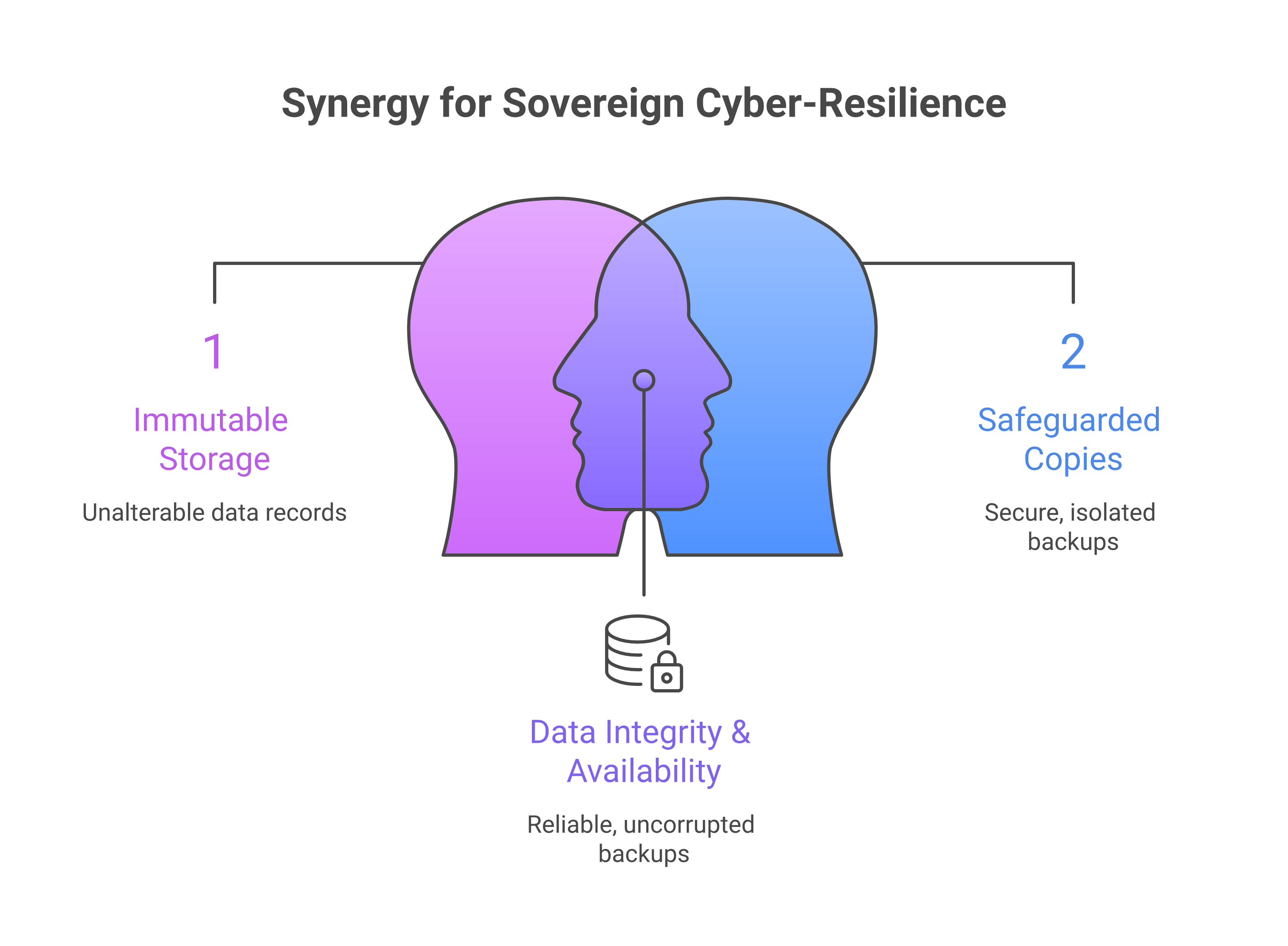
The response is a convergence of several defensive technologies into an integrated resilience architecture. Immutable storage ensures that backup copies, once written, cannot be modified or deleted by any process, including a compromised administrative account. Safeguarded copies — air-gapped or logically isolated replicas maintained on independent infrastructure — provide a recovery source that is architecturally unreachable from the production network. Confidential computing, using hardware-enforced trusted execution environments, protects data and workloads during processing, closing the gap in which data is vulnerable while in use rather than merely at rest or in transit. Autonomous recovery orchestration uses agent-driven workflows to validate backup integrity continuously, detect anomalies in storage patterns that may indicate tampering, and execute recovery procedures in isolated clean-room environments where the recovered workload can be verified before being reconnected to the production estate [16].
The shift is from “backup and restore” as a periodic, manual process to “continuous cyber-resilience” as an always-on architectural property. Integrity validation runs continuously, not on an annual test schedule. Isolation between production and recovery environments is enforced by architecture, not by procedure. Recovery is orchestrated by agents that can execute validated runbooks in minutes, not by on-call engineers interpreting documentation under pressure at three in the morning. IBM Storage Defender exemplifies this pattern, providing cyber-resilience capabilities — including immutable snapshots, safeguarded copies, anomaly detection on storage telemetry and integration with the broader security operations toolchain — that can be deployed within a sovereign zone and governed by the same policy-as-code framework applied to the rest of the estate [16].
IBM Quantum and the dual role. It is worth noting the structural position that IBM occupies in this landscape. Through its IBM Quantum programme and the open-source Qiskit framework, IBM operates one of the world’s largest fleets of quantum processors and is actively advancing the hardware and software stack that will, in time, produce cryptographically relevant machines [17]. Simultaneously, through its sovereign cloud, storage and security portfolio, IBM provides the infrastructure and tooling that organisations use to defend against the very threat that quantum computing creates. This dual role is not a contradiction; it is an acknowledgement that the quantum transition is inevitable and that responsible advancement requires building both the capability and the countermeasures in parallel. For the sovereign operations architect, the practical implication is that the vendor ecosystem already encompasses both sides of the quantum equation, and architectural planning should incorporate PQC readiness into the same roadmap as AI infrastructure, regulatory compliance and operational sovereignty.
Key Takeaways
- The generative AI landscape is evolving at a pace that makes specific predictions unreliable, but directional trends—open-weight models, multimodal capabilities, agentic frameworks, sovereign AI infrastructure—are structurally stable and warrant architectural planning.
- The proliferation of capable open-weight models, including IBM Granite, means that sovereign deployment of foundation models is increasingly feasible: organisations can run, fine-tune and govern capable models entirely within their sovereign zones.
- The progression from conversational assistants to autonomous operational agents is real but gradual; each phase demands correspondingly stronger guardrails, and the guardrail infrastructure described in this book is the prerequisite for safe progression.
- Sovereign AI infrastructure—GPU capacity, inference serving, model registries, training pipelines and governance tooling within the zone—is becoming a standard component of sovereign zone design, not an optional add-on.
- The regulatory landscape for AI is intensifying across horizontal frameworks (EU AI Act), sector-specific rules and international governance principles; operational AI systems will increasingly fall within scope, and system-based evidence will replace paper-based assurance.
- Regulators will ask for sovereign topology evidence, continuous compliance demonstration, AI supervision documentation, incident traces including agent actions, and demonstrable exit strategies—all of which require the architectural foundations described in this book.
- Designing for uncertainty means prioritising optionality: zero-copy integration, IaC, policy-as-code, model abstraction layers and composable agent architectures all reduce the cost of future change.
- The quantum computing threat to classical cryptography demands action now: NIST PQC standards are finalised, and sovereign operations architects should prioritise cryptographic agility, long-lived secret migration, and data minimisation to counter “harvest now, decrypt later” strategies.
- Cyber-resilience is converging from discrete technologies — immutable storage, safeguarded copies, confidential computing, autonomous recovery — into an always-on architectural property that replaces periodic backup-and-restore with continuous integrity validation, pre-emptive isolation and agent-orchestrated clean-room recovery.
- The sovereign estate is best understood not as a fixed target architecture but as a platform for continuous adaptation, designed to be correctable quickly as conditions evolve.
Bridge to Chapter 38 — The Fully Agentic Enterprise
This chapter has examined the generative AI horizon as it appears from the vantage point of the sovereign operations architect: a landscape of rapidly evolving model capabilities, emerging agentic frameworks, expanding sovereign AI infrastructure and intensifying regulatory attention. The emphasis has been on designing for a future that cannot be precisely predicted but can be prepared for.
Chapter 38 takes the next step. Where this chapter has surveyed the landscape, the next chapter imagines what becomes possible when the trends described here converge with the operational foundations laid throughout this book. The result is the fully agentic enterprise: an organisation in which agentic AI is not a tool used within operations but the primary medium through which operations are conducted—continuously, autonomously and within sovereign boundaries. That vision raises its own set of architectural, governance and human questions, and it is to those questions that we now turn.
References
[1] H. Touvron et al., “LLaMA: Open and Efficient Foundation Language Models,” arXiv preprint arXiv:2302.13971, Feb. 2023. [Online]. Available: https://arxiv.org/abs/2302.13971
[2] IBM Research, “Granite 3.0: Open, Performant, and Enterprise-Ready Foundation Models,” IBM Research Blog, Oct. 2024. [Online]. Available: https://research.ibm.com/blog/granite-3-0
[3] E. Hu et al., “LoRA: Low-Rank Adaptation of Large Language Models,” in Proc. ICLR 2022, arXiv preprint arXiv:2106.09685, Jun. 2021. [Online]. Available: https://arxiv.org/abs/2106.09685
[4] IBM, “watsonx.ai: Enterprise Studio for Foundation Models,” IBM Documentation, 2024. [Online]. Available: https://www.ibm.com/products/watsonx-ai
[5] S. Yao et al., “ReAct: Synergizing Reasoning and Acting in Language Models,” in Proc. ICLR 2023, arXiv preprint arXiv:2210.03629, Oct. 2022. [Online]. Available: https://arxiv.org/abs/2210.03629
[6] IBM, “watsonx Orchestrate: AI-Powered Automation for the Enterprise,” IBM Documentation, 2024. [Online]. Available: https://www.ibm.com/products/watsonx-orchestrate
[7] European Commission, “European Chips Act: Regulation (EU) 2023/1781,” Official Journal of the European Union, Sep. 2023. [Online]. Available: https://eur-lex.europa.eu/eli/reg/2023/1781
[8] IBM, “watsonx.governance: AI Governance Toolkit,” IBM Documentation, 2024. [Online]. Available: https://www.ibm.com/products/watsonx-governance
[9] European Parliament and Council, “Regulation (EU) 2024/1689 Laying Down Harmonised Rules on Artificial Intelligence (AI Act),” Official Journal of the European Union, Jul. 2024. [Online]. Available: https://eur-lex.europa.eu/eli/reg/2024/1689
[10] OECD, “OECD Principles on AI,” OECD Legal Instruments, May 2019, updated 2024. [Online]. Available: https://oecd.ai/en/ai-principles
[11] European Parliament and Council of the European Union, “Directive (EU) 2022/2464 as regards corporate sustainability reporting (CSRD),” Official Journal of the European Union, vol. L 322, pp. 15–80, Dec. 2022. [Online]. Available: https://eur-lex.europa.eu/legal-content/EN/TXT/?uri=CELEX%3A32022L2464
[12] European Parliament and Council of the European Union, “Regulation (EU) 2024/2847 on horizontal cybersecurity requirements for products with digital elements (Cyber Resilience Act — CRA),” Official Journal of the European Union, vol. L, Nov. 2024. [Online]. Available: https://eur-lex.europa.eu/eli/reg/2024/2847
[13] National Security Agency, “Cybersecurity Advisory: Commercial National Security Algorithm Suite 2.0,” CNSA 2.0 FAQ, Sep. 2022, updated 2024. [Online]. Available: https://media.defense.gov/2022/Sep/07/2003071834/-1/-1/0/CSA_CNSA_2.0ALGORITHMS.PDF
[14] National Institute of Standards and Technology, “NIST Releases First 3 Finalized Post-Quantum Encryption Standards,” NIST News, Aug. 2024. [Online]. Available: https://www.nist.gov/news-events/news/2024/08/nist-releases-first-3-finalized-post-quantum-encryption-standards
[15] M. Mosca, “Cybersecurity in an Era with Quantum Computers: Will We Be Ready?,” IEEE Security & Privacy, vol. 16, no. 5, pp. 38–41, Sep./Oct. 2018. [Online]. Available: https://doi.org/10.1109/MSP.2018.3761723
[16] IBM, “IBM Storage Defender: Cyber Resilience for Hybrid Cloud,” IBM Documentation, 2024. [Online]. Available: https://www.ibm.com/products/storage-defender
[17] IBM, “IBM Quantum: Hardware, Software, and the Path to Useful Quantum Computing,” IBM Quantum, 2024. [Online]. Available: https://www.ibm.com/quantum
Sovereign Cloud Operations: AI-Driven Management of Sovereign Estates
© 2026 by Alan Hamilton
is licensed under CC BY-SA 4.0


