Chapter 38 — The Fully Agentic Enterprise
Summary
This closing chapter describes what the mature state of agentic operations looks like in practice: an enterprise in which AI agents participate persistently across every significant operational process — detection, diagnosis, remediation, compliance, capacity planning and knowledge management — as capable, bounded, supervised colleagues operating predominantly at autonomy Levels 3 and 4. It grounds the vision in a detailed day-in-the-life narrative set in 2030, illustrating how the four architectural planes converge into a lived operational reality, and examines the trust equation that makes such an enterprise possible through transparency, track record, governance and humility. The chapter confronts the risks honestly — over-reliance, skills atrophy, correlated agent failures, adversarial attack and the accountability gap — before articulating the sovereignty dividend: optionality, resilience, speed, cost efficiency and regulatory confidence that together make sovereignty a competitive advantage rather than a compliance burden.
The previous chapter examined the near-term trajectory of generative AI in sovereign operations: how foundation models, retrieval-augmented generation, and multi-agent orchestration are reshaping the operational surface. That chapter looked forward in months and single-digit years. This chapter looks further, and in a different register. It asks not “what will the next product release enable?” but “what does the mature state of agentic operations look like, and what kind of enterprise emerges on the other side?”
The answer is neither utopian nor dystopian. It is an enterprise in which AI agents participate in every significant operational process—detection, diagnosis, remediation, change management, compliance, capacity planning, knowledge management—as capable, bounded, supervised colleagues. Humans remain accountable. Sovereignty remains non-negotiable. But the texture of daily operations, the distribution of cognitive labour between people and machines, and the speed at which the organisation learns from its own behaviour are qualitatively different from what came before.
This chapter describes that enterprise. It draws on the architectural foundations laid in Parts II through IV, the tooling and workflow patterns explored in Parts V through IX, and the organisational and governance structures discussed in Parts X and XI. It is deliberately reflective rather than prescriptive: the fully agentic enterprise is not a product to be purchased but a condition to be cultivated, maintained, and continuously questioned.
38.1 What “fully agentic” means
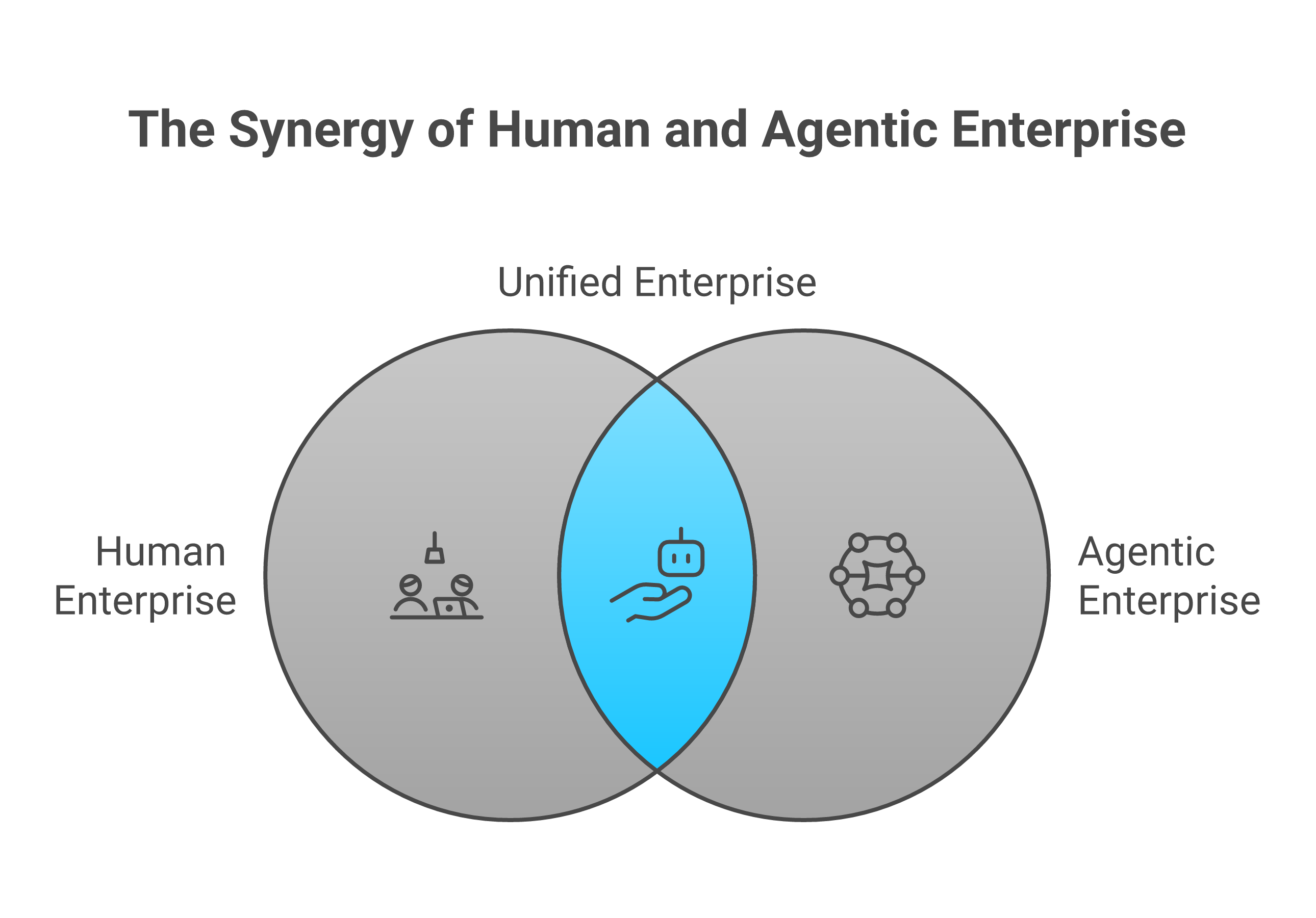
The phrase “fully agentic” is easily misread, and it is worth dispelling the misreading at the outset. It does not mean fully autonomous. It does not describe an enterprise in which AI systems operate without human oversight, make consequential decisions without accountability, or replace the engineering judgement that comes from years of building and running production systems. Chapter 29 described the autonomy spectrum in detail, from Level 0 (fully manual) through Level 5 (fully autonomous), and argued that no responsible sovereign operations architecture should target Level 5 for regulated workloads, because regulatory frameworks universally require demonstrable human accountability for consequential operational decisions [1]. That argument holds. The fully agentic enterprise operates predominantly at Levels 3 and 4—conditionally and highly autonomous—with humans setting the boundaries, reviewing the performance, and intervening when the boundaries prove insufficient.
What “fully agentic” does mean is something more nuanced: an estate in which agents are present and active across every operational process, not as occasional assistants invoked during crises but as persistent participants in the steady-state functioning of the organisation. The distinction is between an enterprise that has agents and an enterprise that operates agentically.
In the former, agents are tools that engineers reach for when a specific task warrants automation. The engineer decides when to invoke the agent, frames the question, interprets the response, and executes the action. The agent is a better search engine, a faster calculator, a more tireless log reader. It is useful but peripheral to the flow of work.
In the latter, agents are woven into the operational fabric. They do not wait to be invoked; they continuously observe, correlate, recommend, and—within their authorised boundaries—act. They participate in change management workflows, proposing risk assessments alongside human reviewers. They contribute to capacity planning, not merely by extrapolating trends but by modelling the implications of planned business changes against the current topology. They maintain compliance posture by continuously evaluating the estate against policy-as-code definitions and surfacing drift before it becomes a finding. They learn from every incident, every change, every audit, updating their models and refining their recommendations without requiring explicit retraining by a human team.
The human role in this enterprise is not diminished; it is elevated. Engineers spend less time on the mechanics of correlation and execution—the work that Chapter 1 described as increasingly unsustainable in the face of growing complexity—and more time on the work that only humans can do: defining what “good” looks like, deciding which trade-offs are acceptable, designing the guardrails within which agents operate, and exercising judgement when situations exceed the boundaries of any agent’s competence. The relationship is not one of delegation but of partnership, and the quality of that partnership determines the quality of the enterprise’s operations.
This is, in essence, the human-agent partnership at maturity. It requires not only capable technology but capable governance, capable culture, and a calibrated understanding of what agents can and cannot be trusted to do. The rest of this chapter examines what that maturity looks like in practice.
38.2 The agentic operations control plane at scale
Throughout this book, the sovereign operations architecture has been described in terms of four interconnected planes: the observability plane, which makes the estate visible and comprehensible; the automation and orchestration plane, which translates decisions into governed actions; the agentic intelligence plane, which provides the reasoning and recommendation capabilities that bridge observation to action; and the governance and audit plane, which ensures that everything the other planes do is accountable, compliant, and traceable [2]. These planes were introduced in Chapter 4, elaborated in their respective parts, and instantiated through IBM Concert, Instana, watsonx Orchestrate, Ansible Automation Platform, watsonx.governance, and the broader sovereign toolchain.
In the fully agentic enterprise, these planes cease to be conceptual layers in an architecture diagram and become the lived infrastructure of daily operations. They function as a coherent whole—not because someone has drawn a line connecting them, but because the data flows, the decision pathways, and the governance controls that link them have been engineered, tested, and refined through years of operational experience.
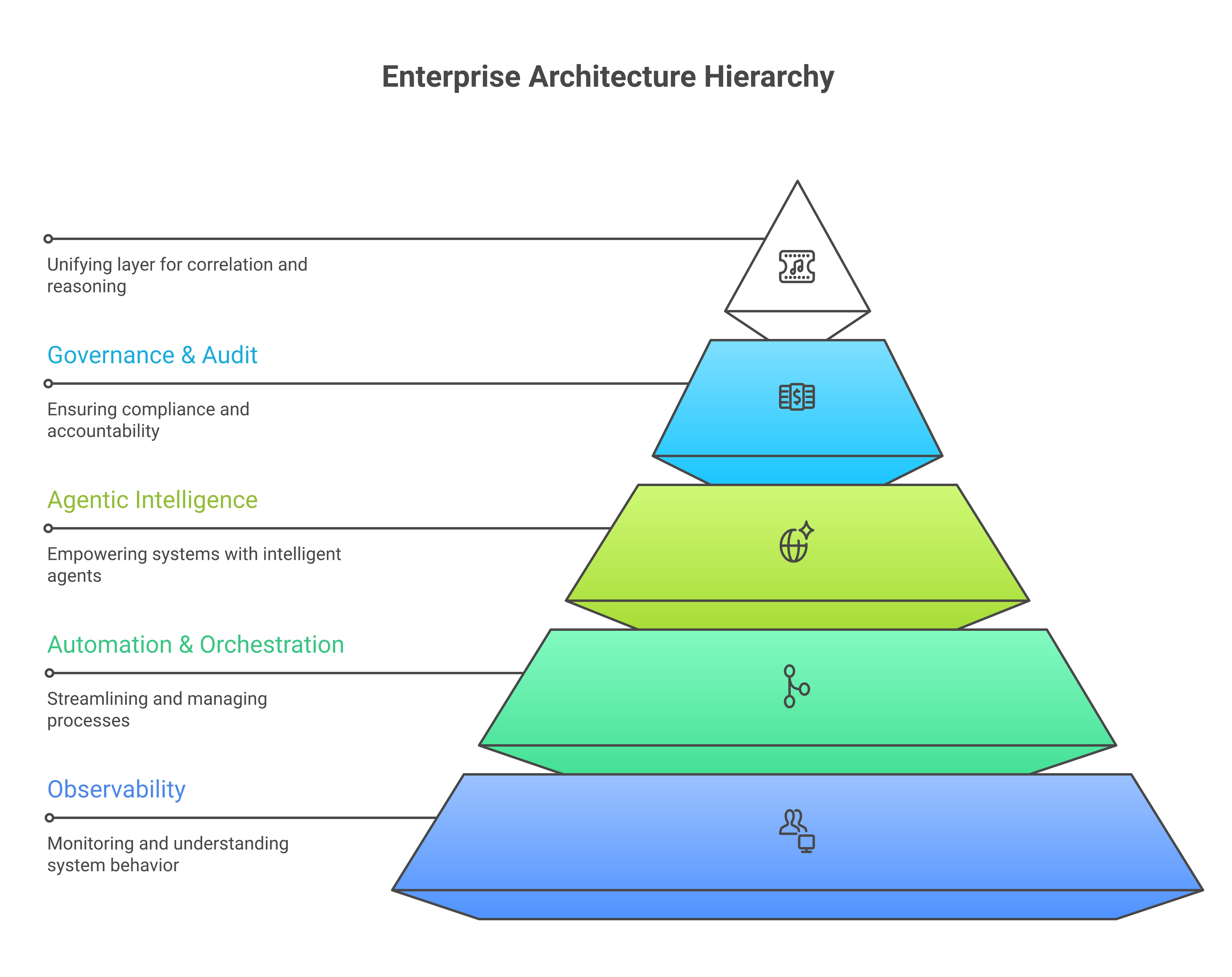
The observability plane at maturity is not merely collecting metrics, logs, and traces; it is maintaining a continuously updated, topology-aware model of the entire estate. Instana’s automatic discovery, combined with Concert’s entity model and dependency graph (described in Chapter 14), means that every service, every deployment, every infrastructure component, and every sovereign zone boundary is represented in a live model that agents can query and reason about. The observability plane understands not just that a service is slow but why it is slow, what depends on it, and what sovereign constraints apply to the remediation options. Signals are not raw data streams waiting for human interpretation; they are contextualised inputs to the agentic intelligence plane, enriched with topology, lineage, and policy metadata.
The automation and orchestration plane at maturity has moved beyond individual runbooks and playbooks to a comprehensive library of composable, policy-governed actions. Every significant operational action—scaling a service, rotating a secret, failing over a database, applying a security patch, modifying a network policy—is codified, version-controlled, tested, and subject to the same governance as application code. Infrastructure as code (Chapter 11), configuration as code (Chapter 12), and policy-as-code (Chapter 10) have converged into a single, auditable corpus that describes not only what the estate should look like but how it should be changed and under what conditions. watsonx Orchestrate composes these atomic actions into multi-step workflows that agents can propose, humans can review, and the system can execute with full traceability.
The agentic intelligence plane at maturity is the reasoning layer that ties everything together. Concert continuously correlates signals from across the observability plane, maps them against the topology model, and generates prioritised, evidence-backed recommendations. But at maturity, Concert is not the only reasoning system. Specialised agents—incident diagnosis agents, capacity planning agents, compliance assessment agents, change risk agents—operate within the intelligence plane, each with defined competencies, defined boundaries, and defined escalation paths. Multi-agent orchestration patterns (Chapter 18) govern how these agents collaborate, share context, and resolve conflicts. The intelligence plane does not produce a single, monolithic recommendation; it produces a structured analysis that reflects the contributions of multiple agents, each operating within its area of expertise.
The governance and audit plane at maturity provides the accountability infrastructure that makes the other three planes trustworthy. watsonx.governance [11] maintains the model inventory, the approval records, and the performance monitoring for every AI model and agent in the estate. Policy-as-code definitions, enforced through admission controllers, workflow gates, and agent guardrails, ensure that governance is not an after-the-fact audit exercise but a continuous, embedded constraint. The sovereign AI record (Chapter 23) captures every consequential agent action—what was recommended, what evidence supported it, what policy authorised it, what human approved it, what the outcome was—in a form that satisfies the evidentiary requirements of DORA [9], the EU AI Act [3], and sector-specific supervisory frameworks.
The integration of these planes is Concert’s central architectural contribution. Concert is not merely one tool among many; it is the unifying layer that maintains the estate model, correlates the signals, and routes the recommendations. In the fully agentic enterprise, Concert functions as the operational nervous system: the system through which the estate becomes aware of its own state and acts on that awareness within governed boundaries. This is, in a concrete sense, the realisation of Kephart and Chess’s vision of autonomic computing [10]—systems that monitor themselves, analyse their own behaviour, plan responses, and execute adjustments—but instantiated within a sovereign governance framework that their original formulation did not anticipate.
38.3 Day in the life: sovereign operations in 2030
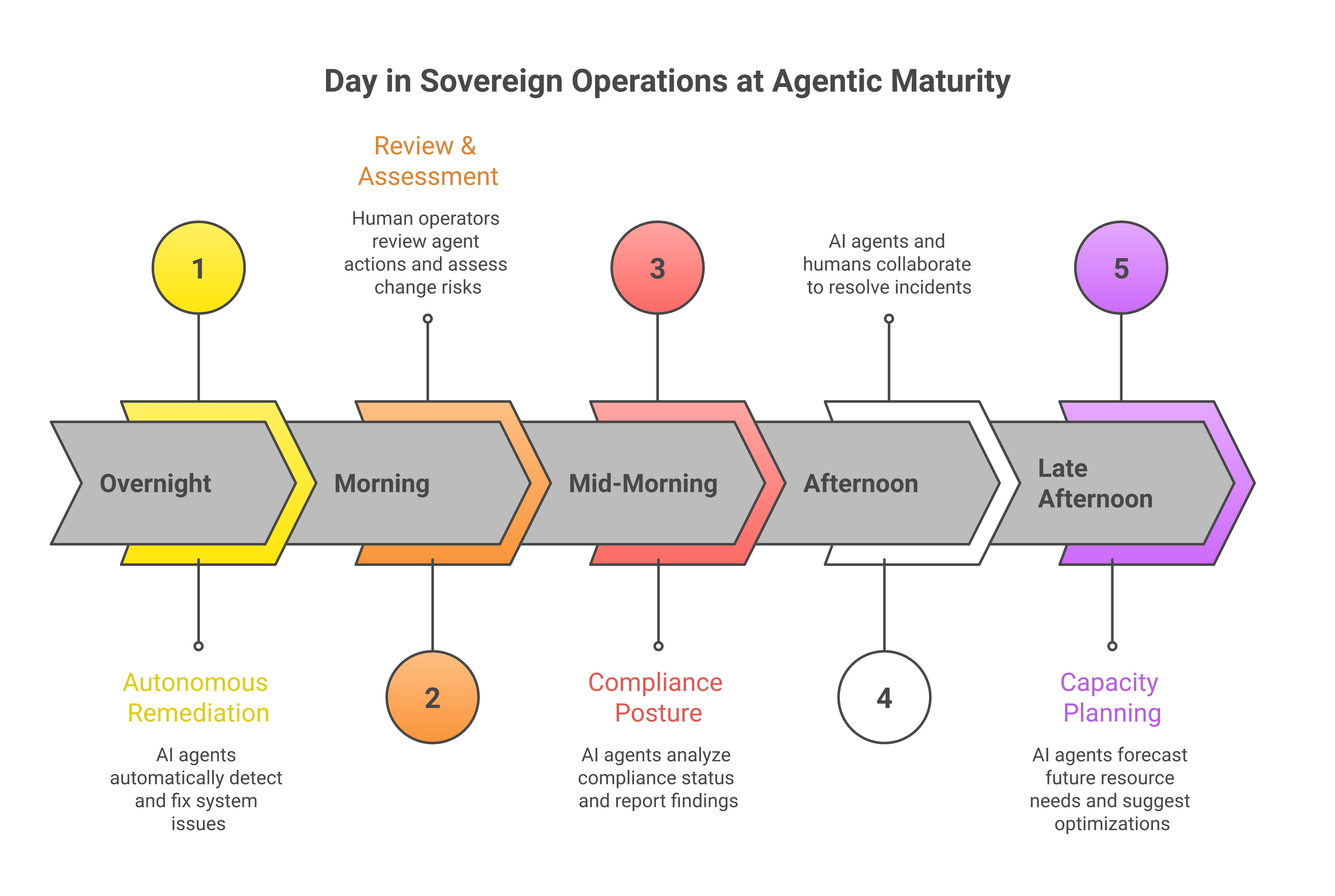
Abstractions become tangible when they are grounded in experience. Consider, then, a day in the life of a sovereign operations team in an enterprise that has reached agentic maturity. The year is 2030. The organisation is a mid-sized European financial services firm, operating across three sovereign zones—EU-regulated, UK-regulated, and a development zone with fewer constraints—on a multi-cloud estate spanning two hyperscaler providers and an on-premises private cloud.
06:15 — Overnight remediation review. The morning begins not with a flood of overnight alerts but with a structured review. During the night, agents handled fourteen operational events autonomously. Twelve were routine: certificate rotations, capacity adjustments triggered by overnight batch processing loads, a transient network path degradation between the EU zone and the UK zone that was mitigated by automatic traffic rerouting. Two were more significant: a memory leak in a trading risk calculation service that was detected by Instana’s anomaly detection, diagnosed by Concert’s correlation engine as a regression introduced by the previous day’s deployment, and remediated by an automatic rollback to the prior container image version. The rollback was authorised under the autonomous action boundary defined for Level 3 remediation of non-critical services in the development zone; the same event in the EU-regulated production zone would have required human approval.
The operations lead, arriving at 06:15, reviews the overnight activity summary presented by Concert. Each event is accompanied by a structured record: what was detected, what was diagnosed, what action was taken, what policy authorised it, and what the verified outcome was. The two rollback events are flagged for closer inspection. The lead reads the evidence, confirms that the remediations were appropriate, and annotates the deployment regression for follow-up with the development team. Total review time: twelve minutes. Under the previous operating model, the overnight on-call engineer would have been woken twice and would have spent forty minutes on each event.
09:30 — Change risk assessment. The platform team is preparing a significant infrastructure change: migrating the payments processing service from one hyperscaler to the other within the EU-regulated zone, motivated by a contractual renegotiation. The change risk agent, drawing on Concert’s topology model, the service’s dependency graph, historical incident data, and the sovereign zone’s compliance requirements, produces a structured risk assessment. It identifies three areas of concern: a hard dependency on a provider-specific managed database service that will require re-platforming; a network latency increase of approximately 4 milliseconds on the critical path, which is within the service’s latency budget but reduces the headroom; and a temporary period during cutover where the service will be running in both providers simultaneously, creating a brief window where data flows must be carefully governed to avoid sovereign zone boundary violations.
The change risk assessment is not a simple red-amber-green traffic light. It is a detailed narrative, supported by evidence, with specific recommendations for mitigating each concern. The platform architect reviews it, discusses the network latency concern with the network engineering team, and approves the change plan with a modification: an additional monitoring checkpoint at the cutover stage that will automatically halt the migration if latency exceeds the defined threshold. The agent incorporates the modification into the change record and updates the rollback plan accordingly.
11:00 — Compliance posture review. The compliance monitoring agent produces its weekly sovereign compliance report. The report is generated automatically from the continuous evaluation of the estate against the policy-as-code corpus: DORA operational resilience requirements, GDPR data residency constraints, the organisation’s internal data classification policies, and the sovereign zone boundary rules. This week, the report identifies one new finding: a development team has deployed a test service in the EU-regulated zone that references an external API endpoint hosted outside the EU. The service is not yet handling production data, but the sovereign zone policy requires that all services deployed in the regulated zone, regardless of lifecycle stage, must have their external dependencies reviewed and approved.
The compliance agent has already raised a ticket with the development team, citing the specific policy clause, and has proposed two remediation paths: either move the test service to the development zone, where the external dependency is permitted, or submit the external API for sovereign compliance review. The compliance officer reviews the finding, confirms the agent’s assessment, and approves the remediation pathway. No human needed to discover the violation; no human needed to look up the relevant policy; no human needed to draft the ticket. The human’s role was to exercise judgement about which remediation path was appropriate—a judgement that required understanding the development team’s timeline and the business context of the test service.
14:00 — Incident response. A genuine incident occurs. The payments processing service in the EU-regulated zone experiences a sudden increase in error rates. Instana detects the anomaly within seconds and feeds the signal to Concert. Concert correlates the error rate increase with a simultaneous latency spike on the database connection pool and a recent certificate rotation on the database cluster. Within ninety seconds, Concert produces a situation assessment: the certificate rotation, which was executed by an automation agent overnight, replaced the TLS certificate on the database primary replica but failed to propagate the new certificate to one of the read replicas, causing connection failures from the payments service’s read-path connections.
The incident response agent proposes a remediation: propagate the certificate to the affected read replica and restart the affected connection pools. The remediation falls within the Level 3 autonomous action boundary for certificate management in the regulated zone, but because the payments service is classified as critical, the policy requires human approval for any remediation that involves restarting connection pools. The agent routes the approval request to the on-call engineer, presenting the full evidence chain. The engineer reviews the proposal, approves it, and the remediation is executed. Error rates return to baseline within four minutes. The incident record is automatically populated with the complete timeline, the evidence, the approval, and the outcome. The post-incident review, conducted the following day, identifies the root cause as an incomplete certificate propagation playbook and updates the automation to include read replica certificate verification as a post-rotation check.
16:30 — Capacity planning. The capacity planning agent presents its quarterly forecast. Drawing on historical resource utilisation trends, the business’s planned product launches for the next quarter, and the topology model’s understanding of service dependencies, it projects that the payments processing service will need a 20 per cent increase in database capacity within eight weeks. It also identifies that the current reserved instance allocation on the primary hyperscaler provider will expire in six weeks, and recommends renewing at a higher tier to accommodate both the projected growth and the headroom required by the organisation’s resilience policy.
The infrastructure architect reviews the forecast, adjusts the growth assumption based on a conversation with the business team about a delayed product launch, and approves a modified capacity plan. The agent translates the approved plan into Terraform changes, raises a pull request, and schedules the change for the next maintenance window.
This is not a frictionless utopia. The operations team still faces uncertainty, still makes difficult judgements, still encounters situations that no agent has seen before. But the baseline of operational work—the detection, correlation, compliance checking, documentation, and routine remediation that once consumed the majority of engineering time—is handled by agents operating within well-governed boundaries. Human attention is directed where it matters most: the novel, the ambiguous, the consequential.
38.4 The trust equation at maturity
The day described in the previous section is only possible if the organisation has developed a deep, calibrated trust in its agentic systems. That trust does not arrive suddenly with a product deployment. It is built over years of experience, incremental boundary expansion, transparent performance, and honest accounting of failures.
Chapter 1 introduced the concept of trust in automation as a critical human factor, and Chapter 29 discussed how trust is operationalised through the autonomous action boundary—the explicit, policy-defined specification of what agents may do without human approval. At maturity, trust is more than a policy document. It is an organisational capability: the ability to make nuanced, evidence-based decisions about how much autonomy to grant, in which contexts, and with what oversight.
The trust equation at maturity has four terms.
Transparency is the foundation. Every agent action is recorded, explained, and auditable. The sovereign AI record (Chapter 23) captures not just what happened but why the agent believed it was the right thing to do, what evidence it relied upon, and what the outcome was. Engineers can inspect agent reasoning at any time, not because they routinely distrust the agents but because the ability to inspect is what makes routine trust possible. Transparency is not a burden imposed on the system; it is the mechanism through which trust is continuously renewed. As Beyer and colleagues observed in the context of site reliability engineering, the precondition for trusting automated systems is the ability to understand their behaviour after the fact, because trust that cannot be verified is not trust but faith [4].
Track record provides the empirical basis for trust calibration. The organisation maintains detailed performance metrics for every agent class: accuracy of recommendations, success rate of autonomous remediations, false positive rates, escalation frequency, and—crucially—the outcomes of actions that were taken versus the counterfactual outcomes of actions that were proposed but not taken. Over time, these metrics build a quantitative picture of agent reliability that informs boundary-setting decisions. An agent that has successfully remediated three hundred certificate propagation failures without error earns a wider boundary than an agent that has been deployed for two weeks. This is not blind trust in historical performance; it is Bayesian calibration, updated continuously as new evidence arrives [5].
Governance provides the structural assurance. The AI governance framework (Chapter 22), with its standing bodies, decision rights, lifecycle processes, and evidence management, ensures that trust is not an informal, person-dependent assessment but an organisational process. The AI Governance Board reviews agent performance quarterly, adjusts autonomy boundaries based on evidence, and makes explicit decisions about which new capabilities to grant autonomy and which to hold at human-approval-required. These decisions are documented, justified, and auditable. When a regulator asks “how do you decide what your agents are allowed to do?” the answer is not “the engineering team thought it was fine” but a structured governance process with defined accountabilities.
Humility is the corrective. The most trustworthy agentic systems are those that know their own limits. An agent that confidently proposes a remediation for a situation it has never encountered is more dangerous than an agent that escalates to a human with an honest assessment: “this situation does not match any pattern in my experience; here is what I observe, and here is why I am uncertain.” Designing agents with calibrated confidence—the ability to distinguish between situations they understand well and situations they do not—is an engineering challenge that remains active, but the organisational posture must reinforce it. An enterprise that rewards agent autonomy without rewarding agent humility will eventually suffer the consequences of overconfident automation.
The balance between autonomy and control is not a fixed point to be found and held. It is a dynamic equilibrium, continuously adjusted as the estate evolves, as agents improve, as new failure modes emerge, and as regulatory expectations shift. The fully agentic enterprise does not achieve trust and then stop thinking about it. It maintains trust as an active practice, just as it maintains security, compliance, and operational resilience.
38.5 Risks of the fully agentic enterprise
Honesty requires that a book advocating agentic operations also confront the risks of the destination it describes. The fully agentic enterprise is not without peril, and the perils are not merely theoretical.
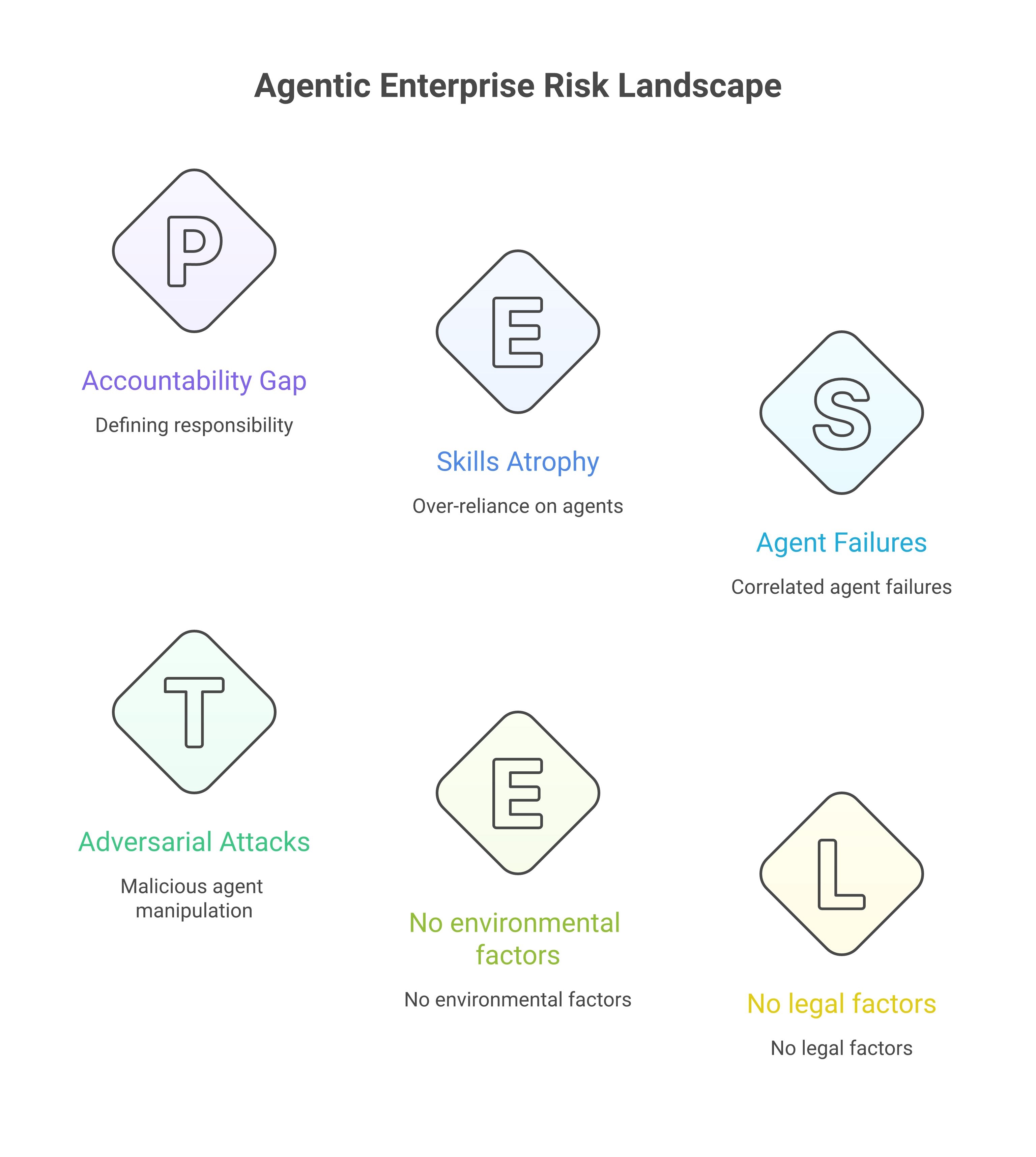
Over-reliance on agents is the most insidious risk, because it manifests gradually and silently. When agents handle the majority of operational events, engineers interact less frequently with the raw signals, the detailed logs, the low-level infrastructure behaviour that once constituted their daily experience. Over time, the deep, intuitive understanding of system behaviour that comes from direct engagement erodes. This is not a hypothetical concern; it is a well-documented phenomenon in aviation, where automation has improved safety overall but has also created instances where pilots lacked the manual flying skills to recover from situations that the automation could not handle [6]. In operations, the equivalent scenario is an agent failure during a complex, multi-system incident, at which point the human team must diagnose and remediate without the assistance they have come to depend on. Mitigating this risk requires deliberate investment in skills maintenance: regular exercises in which engineers operate without agent assistance, structured learning from agent-handled incidents, and rotation through roles that maintain direct system engagement.
Skills atrophy extends beyond the immediate operations team. In an enterprise where agents compose Terraform changes, draft runbooks, assess change risks, and generate compliance reports, the skills required to perform these tasks manually may diminish across the organisation. This is not merely an operational risk; it is a strategic risk. An organisation that cannot perform core operational functions without its agents is an organisation that has traded one form of dependency—on manual processes—for another, arguably more fragile, form of dependency. The mitigation is not to refuse agent assistance but to ensure that the organisation maintains a cadre of engineers who can operate at full capability without it, and to treat that capability as a strategic asset rather than an anachronism.
Systemic failures from correlated agent errors represent a different class of risk. When multiple agents share the same foundation models, the same training data, or the same reasoning patterns, they may be susceptible to correlated failures: situations in which the same blind spot or bias affects multiple agents simultaneously. A foundation model that systematically underestimates the latency impact of a particular network configuration might lead the incident diagnosis agent, the change risk agent, and the capacity planning agent to all make the same error, each reinforcing the others’ conclusions. The mitigation requires diversity in agent architectures and models, independent validation of agent recommendations in high-stakes contexts, and red-team exercises that deliberately probe for correlated failure modes [7].
Adversarial attacks on agent systems are an emerging threat. As agents gain the ability to take consequential actions in production environments, they become attractive targets for adversaries. Prompt injection attacks, data poisoning, and manipulation of the signals that agents rely upon are all potential vectors. An adversary who can influence the telemetry that an agent observes may be able to trick the agent into taking a harmful action—draining a connection pool, triggering an unnecessary failover, approving a malicious change. The security of agent systems requires the same rigour as the security of any other critical production component: input validation, anomaly detection on agent behaviour itself, separation of privileges, and the principle that no single agent should have unconstrained access to the production estate. Chapter 21’s risk taxonomy and Chapter 22’s governance framework provide the structural defences; the technical defences must evolve as the threat landscape evolves.
The accountability challenge is perhaps the most difficult risk to address, because it is as much philosophical as technical. When an agent makes a recommendation, a human approves it, the automation executes it, and the outcome is harmful, who is accountable? The human, who approved a recommendation they may not have fully understood? The engineering team that designed the agent? The governance board that approved the agent’s autonomy boundary? The vendor that provided the foundation model? Current regulatory frameworks are clear that human accountability cannot be delegated to machines [3], but the practical reality of allocating accountability in a complex human-agent system is far from settled. The fully agentic enterprise must invest in clear accountability frameworks—not merely as legal protections but as design constraints that ensure every consequential action has a named human who is empowered and equipped to exercise genuine oversight.
None of these risks is a reason to avoid agentic operations. Each of them is a reason to pursue agentic operations thoughtfully, with the same rigour and humility that the best engineering organisations apply to any consequential system change.
38.6 The sovereignty dividend
The argument of this book has been that sovereign agentic operations is necessary: necessary to meet regulatory obligations, necessary to manage complexity, necessary to sustain operational resilience in multi-cloud estates. But necessity, while a powerful motivator, does not tell the full story. There is also a positive case—a sovereignty dividend—that accrues to organisations that build this capability well.
Optionality is the first dividend. An organisation with a well-governed, codified, provider-spanning control plane has genuine choices about where and how it runs its workloads. It is not locked into a single provider’s ecosystem by entangled dependencies, proprietary integrations, or undocumented operational knowledge. When contract terms change, when a provider’s security posture becomes questionable, when a new regulatory requirement makes a particular deployment model untenable, the organisation can move. Not effortlessly—migration is never effortless—but with a structured, executable plan that has been codified in infrastructure as code, tested through automation, and validated by agents that understand the dependency graph. Chapter 17’s discussion of designing for uncertainty described this as “room to manoeuvre.” At maturity, that room is not aspirational but demonstrable.
Resilience is the second dividend. The observability, automation, and agentic capabilities that the sovereign control plane provides do not merely satisfy regulatory requirements for operational resilience; they produce genuine resilience that manifests in faster detection, faster diagnosis, faster remediation, and fewer cascading failures. The enterprise that can detect an anomaly in seconds, correlate it with its root cause in under a minute, and execute a governed remediation in under five minutes is materially more resilient than the enterprise that relies on human engineers to perform the same sequence manually. That resilience translates directly into reduced downtime, reduced customer impact, and reduced financial loss.
Speed is the third dividend. When change management, compliance checking, and risk assessment are embedded in the operational flow rather than performed as sequential, manual gates, the pace of change increases without a corresponding increase in risk. The enterprise can deploy more frequently, respond to business requirements more quickly, and adapt to regulatory changes with less disruption. Forsgren, Humble, and Kim demonstrated empirically that deployment frequency, lead time for changes, mean time to recovery, and change failure rate are correlated and predictive of organisational performance [12]; the sovereign agentic control plane improves all four metrics simultaneously by removing the manual bottlenecks that traditionally forced organisations to choose between speed and safety. This is not the reckless speed of an enterprise that has eliminated controls; it is the disciplined speed of an enterprise whose controls are automated, continuous, and intelligent.
Cost efficiency is the fourth dividend. Agents that handle routine operational events, generate compliance reports, and optimise capacity allocation reduce the per-unit cost of operations. This is not primarily an argument about headcount reduction—though some organisations may realise staffing efficiencies—but about the reallocation of expensive human expertise from low-value, repetitive work to high-value, creative work. The engineer who spends four hours a week generating compliance reports is not doing work that requires an engineer; the engineer who spends those four hours improving the resilience of a critical service is.
Regulatory confidence is the fifth dividend, and in many ways the most valuable. An organisation that can produce, on demand, a complete, auditable record of how its estate is governed, how its agents operate, how its compliance posture is maintained, and how every consequential operational action was authorised and executed is an organisation that approaches regulatory interactions with confidence rather than anxiety. The sovereign AI record, the policy-as-code corpus, the governance board minutes, and the continuous compliance reports together constitute a body of evidence that no amount of retrospective documentation assembly can match. Regulators, increasingly, are learning to distinguish between organisations that can demonstrate their controls and organisations that can only describe them. The former earn a different quality of supervisory relationship.
Taken together, these dividends amount to something more than the sum of their parts. They amount to sovereignty as competitive advantage. The organisation that has invested in building a sovereign, agentic operations capability is not merely compliant; it is more agile, more resilient, more efficient, and more trustworthy than its peers. In a market where trust is a differentiator—where customers, partners, and regulators increasingly choose to work with organisations that can demonstrate genuine operational control—sovereignty is not a cost centre. It is a strategic asset [8].
38.7 Systems that can be lived with
The closing section of the staged content that seeded this chapter’s predecessor asked a simple question: would you be comfortable putting your name to the system you are building, knowing that you and your colleagues will be the ones on call when it misbehaves? That question deserves to be carried forward, because it captures something essential about the relationship between architects, operators, and the systems they tend.
The fully agentic enterprise is not a destination with a ribbon to cut. There is no moment at which an organisation declares itself “done” with the work of building sovereign, agentic operations. The estate will continue to evolve: new services, new providers, new regulations, new AI capabilities, new failure modes. The agents will improve, but they will also encounter situations they were not designed for. The governance frameworks will need to be updated as regulatory expectations shift. The human skills required to oversee the system will change as the system itself changes.
What the enterprise can achieve is not a final state but a sustainable practice: the ongoing work of tending an evolving estate with care, rigour, and enough slack in the system that people can think. This is not a small achievement. Many organisations are currently overwhelmed by the complexity of their estates, struggling to keep pace with the volume of signals, changes, and obligations. Moving from that state to one in which the operational baseline is handled by well-governed agents, freeing human attention for the genuinely difficult problems, represents a profound improvement in the quality of operational life.
There is a temptation, in a book about technology, to focus exclusively on the systems and to treat the people as inputs to be optimised. This book has tried to resist that temptation. Chapter 32 discussed the skills, culture, and human factors that determine whether technology investments translate into operational outcomes. Chapter 31 described the operating model shifts required to make agentic operations sustainable. The maturity model in Chapter 33 was deliberately constructed to include organisational and cultural dimensions alongside technical ones. These are not supplementary concerns; they are co-equal with the architecture.
The systems that can be lived with are systems that respect the limits of both human and machine cognition. They do not overwhelm engineers with noise. They do not make decisions opaque. They do not create new forms of dependency without acknowledging them. They do not promise certainty where uncertainty is the honest condition. They provide the tools, the intelligence, and the governance infrastructure that people need to do their work well, and then they get out of the way.
If there is a single design principle that unites the patterns described in this book—sovereign zones, zero-copy integration, policy-as-code, observability planes, agentic intelligence, guardrails, governance frameworks, human-agent partnership—it is this: build systems that make it easier for good engineers to do the right thing under pressure. Everything else follows.
Key Takeaways
-
The “fully agentic” enterprise is not a fully autonomous enterprise: humans remain accountable for consequential decisions, and agents operate within explicitly defined, policy-governed autonomy boundaries at Levels 3 and 4 of the operational autonomy spectrum.
-
At maturity, the four planes of the sovereign operations architecture—observability, automation and orchestration, agentic intelligence, and governance and audit—function as a coherent, integrated control plane, with IBM Concert serving as the unifying correlation and reasoning layer.
-
Daily operations in a mature agentic estate are characterised by agents handling routine detection, correlation, compliance checking, and remediation, with human engineers focusing on novel situations, architectural decisions, boundary-setting, and genuine oversight.
-
Trust in agentic systems is built and maintained through four reinforcing mechanisms: transparency (full auditability of agent actions), track record (quantitative performance evidence), governance (structured organisational oversight), and humility (calibrated agent confidence and honest escalation of uncertainty).
-
The risks of the fully agentic enterprise—over-reliance on agents, skills atrophy, correlated agent failures, adversarial attacks, and the accountability challenge—are real and must be actively mitigated through deliberate investment in skills maintenance, architectural diversity, security rigour, and clear accountability frameworks.
-
Sovereign agentic operations yields a measurable sovereignty dividend: optionality across providers, genuine operational resilience, disciplined speed of change, cost efficiency through reallocation of human expertise, and regulatory confidence grounded in demonstrable, auditable controls.
-
There is no final state in which sovereign agentic operations is “done”; the enterprise must maintain a sustainable practice of continuous improvement, treating the operational estate as a living system that requires ongoing care, adaptation, and enough slack for people to think.
Closing reflection
This book began, in Chapter 1, with an observation about the limits of yesterday’s cloud operations: the dashboard fatigue, the integration complexity, the regulatory pressure, the growing gap between what distributed architectures demand and what human teams can sustain unaided. It proposed that the response to those limits is not more dashboards, more analysts, or more documentation, but a sovereign cloud operations control plane: a set of interconnected capabilities that continuously models the estate, correlates signals intelligently, surfaces recommended actions, executes approved changes through governed automation, and produces an auditable record of everything it does.
Thirty-seven chapters later, that proposition has been examined from every angle this book could bring to bear: architecture and topology, observability and signals, automation and code, orchestration and agents, governance and audit, operating models and human factors, blueprints and case studies, risks and horizons. The details are extensive, but the core idea remains simple: in a world where data, computation, and regulation are distributed across jurisdictions and providers, the organisation needs a control plane that is as thoughtfully designed as the applications it supports—one that treats sovereignty as an operational property, AI as a supervised colleague, and human judgement as the irreplaceable resource it is.
Whether the tools that instantiate this control plane carry IBM’s name or another’s, the patterns endure. Sovereign zones that enforce jurisdictional boundaries. Zero-copy integration that reduces the governance surface. Policy-as-code that makes compliance continuous. Observability that understands topology, not merely metrics. Agents that recommend and act within governed boundaries. Governance that produces evidence, not merely assertions. Humans who design, supervise, and improve—and who remain, always, the accountable parties.
The work is not finished. It will not be finished. But it is worth doing, and worth doing well. If the ideas in this book help even a few organisations build operational estates that are more sovereign, more intelligent, more resilient, and more humane—estates that their architects and operators are genuinely proud to put their names to—then the book has served its purpose.
References
[1] SAE International, Taxonomy and Definitions for Terms Related to Driving Automation Systems for On-Road Motor Vehicles, Standard J3016_202104, SAE International, Warrendale, PA, USA, Apr. 2021. [Online]. Available: https://www.sae.org/standards/content/j3016_202104/
[2] IBM, IBM Concert Product Documentation: Architecture and Core Concepts, IBM Corp., Armonk, NY, USA, 2025. [Online]. Available: https://www.ibm.com/docs/en/concert
[3] European Parliament and Council of the European Union, “Regulation (EU) 2024/1689 of the European Parliament and of the Council of 13 June 2024 laying down harmonised rules on artificial intelligence (AI Act),” Official Journal of the European Union, Jun. 2024. [Online]. Available: https://eur-lex.europa.eu/legal-content/EN/TXT/?uri=CELEX%3A32024R1689
[4] B. Beyer, C. Jones, J. Petoff, and N. R. Murphy, Eds., Site Reliability Engineering: How Google Runs Production Systems, O’Reilly Media, Sebastopol, CA, USA, 2016. [Online]. Available: https://sre.google/sre-book/table-of-contents/
[5] D. Kahneman, Thinking, Fast and Slow, Farrar, Straus and Giroux, New York, NY, USA, 2011.
[6] N. B. Sarter, D. D. Woods, and C. E. Billings, “Automation surprises,” in Handbook of Human Factors and Ergonomics, 2nd ed., G. Salvendy, Ed., John Wiley & Sons, New York, NY, USA, 1997, pp. 1926–1943.
[7] M. Brundage et al., “Toward trustworthy AI development: mechanisms for supporting verifiable claims,” arXiv preprint arXiv:2004.07213, Apr. 2020. [Online]. Available: https://arxiv.org/abs/2004.07213
[8] European Union Agency for Cybersecurity (ENISA), Cloud Security for the EU: Security Framework for Cloud Services, ENISA, Heraklion, Greece, 2021. [Online]. Available: https://www.enisa.europa.eu/publications/cloud-security-for-the-eu
[9] European Parliament and Council of the European Union, “Regulation (EU) 2022/2554 of the European Parliament and of the Council of 14 December 2022 on digital operational resilience for the financial sector (DORA),” Official Journal of the European Union, L 333, pp. 1–79, Dec. 2022. [Online]. Available: https://eur-lex.europa.eu/legal-content/EN/TXT/?uri=CELEX%3A32022R2554
[10] J. O. Kephart and D. M. Chess, “The vision of autonomic computing,” IEEE Computer, vol. 36, no. 1, pp. 41–50, Jan. 2003. [Online]. Available: https://doi.org/10.1109/MC.2003.1160055
[11] IBM, IBM watsonx.governance: AI Governance and Risk Management, IBM Corp., Armonk, NY, USA, 2025. [Online]. Available: https://www.ibm.com/docs/en/watsonx/watsonxgov
[12] N. Forsgren, J. Humble, and G. Kim, Accelerate: The Science of Lean Software and DevOps, IT Revolution Press, Portland, OR, USA, 2018. [Online]. Available: https://itrevolution.com/product/accelerate/
Sovereign Cloud Operations: AI-Driven Management of Sovereign Estates
© 2026 by Alan Hamilton
is licensed under CC BY-SA 4.0


