Chapter 35 — Industry Patterns for Sovereign Operations
Summary
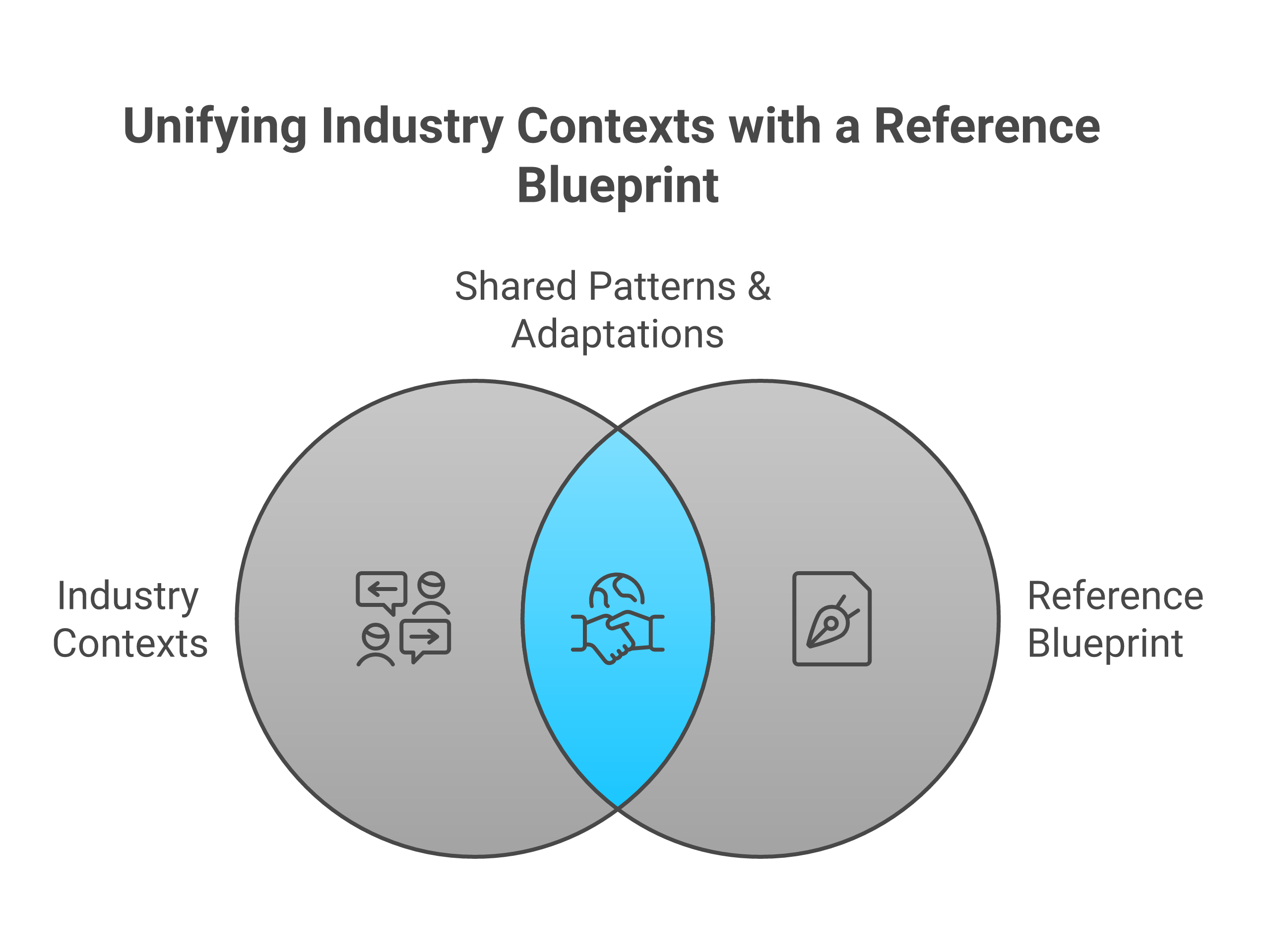
This chapter applies the reference blueprints of Chapter 34 to four regulated industry contexts — financial services, public sector, healthcare and telecommunications — showing how the same core architectural patterns adapt when they encounter sector-specific regulatory constraints, failure tolerances and transparency expectations. It examines sovereign zone design aligned to supervisory boundaries, zero-copy integration for transaction and patient data, agentic incident response calibrated to each sector’s risk profile, and the governance implications of frameworks such as DORA, NIS 2 and medical device regulation. The chapter closes by identifying the five structural patterns shared across all industries and the key divergences — autonomy thresholds, regulatory specificity, transparency obligations and political dimensions — that architects must calibrate for their own context.
35.1 Why industry context matters
The reference blueprints developed in Chapter 34 are deliberately technology-centric. They describe the structural patterns — sovereign zones, zero-copy integration layers, observability planes, agentic orchestration — that any large organisation can assemble from the components discussed throughout this book. What they do not do is account for the fact that a payment outage in a retail bank is not the same event as a degraded patient-record service in a hospital, a portal failure in a national tax authority, or a routing misconfiguration at a telecoms operator serving emergency services. The underlying architectural patterns may rhyme, but the constraints — regulatory, ethical, operational — are profoundly different.
Financial services organisations operate under prescriptive frameworks such as the Digital Operational Resilience Act (DORA) [1], which imposes specific obligations on ICT risk management, incident classification timelines, and third-party oversight. Public-sector bodies must satisfy constitutional expectations of transparency and national jurisdiction that have no precise analogue in the private sector. Healthcare providers navigate clinical safety requirements where the consequences of an automated decision are measured not in revenue but in patient outcomes. Telecommunications operators bear critical national infrastructure obligations where service continuity is a matter of public safety. Each sector has its own vocabulary, its own regulators, its own failure tolerances, and its own cultural relationship with automation and risk.
This chapter applies the blueprints of Chapter 34 to four industry contexts: financial services, public sector, healthcare, and telecommunications. In each case, the goal is not to produce a prescriptive reference architecture — the permutations are too many and the regulatory landscapes too jurisdiction-specific for that to be honest work — but to show how the same core ideas adapt when they meet real sectoral constraints. The chapter closes by drawing out the cross-industry patterns and divergences, so that practitioners in any sector can extract the lessons most relevant to their own estates.
Readers should treat this chapter as a companion to Chapter 34. Where Chapter 34 answers “what does the architecture look like?”, this chapter answers “what does it feel like to operate it in a specific industry, and what sector-specific traps should the architect anticipate?”
35.2 Financial services: sovereign payments and trading
Consider a pan-European bank with operations in seven member states, a mix of legacy mainframes and modern microservices, and regulatory obligations under the Payment Services Directive (PSD2), the General Data Protection Regulation (GDPR) [2], DORA [1], and a patchwork of national supervisory requirements. Its board has made three commitments: to keep critical services — payments, card processing, core banking — available even under geopolitical stress; to ensure that customer data stays within defined jurisdictions and under local control where required; and to adopt AI-assisted operations without creating unmanageable new risks.
The regulatory surface for financial services is broader than even this list suggests (see Chapter 3 for the full landscape). PSD2’s Strong Customer Authentication requirements constrain how payment flows may be rerouted during incidents, because failover paths must continue to satisfy the authentication obligations. The Markets in Crypto-Assets Regulation (MiCA) [12] extends comparable operational resilience and disclosure requirements to crypto-asset service providers, meaning that institutions with digital-asset operations must include those workloads within the same sovereign zone and compliance signal fabric. PCI DSS v4.0’s continuous monitoring mandate [13] requires that security controls for cardholder data environments be verified on an ongoing basis, not merely at quarterly assessment time — reinforcing the need for the real-time compliance posture view that Concert and OpenPages provide.
35.2.1 Sovereign zones aligned to supervisory boundaries
The bank defines sovereign zones aligned not merely to data residency requirements but to the broader concept of supervisory boundaries. An EU zone encompasses the core eurozone processing estate. A UK zone handles post-Brexit regulatory divergence, particularly around the Prudential Regulation Authority’s expectations for operational resilience [3]. National zones exist for member states where local supervisors impose additional constraints — Germany’s BaFin requirements for critical outsourcing, for example, or France’s ACPR expectations around third-party cloud usage.
Each zone is implemented as a set of cloud accounts, dedicated OpenShift clusters, and data-centre partitions with well-defined properties. Network fabrics and interconnects are defined via infrastructure as code, with policy-as-code guardrails enforcing that payment transaction data cannot traverse zone boundaries without explicit, auditable authorisation. Local identity providers and hardware security modules operate under bank or trusted-partner control. Observability backends and log stores are pinned to the zone, ensuring that operational telemetry about customer transactions does not inadvertently leave the supervisory jurisdiction in which those transactions originated.
Payment flows are zone-local by default. A card transaction in France is processed entirely within the EU zone: API gateways, fraud-scoring models, ledger updates, and customer notifications all execute within the sovereign boundary. Only derived analytics — aggregated fraud pattern scores, anonymised transaction volume statistics — leave the zone, and even then through carefully governed event streams with schema enforcement and data-classification tagging as described in Chapter 9.
35.2.2 Zero-copy transaction data and event-driven settlement
The bank has moved away from the legacy pattern of copying transaction data into multiple warehouses for risk, compliance, anti-money-laundering (AML), and marketing analytics. Instead, it employs a zero-copy integration pattern where systems of record expose data via governed APIs and virtualisation layers. Payment events — authorisations, settlements, chargebacks, disputes — flow through a zone-local event mesh built on Apache Kafka with schema registry enforcement [4].
Downstream consumers — risk engines, regulatory reporting systems, AML surveillance, customer analytics — subscribe to event topics and maintain their own materialised projections, rather than owning independent copies of raw transaction tables. The operational consequence is significant: payments site reliability engineers can observe the semantic flow of transactions as business events move through the system. Spikes in “AuthorisationFailed” events, unusual delays between “Authorised” and “Settled” states, bursts of “AMLAlertRaised” for a particular corridor — all of these are visible as first-class operational signals.
IBM Concert ingests these event streams alongside infrastructure telemetry, correlating business events with topology state [5]. When Concert observes that “AuthorisationFailed” events are rising for a specific acquirer path while infrastructure metrics for the corresponding services remain healthy, it can infer that the problem is upstream — perhaps a card network gateway issue — rather than internal. This correlation between business semantics and infrastructure state is precisely the kind of reasoning that traditional monitoring tools, operating only at the infrastructure layer, cannot perform.
35.2.3 Agentic incident response for payments
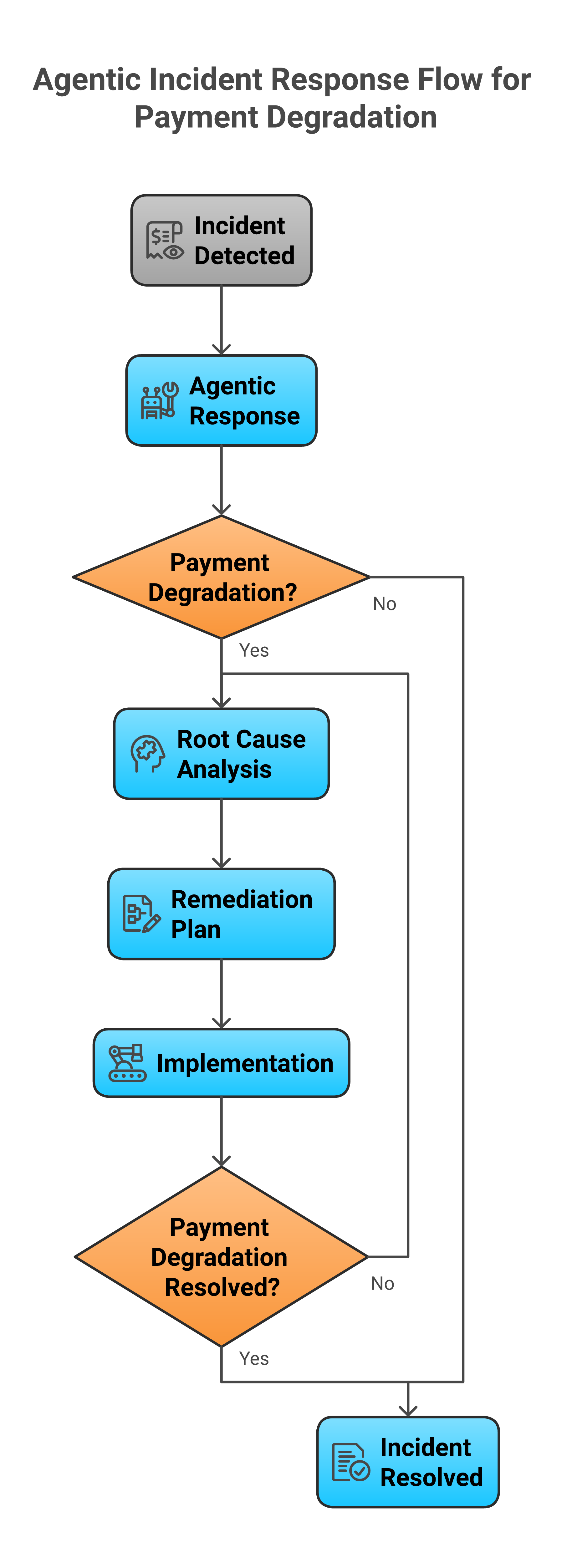
When payment success rates in the EU zone drop below the defined service level objective for a subset of merchants, the agentic operations framework activates a structured response.
A scout agent detects that, over the preceding ten minutes, “PaymentAuthorised” events have fallen by forty per cent while “PaymentAttempted” events remain steady. It tags the incident as affecting the EU sovereign zone, classifies it as a P1 business impact event given the payment SLO breach, and opens an incident record.
A planner agent correlates the situation. It pulls relevant metrics and distributed traces from the observability plane, queries event history for patterns — which issuers, which acquirers, which channels are affected — and checks recent deployment and configuration changes in the payment stack via the change event feed. It matches the pattern against the runbook library and identifies the relevant playbook: “Partial payment degradation in a single acquirer path.”
The planner proposes three remediation options to the human incident commander. First, route affected payment traffic to a backup acquirer within the same sovereign zone, accepting slightly higher interchange fees but restoring success rates. Second, degrade optional features — loyalty point accrual, real-time spending notifications — to reduce processing load and prevent retry storms from compounding the degradation. Third, in extremis, fall back to store-and-forward offline authorisation for low-value transactions below a configurable threshold.
A doer agent is authorised, within this zone’s policy framework, to implement the first and second options upon approval from the incident commander. It may not execute the third option — which carries regulatory implications under PSD2’s strong customer authentication requirements — without explicit risk sign-off from the payments risk function. The doer prepares the necessary configuration changes as infrastructure-as-code diffs, runs policy checks to ensure that no cross-zone routing would result, and executes upon receiving the required approvals.
Throughout the incident, every agent action is logged: what was observed, what was proposed, what was approved, what was executed, and what the measured outcome was. Post-incident, these traces feed directly into the regulatory reporting obligations described in the next section, into resilience scoring within Concert’s posture dashboard, and into the continuous refinement of runbooks and agent policies.
35.3 Financial services: agent governance under DORA
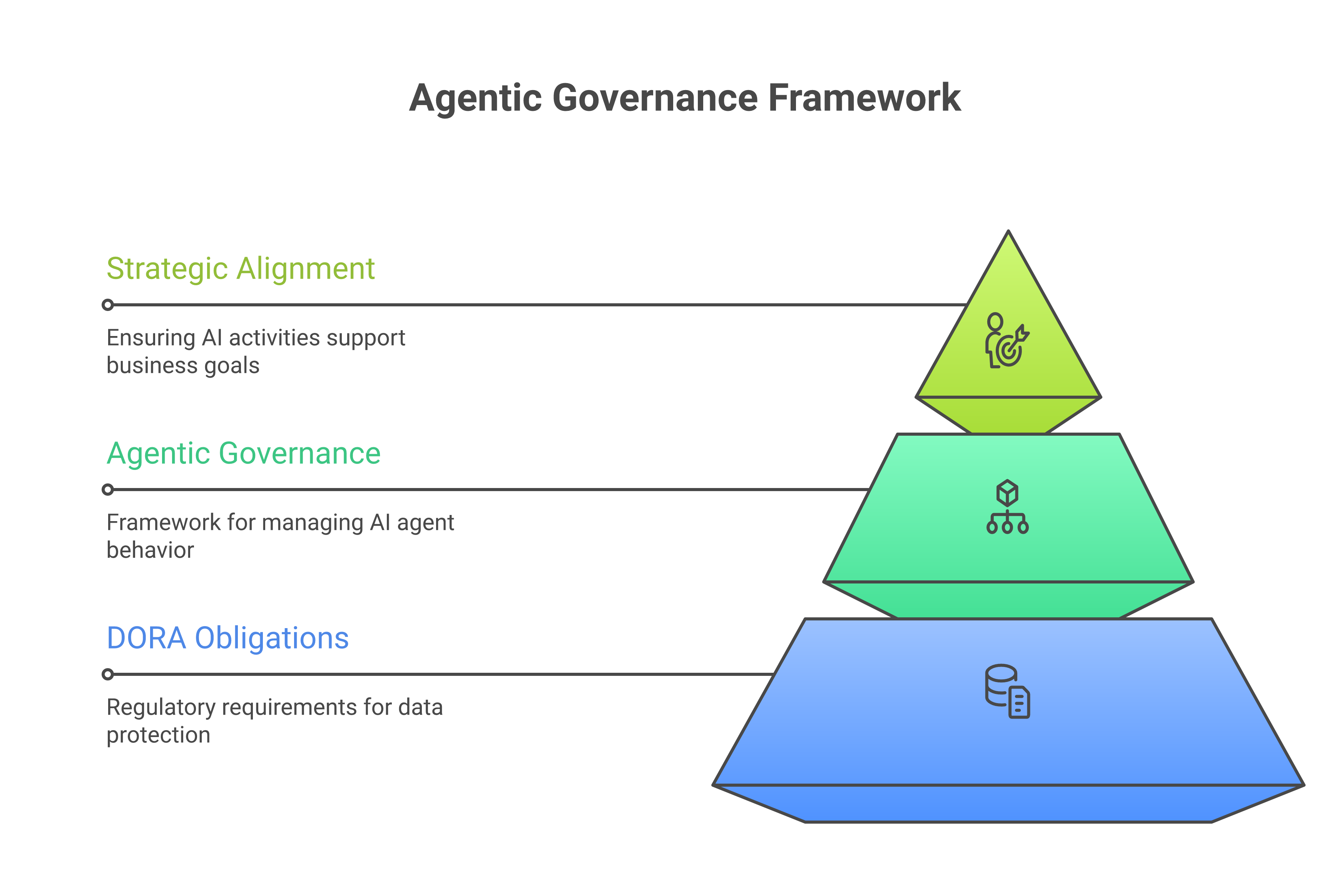
DORA [1] imposes obligations on financial entities that have direct implications for the governance of AI agents operating in production environments. The regulation was designed before agentic operations became mainstream, but its requirements around ICT risk management, incident reporting, and third-party oversight map onto the agentic governance framework described in Chapter 22 with uncomfortable precision.
35.3.1 ICT risk management and agent classification
DORA Article 6 requires financial entities to establish and maintain an ICT risk management framework that includes, among other things, the identification and classification of ICT-supported business functions and their dependencies on ICT systems and services. In an estate where AI agents can initiate configuration changes, execute runbook steps, and interact with production systems, those agents are themselves ICT components that must be classified within the framework.
The practical implication is that each agent type — scout, planner, doer — must be registered in the ICT asset inventory, classified by the criticality of the functions it supports, and subject to the same risk assessment discipline applied to any other ICT system. An agent that can reroute payment traffic is not a convenience; it is a critical ICT component whose failure, compromise, or misbehaviour could affect a critical or important function as defined under DORA Article 3.
Concert’s entity model, as described in Chapter 14, supports this classification naturally. Agents are entities in the topology graph, with typed relationships to the services they monitor and the actions they are authorised to perform. Their sovereign zone assignments, criticality classifications, and dependency relationships are maintained alongside those of every other component in the estate. When Concert generates a compliance posture view, agent entities are included in the assessment.
35.3.2 Incident reporting timelines and agent transparency
DORA Article 19 establishes specific timelines for reporting major ICT-related incidents to competent authorities: an initial notification within four hours of classification, an intermediate report within seventy-two hours, and a final report within one month. These timelines apply regardless of whether the incident was detected by a human or by an agent, and regardless of whether remediation involved automated actions.
For agentic operations, this creates a documentation requirement that goes beyond traditional incident management. If an agent detected the incident, the reporting chain must include what the agent observed, what thresholds triggered the detection, and what data sources informed its assessment. If an agent proposed or executed remediation actions, the report must describe what was proposed, what was authorised, what was executed, and what the measured impact was. The audit trail described in the payments scenario of section 35.2.3 is not optional good practice; it is a regulatory necessity.
The governance framework from Chapter 22 addresses this through mandatory action logging, approval chain recording, and outcome measurement for all agent actions above Level 1 autonomy. The DORA mapping is direct: the agent action log becomes a primary input to the incident report, and the approval chain recording demonstrates that human oversight was exercised in accordance with the entity’s ICT risk management framework.
35.3.3 Third-party risk management for AI model providers
DORA Chapter V establishes a framework for managing ICT third-party risk, including requirements for contractual provisions, exit strategies, and concentration risk assessment. When an organisation uses large language models or other AI foundation models from external providers as the reasoning substrate for its operational agents, those model providers become ICT third-party service providers within the meaning of the regulation.
This has several consequences. The organisation must conduct due diligence on the model provider, including assessment of the provider’s own operational resilience, data handling practices, and subcontracting arrangements. The contract must include provisions for audit rights, data location guarantees, and exit or substitution strategies. If the model provider is designated as a critical ICT third-party service provider under DORA Article 31, the European Supervisory Authorities gain direct oversight powers over that provider.
For architects, the implication is that the agentic operations architecture must be designed with model provider substitutability in mind. The abstraction layers described in Chapter 22 — which separate the agent’s decision logic from the underlying model invocation — serve not only as good engineering practice but as a regulatory compliance mechanism. An organisation that has hard-coded a dependency on a single model provider’s API, with no abstraction or substitution capability, may find itself unable to satisfy the exit strategy and concentration risk requirements of DORA.
35.4 Public sector: sovereign digital services
Now consider a national tax authority. It holds some of the most sensitive data in the country: income, assets, employers, benefits, family relationships. It faces intense public scrutiny and is subject to constitutional, privacy, and administrative law constraints as well as cybersecurity mandates under the NIS 2 Directive [6] for entities providing essential services. Its commitments look different from those of a bank: maintain availability of core services during filing seasons and crises; ensure that citizen data remains under national jurisdiction and that operational control is not ceded to foreign entities; and use AI to improve operations and citizen experience, but with strong transparency and accountability.
The regulatory framework for public-sector digital services varies by jurisdiction but converges on common themes of data sovereignty, operational control and supply-chain assurance (see Chapter 3). In the United States, FedRAMP establishes the security assessment and continuous monitoring baseline that cloud services must satisfy before hosting federal data [14]. In Europe, the proposed EU Cybersecurity Certification Scheme for Cloud Services (EUCS) aims to provide an equivalent assurance framework, with sovereignty tiers that map onto the zone-based architecture described throughout this book [15]. National frameworks — the UK’s Cyber Essentials and the German BSI C5 catalogue, among others — add further requirements that shape how sovereign zones are configured, audited and maintained for government workloads.
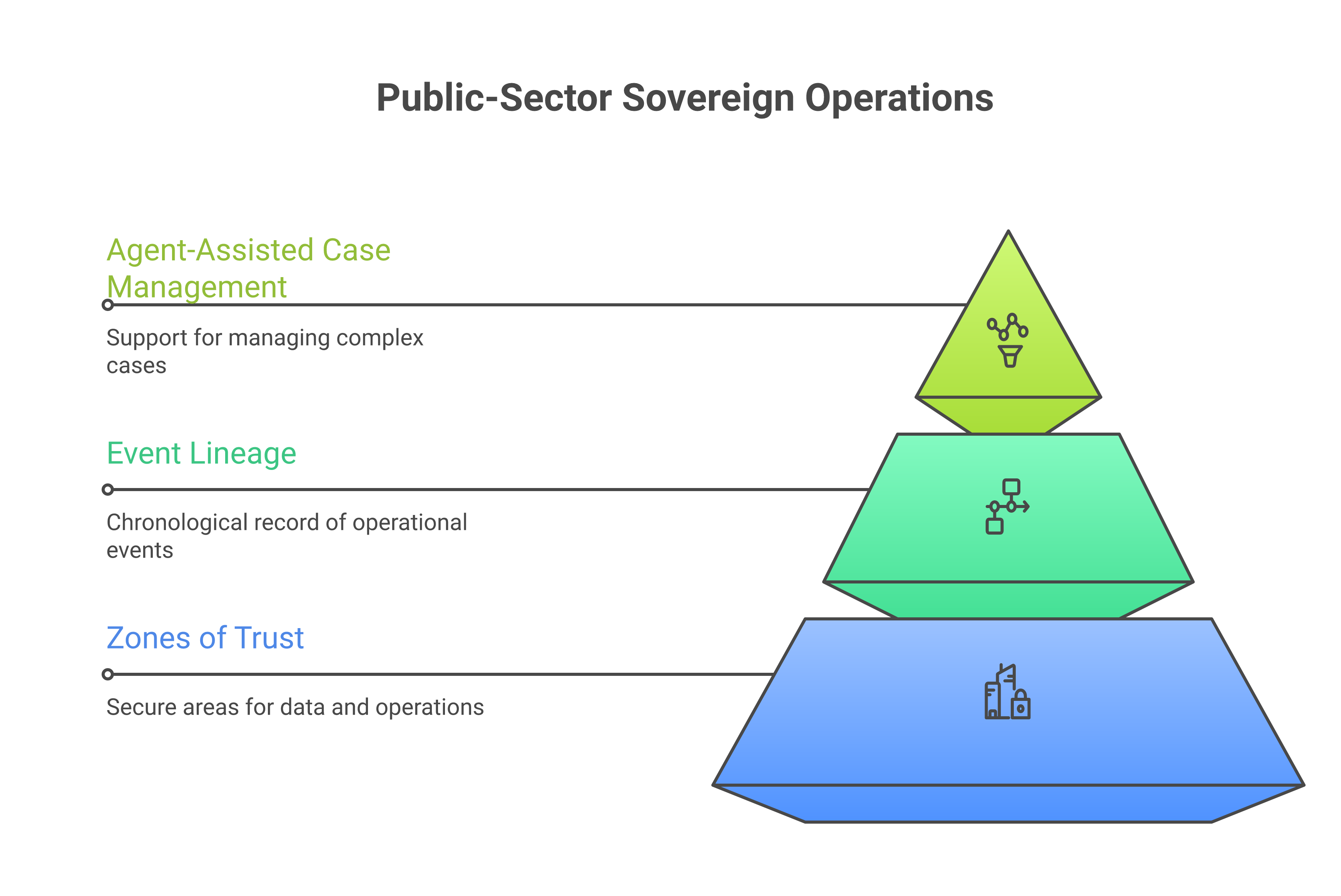
35.4.1 Sovereign core and zones of trust
The authority adopts a sovereign stack in which core tax processing systems run on a platform under national operational authority — whether in government data centres, trusted sovereign cloud regions, or a combination of both. Identity management, cryptographic key management, log aggregation, and AI control planes are operated domestically by personnel holding appropriate security clearances.
External hyperscaler services and SaaS platforms are not excluded but are treated as adjuncts, not as primary hosts for citizen data. They may serve roles in content delivery for public-facing portals, in development and testing environments using synthetic data, or in analytical workloads operating on anonymised datasets. The architectural principle is that the sovereign boundary is drawn around the citizen’s relationship with the state, not around every workload the authority operates.
Sovereign zones are defined for three tiers. A core processing zone, highly regulated and with minimal external connectivity, hosts the tax calculation engine, the citizen master record, and the benefits processing system. A digital services zone, with strict but somewhat more open connectivity, hosts portals, mobile applications, and public APIs through which citizens interact with the authority. An analytics and policy modelling zone uses anonymised or pseudonymised data under tight governance for economic modelling, fraud detection pattern development, and service improvement analysis.
The network topology ensures that a portal request that reads or writes tax data traverses only national infrastructure and approved providers. Observability telemetry follows the same constraint: traces and logs generated by the processing of citizen data remain within the sovereign boundary. Policy-as-code guardrails enforce these constraints at the infrastructure level, not merely as documented procedures.
35.4.2 Events, lineage, and democratic accountability
The authority leans heavily into events and lineage for transparency — not merely as an operational convenience but as a democratic accountability mechanism. When a public body uses automated systems to process citizens’ affairs, the expectation of explainability and traceability is qualitatively different from the private sector. Citizens have a right to understand how decisions affecting them were made, and public auditors have a right to verify that the authority’s systems behaved as intended.
Events capture key milestones in the tax lifecycle: “ReturnSubmitted,” “AssessmentCalculated,” “RefundIssued,” “AuditFlagRaised,” “AppealLogged,” “PenaltyApplied.” Lineage maps show which systems touched each return, which rules were applied, which models were consulted, and which data sources informed the assessment. When a citizen challenges an assessment, case workers and their supporting agents can see exactly what happened, step by step, across systems — not just the final numbers but the entire chain of computation and decision.
When incidents occur — a miscalculated benefit rate due to a rule-engine misconfiguration, for example — agents and human operators use lineage to identify affected citizens quickly, quantify the impact, generate draft communications, and plan remediation. The lineage trace also proves that certain data flows never left national boundaries. When parliamentary committees, national audit offices, or courts ask “Did this data leave the country or pass through foreign-operated systems?”, the answer is supported by actual flow graphs derived from the event fabric, not by contractual assurances or vendor attestations.
35.4.3 Agent-assisted case management and citizen interaction
Agentic operations in the public sector manifest in two principal domains.
Internally, operator-facing agents support incident response and case management. When an incident affects a subset of tax returns — perhaps a batch processing failure during filing season that left several thousand assessments in an inconsistent state — an agent correlates alerts and logs across systems, identifies which returns and taxpayers are impacted, generates draft remediation plans with estimated timelines, and ensures that proposed corrective actions remain within sovereign zones and legal constraints. The agent can draft citizen communications for human review, calculate the financial impact of delays or errors, and prepare the evidence package that the authority’s internal audit function will require.
Externally, citizen-facing agents — guided assistants embedded in the authority’s digital services — help people navigate forms, understand notices, and correct errors. These agents operate under stricter guardrails than their internal counterparts. They must be transparent about their nature as automated systems. They must be clear when they are not certain, explicitly declining to answer rather than confabulating. They must avoid giving legal or financial advice, instead directing citizens to qualified human advisors for complex situations. They must never access or disclose data outside the citizen’s own authenticated scope. And they must provide citizens with a clear, accessible path to speak with a human at any point in the interaction.
The governance framework for public-sector agents must also account for the political dimension. A commercial bank’s chatbot that gives an unhelpful answer loses a customer; a tax authority’s chatbot that gives incorrect guidance on a tax obligation can create legal liability for the citizen and political liability for the government. The guardrail framework must therefore be calibrated not only for technical accuracy but for the specific harms that public-sector errors can cause.
35.5 Healthcare: clinical and operational sovereignty
A national or regional health system deals with some of the most sensitive data that exists and operates under tight clinical safety and privacy requirements. Health data regulations — GDPR [2], national health data legislation, and sector-specific frameworks such as the UK’s Data Security and Protection Toolkit or Germany’s Patientendaten-Schutz-Gesetz — impose constraints that are at once similar to and different from financial regulation. The similarity lies in the emphasis on data protection and access control. The difference lies in the immediacy of consequences: in healthcare, a system failure or an incorrect automated recommendation can affect clinical outcomes in ways that are irreversible.
Three regulatory frameworks deserve specific mention because they impose operational requirements that directly shape the sovereign architecture (see Chapter 3). HIPAA’s Security Rule requires administrative, physical and technical safeguards for electronic protected health information (ePHI), including access controls, audit logging and encryption, that must be enforced within every sovereign zone hosting clinical data [16]. The EU Medical Device Regulation (EU MDR) [7] classifies certain health software — including clinical decision support tools and AI-based diagnostic aids — as medical devices subject to conformity assessment, clinical evaluation and post-market surveillance, obligations that extend to the observability plane and change management processes for those workloads. The US FDA’s 21 CFR Part 11 requires that electronic records and electronic signatures used in regulated pharmaceutical and clinical trial processes satisfy validation, audit trail and access control requirements [17], imposing constraints on CI/CD pipelines and configuration management systems that serve GxP-regulated environments within the health system’s estate.
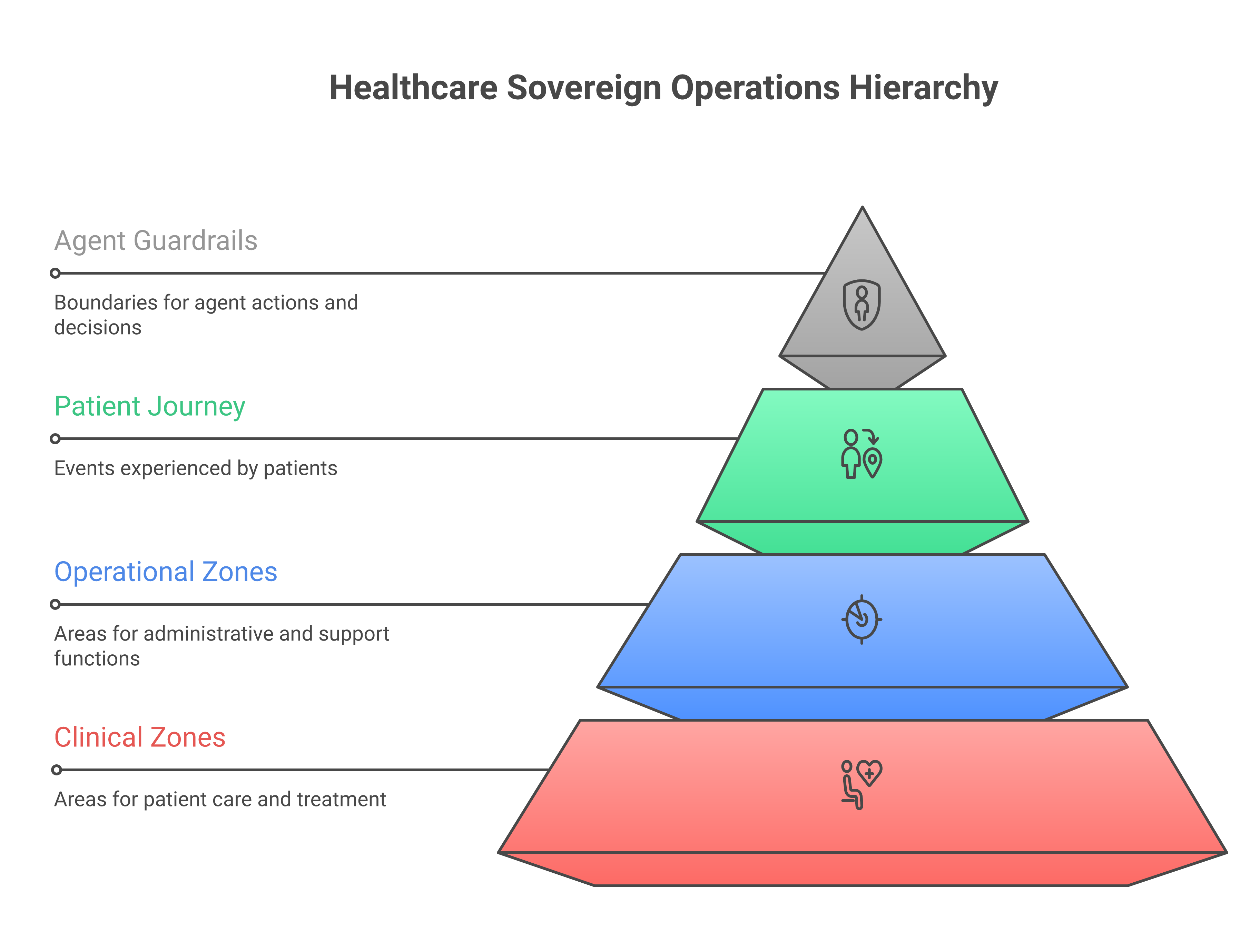
35.5.1 Clinical and operational zones
The health system defines at least two major sovereign zones, reflecting the fundamental distinction between clinical and operational data.
A clinical zone houses patient-identifiable data and the systems that support real-time clinical decisions: electronic health records (EHRs), prescribing systems, clinical imaging repositories, and laboratory information systems. This zone has the strongest controls and the most restrictive connectivity. Core EHR and ancillary systems are co-located to minimise latency and to eliminate dependence on external networks for time-critical clinical workflows. Observability telemetry and logs generated within the clinical zone remain local; aggregated, de-identified metrics may be exported for capacity planning, but raw patient data never leaves the zone boundary. Failover paths respect data-location constraints and clinical safety requirements — a failover that compromises data integrity in a prescribing system is worse than a temporary outage.
An operational and analytics zone hosts de-identified or pseudonymised data used for capacity planning, population health analytics, clinical research, and service improvement. Governance here is still rigorous — pseudonymised data can, under certain conditions, be re-identified, and the regulatory frameworks recognise this — but connectivity is somewhat more open, allowing collaboration with research institutions and public health bodies under data-sharing agreements.
Zero-copy integration patterns are particularly valuable in healthcare, where the historical pattern of duplicating patient data into departmental silos has created sprawling, ungoverned copies that are both a clinical risk and a regulatory liability. By exposing data through governed APIs and event streams rather than bulk extracts, the health system reduces the surface area of patient data exposure while maintaining the access that clinical and operational systems require.
35.5.2 Patient journey events and clinical lineage
Events map the patient journey through the health system: “AppointmentBooked,” “Admitted,” “TriageCompleted,” “MedicationPrescribed,” “ScanCompleted,” “LabResultReceived,” “Discharged,” “Readmitted.” For operations teams, these events provide a semantic view of system health that infrastructure metrics alone cannot deliver.
Patient journey events allow the system to track flow bottlenecks and delays — the time from “Admitted” to “BedAssigned,” for example, or the elapsed period between “ScanRequested” and “ScanCompleted.” They help detect anomalies: unusual spikes in “MedicationDelayed” events in a particular ward, or a sudden increase in “ReadmittedWithin48Hours” events that may indicate a systemic problem with discharge processes. They provide the semantic basis for agents to reason about system health and resource allocation in terms that clinicians and hospital managers understand.
Clinical lineage serves a more specific and higher-stakes purpose. It traces how diagnostic and treatment decisions were informed: which laboratory results were available at the time of prescribing, which imaging studies were reviewed, which clinical decision support models were consulted, which guidelines were applied. This lineage becomes critical when auditing clinical outcomes or investigating adverse events. If a patient received an incorrect medication, the lineage trace shows exactly what information was available to the prescribing system and whether the clinical decision support system flagged a contraindication. This is not merely an operational convenience; it is a patient safety mechanism and, increasingly, a medico-legal requirement.
35.5.3 Agents as clinical and operational assistants
In healthcare, the threshold for automation is higher than in any other sector discussed in this chapter, because the consequences of error are immediate, personal, and potentially irreversible. The agentic operations model must therefore be calibrated with particular care.
Operational agents — those supporting bed management, discharge planning, staff scheduling, theatre utilisation, and supply chain logistics — operate in domains where the consequences of suboptimal decisions are measured in efficiency and cost, not in clinical harm. An operational agent might predict bottlenecks based on recent admission events and historical patterns, suggest reallocation of nursing staff across wards to match predicted demand, or trigger runbooks when capacity thresholds are breached — diverting ambulances when emergency department occupancy exceeds safe levels, for example.
Clinical-adjacent agents operate under far stricter supervision. A clinical decision support agent may surface relevant guidelines and patient history for a clinician reviewing a case, highlight potential drug interactions or contraindications based on the patient’s medication record, or suggest differential diagnoses ranked by probability given the available evidence. But every output from such an agent must be clearly marked as a suggestion, never as an instruction. The clinician retains full decision authority, and the system must never create the impression that the agent’s recommendation carries clinical authority of its own.
The guardrail framework for clinical agents must enforce several non-negotiable boundaries. The agent must operate only on data within the clinical zone, unless exceptionally strong guarantees — including patient consent where required — permit access to data from external sources. The agent must be subject to clinical validation processes equivalent to those applied to any other clinical decision support tool, including the medical device regulatory frameworks that may apply in certain jurisdictions [7]. The agent must be continuously monitored for performance degradation, bias, and drift. And the agent must be immediately overrideable by the clinician, with every decision and override logged for clinical audit.
35.6 Telecommunications and critical infrastructure
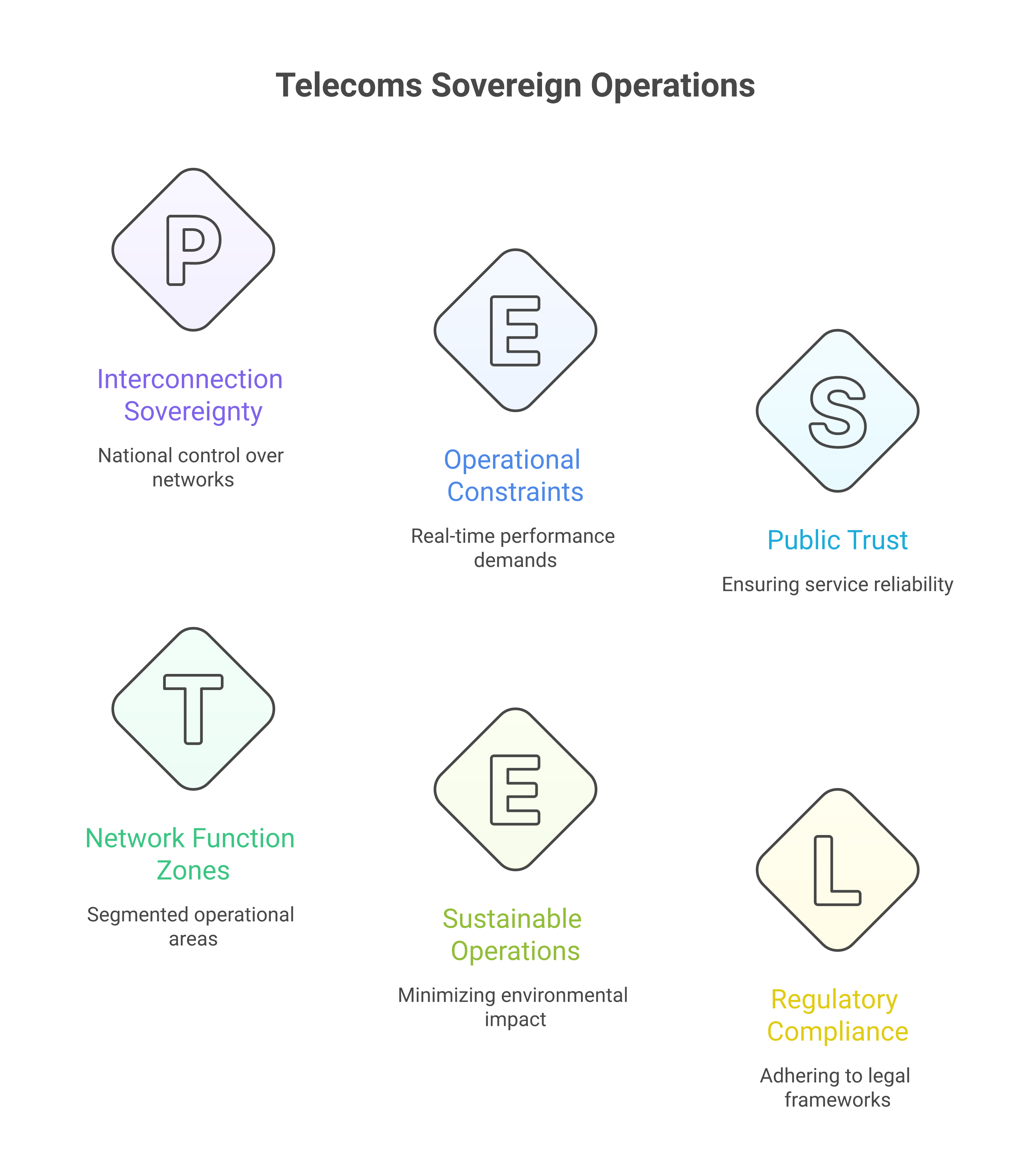
A large telecommunications operator presents a distinct set of sovereign operations challenges. Telecoms networks are classified as critical national infrastructure in most jurisdictions, subject to obligations under NIS 2 [6] and national security legislation that can impose requirements going well beyond those faced by other regulated sectors. The operator must maintain network availability for emergency services, law enforcement communications, and national resilience scenarios. Its infrastructure spans national borders for interconnection purposes, yet national regulators demand that the control and management planes for domestic network functions remain under national jurisdiction.
Beyond NIS 2, the telecoms sector operates under a layered regulatory framework (see Chapter 3). The European Electronic Communications Code (EECC) [18] establishes security and integrity obligations for providers of electronic communications networks and services, including incident reporting requirements and expectations for network resilience that inform how sovereign zones for network functions are designed and monitored. In the United Kingdom, the Telecommunications (Security) Act 2021 [19] imposes specific security duties on providers, with a Code of Practice that mandates network segmentation, supply-chain risk management and continuous monitoring of critical infrastructure — requirements that align closely with the eBPF-based and service-mesh-based observability patterns described in Chapter 8.
35.6.1 Network function sovereignty
Modern telecoms networks are increasingly software-defined. Network functions that were once implemented in proprietary hardware — core network elements, session border controllers, subscriber databases, policy and charging functions — now run as virtualised or containerised workloads on commodity infrastructure. This transformation, broadly described as network function virtualisation (NFV) [9] and its evolution into cloud-native network functions (CNFs), creates both an opportunity and a risk for sovereignty.
The opportunity is that software-defined network functions can, in principle, be deployed and managed with the same infrastructure-as-code, policy-as-code, and observability patterns described throughout this book. The risk is that the management and orchestration layers — the control planes that configure, scale, and monitor network functions — may themselves be hosted on platforms or by providers whose operational jurisdiction does not align with national security requirements.
The operator therefore defines sovereign zones that encompass not just the data plane (the infrastructure carrying customer traffic) but the control plane and management plane for network functions. The orchestration platform — typically an OpenShift-based environment running telecoms-specific workloads — is deployed within the sovereign boundary. Configuration management, software lifecycle management, and observability for network functions are all operated domestically. External vendor access for maintenance and support is mediated through controlled, auditable channels with session recording and just-in-time access provisioning.
35.6.2 Real-time operational requirements
Telecoms operations impose real-time constraints that are more stringent than those in most other sectors. Voice call setup must complete within defined timeframes measured in milliseconds. Emergency service routing must function under all conditions, including partial network failure. Signalling protocols operate on timescales where even modest latency increases can cause cascading failures across interconnected networks.
These constraints shape the agentic operations model in specific ways. Agent response loops must be designed with latency budgets that account for the time-criticality of telecoms operations. A planner agent evaluating a network fault cannot deliberate for minutes; it must produce recommendations within seconds if the affected network function supports real-time services. This may require pre-computed remediation plans — runbooks that have been compiled into decision trees optimised for rapid traversal — rather than the more deliberative reasoning appropriate for less time-sensitive domains.
Concert’s role in a telecoms context extends to the correlation of network performance indicators — call setup success rates, handover failure rates, signalling load — with infrastructure telemetry. When Concert observes that call setup failures are rising in a particular geographic area, it correlates this with the topology of network functions serving that area, recent configuration changes to those functions, and infrastructure health indicators from the hosting platform. The resulting situation assessment and recommendation are enriched with telecoms-specific context that a generic AIOps platform would lack.
35.6.3 Cross-border interconnection and sovereignty boundaries
Telecoms networks are inherently interconnected. Domestic operators exchange traffic with international carriers, roaming partners, and content delivery networks. These interconnection points are sovereignty boundaries: the point at which traffic, signalling, and management information cross from one jurisdictional domain to another.
The operator must manage these boundaries with particular care. Signalling protocols — SS7, Diameter, SIP — carry metadata about subscribers that is subject to data protection regulation. Interconnect traffic must be monitored for security threats, including signalling attacks that exploit protocol vulnerabilities to track subscribers or intercept communications. The observability plane must extend to interconnection points, providing visibility into cross-border traffic patterns without itself creating a data sovereignty violation by exporting subscriber metadata to an analytics platform outside the jurisdiction.
Policy-as-code guardrails at interconnection boundaries enforce constraints on what data may cross, what signalling messages are permitted, and what management operations may be initiated from external sources. These guardrails operate at the network function level, complementing the infrastructure-level policies applied to the hosting platform.
35.6A Manufacturing and industrial operations
Although this chapter’s detailed scenarios focus on financial services, public sector, healthcare and telecommunications, manufacturing and industrial operations represent a growing area of sovereign cloud adoption that warrants brief treatment. The regulatory landscape for connected manufacturing is shaped by three instruments discussed in Chapter 3. The EU Cyber Resilience Act (CRA) [20] imposes cybersecurity requirements on products with digital elements — including industrial IoT devices, programmable logic controllers and connected machinery — covering vulnerability handling, software bill of materials and security update obligations that affect both the products a manufacturer ships and the operational technology it uses on its own factory floor. IEC 62443 [21] provides the detailed security framework for industrial automation and control systems (IACS), defining zones and conduits that must be mapped onto the sovereign zone model, with security levels assigned based on threat analysis and enforced through policy-as-code. The EU Machinery Regulation [22], which replaces the Machinery Directive from 2027, introduces cybersecurity requirements for machinery with digital components, requiring manufacturers to address risks arising from software updates, connectivity and potential corruption of safety functions. For sovereign estates hosting manufacturing workloads, these frameworks demand that OT networks and IT networks are segmented, monitored and governed as distinct but interconnected sovereign zones, with the observability plane extending to cover industrial protocols, PLC state changes and safety system events alongside conventional cloud telemetry.
IBM Maximo [23] provides the asset management and predictive maintenance foundation that connects physical plant operations to the sovereign operations architecture. Maximo maintains a comprehensive asset registry — equipment hierarchies, maintenance histories, condition sensor feeds and work order lifecycles — that represents the OT estate’s equivalent of Concert’s application topology. When Maximo’s asset data is integrated into Concert’s topology model, the operations plane gains visibility into the relationship between IT service health and physical asset state: a degraded edge cluster at a factory site can be correlated with the Maximo work orders and sensor readings for the production line it supports, enabling agentic workflows that consider both IT remediation and operational impact on manufacturing schedules. For sovereign deployments, Maximo Application Suite can be deployed on Red Hat OpenShift within the factory’s edge sovereign zone, keeping asset telemetry and maintenance records within the jurisdictional boundary while feeding aggregated operational signals to the central observability plane.
35.7 Cross-industry patterns and lessons
Having examined four industry contexts in some detail, it is worth stepping back to identify what all of them share and where they diverge. The patterns that recur across industries represent the strongest validation of the architectural principles developed throughout this book; the divergences represent the tuning parameters that architects must calibrate for their specific context.
35.7.1 What all industries share
Every sector examined in this chapter shares five structural patterns.
First, sovereign zones are explicit, architected constructs. In every case, the organisation has moved beyond vague contractual assurances about data location to define zones with precise technical boundaries — cloud accounts, cluster configurations, network topologies, identity domains — that are enforced by infrastructure-as-code and policy-as-code, not merely documented in policy papers. National cybersecurity guidance frameworks reinforce this pattern: the UK National Cyber Security Centre’s cloud security principles [10], for example, provide a structured assessment model that maps directly onto the zone-boundary and access-control decisions every sector must make.
Second, zero-copy integration reduces uncontrolled data replication. Whether the data in question is payment transactions, tax returns, patient records, or subscriber information, the pattern is the same: systems of record expose data through governed APIs and event streams, and downstream consumers operate on projections rather than independent copies. This reduces the regulatory surface area, improves data freshness, and makes flows observable.
Third, the observability plane operates in business semantics, not just infrastructure metrics. Payment events, tax lifecycle events, patient journey events, and network performance indicators all serve as first-class operational signals that are correlated with infrastructure telemetry by Concert to produce situation assessments meaningful to both engineers and business stakeholders.
Fourth, agentic operations follow a graduated autonomy model with explicit guardrails. In no sector does the organisation grant agents unrestricted access to production systems. Instead, agents operate within policy-bounded scopes, with human approval required for actions above defined risk thresholds, and with comprehensive audit trails capturing every observation, proposal, authorisation, and execution.
Fifth, regulatory compliance is a continuous operational property, not a periodic exercise. The compliance signal fabric described in Chapter 10, combined with Concert’s posture dashboard and the evidence-by-default design principle, enables every sector to demonstrate ongoing compliance rather than producing point-in-time audit snapshots.
35.7.2 Where industries diverge
The divergences are equally instructive.
Autonomy levels and failure tolerances vary dramatically. A financial services agent authorised to reroute payment traffic to a backup acquirer operates in a domain where the consequence of a suboptimal decision is measured in interchange fees and merchant experience — significant, but recoverable. A healthcare agent operating near clinical decision-making confronts consequences that may be irreversible. A telecoms agent managing real-time network functions operates under latency constraints that preclude the deliberative reasoning appropriate for less time-critical domains. The autonomy framework must be calibrated for each sector’s specific risk profile.
Regulatory specificity varies in both content and enforcement style. DORA prescribes specific incident reporting timelines, third-party oversight mechanisms, and resilience testing requirements with a level of detail that healthcare regulation does not yet match for operational technology. NIS 2 imposes broad obligations on essential service providers but leaves much of the implementation detail to national transposition. Public-sector obligations may derive from constitutional law, administrative procedure requirements, and freedom-of-information legislation that have no direct analogue in private-sector regulation. The compliance mapping from architectural patterns to regulatory obligations is necessarily sector-specific.
Transparency expectations differ qualitatively. A bank must demonstrate to its supervisor that its ICT risk management framework is effective. A tax authority must demonstrate to its citizens — and to democratic oversight bodies — that its automated systems are fair, accurate, and subject to meaningful human control. A healthcare provider must demonstrate to clinicians, patients, and medical regulators that its decision support tools are clinically validated and safe. The depth and audience of the transparency obligation shapes the design of audit trails, explainability mechanisms, and human override procedures.
The political dimension is most pronounced in the public sector and telecoms, where operational decisions about cloud providers, AI model suppliers, and infrastructure partners carry geopolitical implications that go beyond commercial considerations. A bank choosing between cloud providers is making a business decision; a national tax authority or a critical infrastructure operator making the same choice is making a sovereignty decision that may be subject to political scrutiny and national security review.
35.7.3 Portable lessons
Three lessons are portable across all four sectors.
The first is that sovereignty must be designed into the architecture, not bolted on. Organisations that attempt to retrofit sovereign zones onto an estate built without sovereignty in mind face a painful and expensive migration. Those that begin with explicit zone definitions, even if initially limited to a single critical service, create an extensible foundation.
The second is that agentic operations are only as safe as the substrate they operate on. Agents amplify the capabilities of the observability plane, the event fabric, the runbook library, and the policy-as-code framework. If those foundations are weak — if observability is patchy, if runbooks are incomplete, if policies are not machine-enforceable — then agents will either be ineffective or dangerous. The maturity model of Chapter 33 applies regardless of sector.
The third is that regulatory frameworks are converging in direction even as they diverge in detail. DORA, NIS 2, GDPR, the EU AI Act [8], and their national-level implementations all point in the same direction: operational transparency, demonstrable control, continuous compliance, and meaningful human oversight of automated systems. ENISA’s analysis of the European cloud cybersecurity market confirms this convergence, noting that security expectations across sectors are increasingly aligned around common principles of supply-chain transparency, operational accountability, and continuous assurance [11]. An organisation that builds for these principles — rather than for the letter of any single regulation — will find itself better prepared for the regulatory developments that are already visible on the horizon.
Key Takeaways
- The same architectural patterns — sovereign zones, zero-copy integration, observability planes, agentic operations with guardrails — apply across financial services, public sector, healthcare, and telecommunications, but must be calibrated for each sector’s regulatory constraints, failure tolerances, and transparency expectations.
- DORA imposes specific obligations on financial entities that map directly onto the agentic governance framework: agent classification within ICT risk management, incident reporting that includes automated action audit trails, and third-party risk management for AI model providers.
- Public-sector sovereign operations carry a democratic accountability dimension that demands event lineage not merely for operational diagnosis but for demonstrating to citizens and oversight bodies that automated systems behaved as intended.
- Healthcare places the highest bar on agent autonomy, requiring clinical validation, strict zone containment for patient data, and an unambiguous principle that clinical agents advise but never decide.
- Telecommunications operations impose real-time constraints that shape agent response loops, require sovereignty over control and management planes as well as data planes, and demand careful governance of cross-border interconnection points.
- Regulatory frameworks are converging on common expectations — operational transparency, continuous compliance, demonstrable control — even where the specific requirements differ in detail and enforcement style.
- Sovereignty must be an architectural property designed in from the start, not a compliance layer added after the estate is built.
Bridge to Chapter 36 — Case Studies
This chapter has shown how the reference patterns of this book adapt when they meet the specific constraints of regulated industries. The scenarios are deliberately generalised — no single bank, tax authority, hospital, or telecoms operator will match any of them exactly. Chapter 36 moves from generalised industry patterns to specific case studies: real-world implementations where organisations have applied sovereign operations principles to their estates, confronted the practical challenges of migration and coexistence, and produced measurable outcomes. Where this chapter asks “what should it look like?”, the next chapter asks “what did it actually look like, and what was learned?”
References
[1] European Parliament and Council of the European Union, “Regulation (EU) 2022/2554 of the European Parliament and of the Council of 14 December 2022 on digital operational resilience for the financial sector (Digital Operational Resilience Act — DORA),” Official Journal of the European Union, vol. L 333, pp. 1–79, Dec. 2022. [Online]. Available: https://eur-lex.europa.eu/legal-content/EN/TXT/?uri=CELEX%3A32022R2554
[2] European Parliament and Council of the European Union, “Regulation (EU) 2016/679 of the European Parliament and of the Council of 27 April 2016 on the protection of natural persons with regard to the processing of personal data and on the free movement of such data (General Data Protection Regulation),” Official Journal of the European Union, vol. L 119, pp. 1–88, Apr. 2016. [Online]. Available: https://eur-lex.europa.eu/legal-content/EN/TXT/?uri=CELEX%3A32016R0679
[3] Bank of England, Prudential Regulation Authority, “Operational Resilience: Impact Tolerances for Important Business Services,” Supervisory Statement SS1/21, Mar. 2021. [Online]. Available: https://www.bankofengland.co.uk/prudential-regulation/publication/2018/building-the-uk-financial-sectors-operational-resilience
[4] Apache Software Foundation, “Apache Kafka Documentation,” 2024. [Online]. Available: https://kafka.apache.org/documentation/
[5] IBM Corporation, “IBM Concert Documentation,” IBM Cloud Docs, 2024. [Online]. Available: https://www.ibm.com/docs/en/concert
[6] European Parliament and Council of the European Union, “Directive (EU) 2022/2555 of the European Parliament and of the Council of 14 December 2022 on measures for a high common level of cybersecurity across the Union (NIS 2 Directive),” Official Journal of the European Union, vol. L 333, pp. 80–152, Dec. 2022. [Online]. Available: https://eur-lex.europa.eu/legal-content/EN/TXT/?uri=CELEX%3A32022L2555
[7] European Parliament and Council of the European Union, “Regulation (EU) 2017/745 of the European Parliament and of the Council of 5 April 2017 on medical devices (Medical Device Regulation — MDR),” Official Journal of the European Union, vol. L 117, pp. 1–175, May 2017. [Online]. Available: https://eur-lex.europa.eu/legal-content/EN/TXT/?uri=CELEX%3A32017R0745
[8] European Parliament and Council of the European Union, “Regulation (EU) 2024/1689 of the European Parliament and of the Council of 13 June 2024 laying down harmonised rules on artificial intelligence (Artificial Intelligence Act),” Official Journal of the European Union, vol. L, Jun. 2024. [Online]. Available: https://eur-lex.europa.eu/legal-content/EN/TXT/?uri=CELEX%3A32024R1689
[9] ETSI, “Network Functions Virtualisation (NFV); Architectural Framework,” ETSI GS NFV 002, v1.2.1, Dec. 2014. [Online]. Available: https://www.etsi.org/deliver/etsi_gs/NFV/001_099/002/01.02.01_60/gs_NFV002v010201p.pdf
[10] National Cyber Security Centre (UK), “Cloud Security Guidance,” NCSC, London, UK, 2024. [Online]. Available: https://www.ncsc.gov.uk/collection/cloud
[11] European Union Agency for Cybersecurity (ENISA), “Cloud Cybersecurity Market Analysis,” ENISA, Athens, Greece, 2023. [Online]. Available: https://www.enisa.europa.eu/publications/cloud-cybersecurity-market-analysis
[12] European Parliament and Council of the European Union, “Regulation (EU) 2023/1114 on markets in crypto-assets (MiCA),” Official Journal of the European Union, vol. L 150, pp. 40–205, Jun. 2023. [Online]. Available: https://eur-lex.europa.eu/legal-content/EN/TXT/?uri=CELEX%3A32023R1114
[13] PCI Security Standards Council, “Payment Card Industry Data Security Standard (PCI DSS), Version 4.0,” PCI SSC, Wakefield, MA, USA, Mar. 2022. [Online]. Available: https://www.pcisecuritystandards.org/document_library/
[14] Federal Risk and Authorization Management Program (FedRAMP), “FedRAMP Authorization Framework,” General Services Administration, Washington, DC, USA, 2024. [Online]. Available: https://www.fedramp.gov/
[15] European Union Agency for Cybersecurity (ENISA), “European Cybersecurity Certification Scheme for Cloud Services (EUCS),” ENISA, Athens, Greece, 2024. [Online]. Available: https://www.enisa.europa.eu/publications/eucs-cloud-service-scheme
[16] U.S. Department of Health and Human Services, “HIPAA Security Rule: Security Standards for the Protection of Electronic Protected Health Information,” 45 CFR Parts 160, 162, and 164, Feb. 2003 (as amended). [Online]. Available: https://www.hhs.gov/hipaa/for-professionals/security/index.html
[17] U.S. Food and Drug Administration, “21 CFR Part 11: Electronic Records; Electronic Signatures,” Code of Federal Regulations, Title 21, Part 11, U.S. Government Publishing Office, Washington, DC, 1997 (as amended). [Online]. Available: https://www.ecfr.gov/current/title-21/chapter-I/subchapter-A/part-11
[18] European Parliament and Council of the European Union, “Directive (EU) 2018/1972 establishing the European Electronic Communications Code (EECC),” Official Journal of the European Union, vol. L 321, pp. 36–214, Dec. 2018. [Online]. Available: https://eur-lex.europa.eu/legal-content/EN/TXT/?uri=CELEX%3A32018L1972
[19] UK Parliament, “Telecommunications (Security) Act 2021,” Chapter 31, London, UK, Nov. 2021. [Online]. Available: https://www.legislation.gov.uk/ukpga/2021/31
[20] European Parliament and Council of the European Union, “Regulation (EU) 2024/2847 on horizontal cybersecurity requirements for products with digital elements (Cyber Resilience Act — CRA),” Official Journal of the European Union, vol. L, Nov. 2024. [Online]. Available: https://eur-lex.europa.eu/legal-content/EN/TXT/?uri=CELEX%3A32024R2847
[21] International Electrotechnical Commission, “IEC 62443: Industrial Communication Networks — Network and System Security,” IEC, Geneva, Switzerland, 2018–2024 (multi-part standard). [Online]. Available: https://www.iec.ch/cyber-security
[22] European Parliament and Council of the European Union, “Regulation (EU) 2023/1230 on machinery products (EU Machinery Regulation),” Official Journal of the European Union, vol. L 165, pp. 1–87, Jun. 2023. [Online]. Available: https://eur-lex.europa.eu/legal-content/EN/TXT/?uri=CELEX%3A32023R1230
[23] IBM Corporation, “IBM Maximo Application Suite: Intelligent Asset Management,” IBM Documentation, Armonk, NY, USA, 2024. [Online]. Available: https://www.ibm.com/products/maximo
Sovereign Cloud Operations: AI-Driven Management of Sovereign Estates
© 2026 by Alan Hamilton
is licensed under CC BY-SA 4.0


