Introduction
The Case for Zero-Copy Integration and a Guide to This Book
The Condition We Are In
The enterprise technology estate of the mid-2020s is defined by a contradiction that every senior technology leader will recognise with some discomfort. Organisations have invested more than a decade of capital, engineering effort, and organisational attention in making data more accessible, more analytically rich, and more operationally useful. The dominant architectural method for achieving that ambition has been to replicate data everywhere. Copies flow from systems of record into data warehouses, from warehouses into lakes, from lakes into feature stores, from feature stores into AI training environments, and then outward again into downstream applications, partner ecosystems, and analytical sandboxes. What began as a series of individually reasonable engineering decisions has accumulated into an enterprise condition: integration by proliferation.
That condition is now breaking down simultaneously on four fronts. It is breaking down economically, as cloud egress fees turn cross-domain, hybrid and multi-cloud data movement into a board-level cost exposure that FinOps teams are increasingly unable to contain through optimisation alone. It is breaking down legally, as digital sovereignty obligations evolve from the relatively simple question of where data is stored to the considerably more complex questions of who controls the platform, who operates it, where computation occurs, and whether the administrative access of a cloud provider’s engineering staff constitutes a regulated data transfer in the jurisdiction of the data subject. It is breaking down operationally, as architectures built on the assumption of reliable, low-latency, always-available connectivity fail with increasing frequency and consequence under real-world outage conditions — exposing the fragility of integration models that treat network availability as a given rather than as a design parameter. And it is breaking down strategically, as the emergence of enterprise AI creates a new and exacting demand for data that is current, authoritative, and traceable — precisely the qualities that copy-centric pipelines, with their inherent lag, drift, and uncertain provenance, systematically undermine.
These are not temporary conditions. They are structural features of the environment in which enterprises now operate, and because they are structural, they require a structural architectural response.
The Response: Zero-Copy Integration
This book argues that the required response is Zero-Copy Integration: an architectural discipline that accesses data where it resides rather than copying it to where processing occurs, propagates state changes as lightweight events rather than bulk data transfers, and governs every data access through a unified policy and observability framework that makes the enterprise’s integration estate visible, auditable, and defensible under regulatory scrutiny.
Zero-Copy Integration is not a single product, nor a rebranding of an existing technology category, nor a promise of an absolute prohibition on all data movement. It is a set of design principles and implementation patterns that together reduce unnecessary replication, enforce sovereignty constraints by design rather than by procedure, build resilience into the integration fabric through architectural choices rather than operational heroics, and create the conditions under which AI and analytical workloads can operate on authoritative, governed data without accumulating uncontrolled copies of the enterprise’s most sensitive assets.
The distinction that matters is one of intent and governance rather than technology. Copy-first architectures create persistent replicas as the default mechanism of integration — the path of least resistance for individual engineering teams, even when the aggregate cost of that path to the enterprise is substantially higher than governed alternatives. Zero-Copy architectures create data copies only where specifically justified by operational requirements — controlled, time-bounded, purpose-specific caches, snapshots, and durable event logs — and subject every such justified copy to the governance framework that makes it visible, attributable, and eliminable when its justification lapses. The metric of success is not ideological purity about data movement; it is the reduction of what this book terms the integration tax: the total cost, risk, and operational burden created by unnecessary movement and unmanaged copies across the enterprise’s full integration estate.
Who This Book Is For
This book is written for senior technology leaders and principal architects who are responsible for the strategic direction of enterprise integration and data architecture. It addresses simultaneously three audiences whose concerns, whilst distinct, are deeply interconnected.
Chief Information Officers and Chief Technology Officers will find in these pages a structured argument for why the current integration paradigm is becoming untenable, a clear articulation of the business case for Zero-Copy transformation, and the governance and organisational frameworks that determine whether a transformation programme of this scale succeeds or stalls. The chapters on the sovereign operating model, the maturity model, the three-year transformation agenda, and the strategic advantages of the Zero-Copy enterprise are written specifically for the technology leader who must make and sustain the investment case at board level.
Chief and lead architects will find a comprehensive technical framework that addresses every major dimension of enterprise integration: the data, application integration, and event planes that constitute the architecture’s technical foundation; the network topology, security, observability, and resilience disciplines that make it operationally deployable; the integration fabric that unifies the planes under a coherent governance and operational model; and the six reference blueprints that translate the framework’s principles into deployable patterns for the scenarios most commonly encountered in regulated, multi-cloud enterprises.
Platform, security, and data governance leaders will find a detailed treatment of the policy-as-code frameworks, identity federation models, secrets management disciplines, and lineage capture mechanisms that translate compliance obligations into enforced system properties — policies that the architecture makes impossible to bypass by accident or expedience, rather than guidelines that depend on individual operator discipline for their consistent application.
The book uses IBM’s enterprise technology portfolio — IBM watsonx.data, IBM Cloud Pak for Integration, IBM Knowledge Catalog, IBM API Connect, IBM Event Streams, IBM MQ, IBM DataPower, IBM Guardium, IBM Instana, IBM Hyper Protect, Red Hat OpenShift, HashiCorp Terraform, and HashiCorp Vault — as the primary implementation reference, because these platforms together represent one of the most mature and comprehensive available implementations of the Zero-Copy architectural principles in a production enterprise context. It also examines the open-source ecosystem — Apache Kafka, Apache Iceberg, Open Policy Agent, OpenLineage, OpenTelemetry, and the CNCF project landscape — that provides the portability, standards-based independence, and community-driven innovation that the architecture requires to remain viable across the inevitable evolution of the vendor landscape. The underlying principles are transferable across platforms; the goal is to equip the reader to reason clearly about trade-offs so that the architecture remains coherent as providers, products, and regulations evolve.
The Structural Framework: Three Planes and a Control Layer
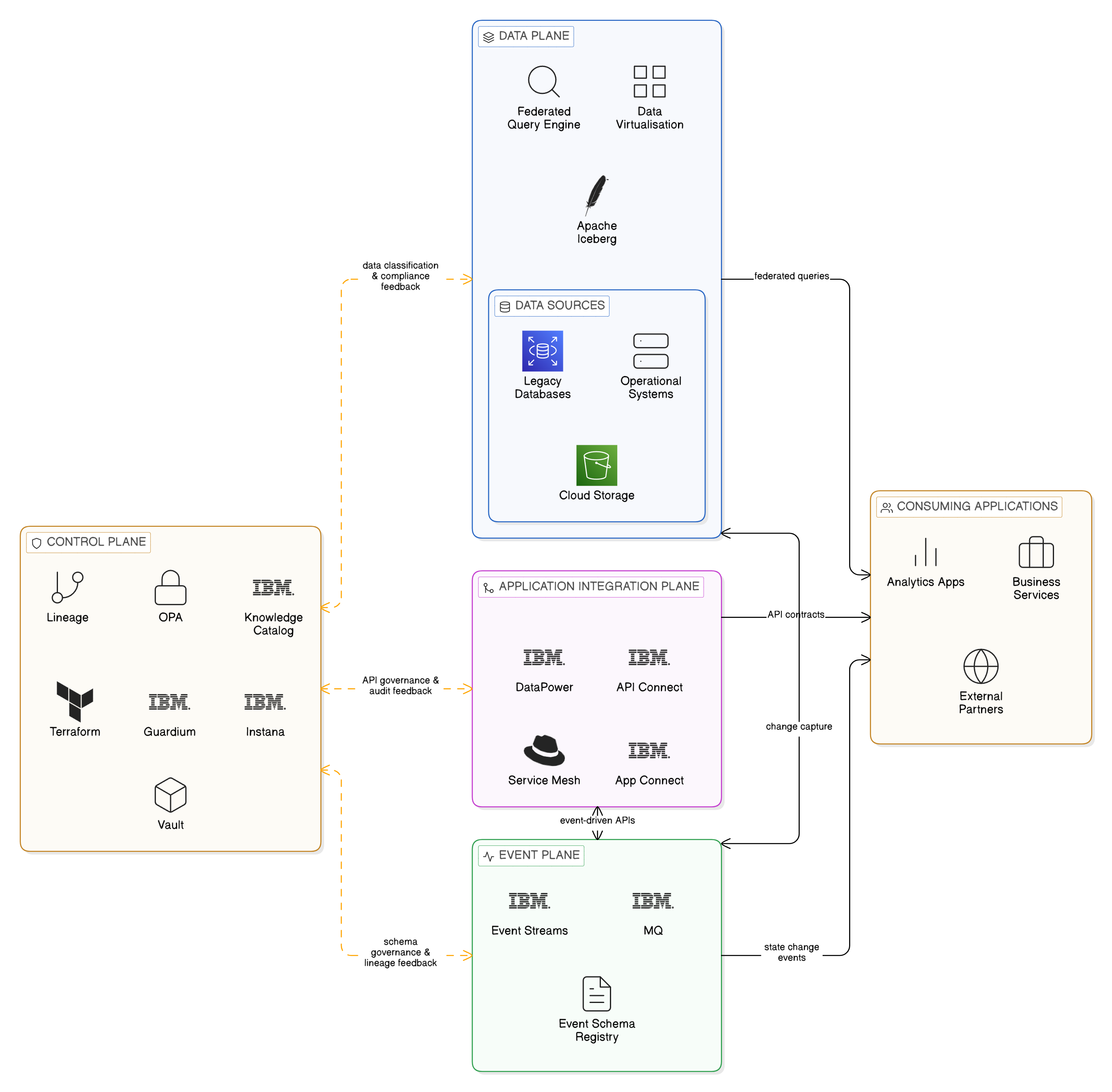
A useful way to reason about Zero-Copy Integration before entering the detailed chapters is to understand its structural decomposition into three interacting integration planes, each addressing a distinct class of integration requirement, governed by a common Control Plane that enforces the enterprise’s sovereignty, security, and access policies across all three.
The Data Plane addresses integration requirements concerned with access to existing data. In conventional integration architectures, the Data Plane is implemented primarily through replication: extract the data from its source, load it into a consuming system or analytical environment, and manage the resultant copies as the enterprise’s analytical and operational infrastructure. In the Zero-Copy architecture, the Data Plane is implemented through federation and virtualisation: federated query engines execute analytical workloads at or near the data source, returning results rather than raw data to consuming systems; data virtualisation layers present distributed data assets as unified logical views without physical consolidation; and Apache Iceberg open table formats provide the storage-layer foundation for multi-engine access to the same data assets without format-specific replication. The Data Plane’s primary value is the elimination of the analytical data copies — the data warehouses populated from operational systems, the data marts extracted from warehouses, the feature stores derived from marts — that constitute the largest proportion of most enterprises’ replication-driven cost and compliance exposure.
The Application Integration Plane addresses integration requirements concerned with mediated interaction between applications and services. Its primary mechanism is the API contract: a published, versioned interface definition that defines what a service will provide, to whom, under what conditions, and with what governance obligations, without exposing the service’s internal data model to consuming applications. API-first design, governed by IBM API Connect and enforced by IBM DataPower, eliminates the shared-database integration patterns that create tight coupling between applications and the data replication that tight coupling necessitates. IBM App Connect Enterprise provides the integration mediation and connectivity that enables governed inter-application communication across the full range of enterprise systems, protocols, and data formats. Service mesh infrastructure through Red Hat OpenShift Service Mesh enforces security, observability, and traffic management policies at the service-to-service communication layer.
The Event Plane addresses integration requirements concerned with the propagation of state changes across the enterprise. Its primary mechanism is event streaming: the publication of lightweight, schema-governed notifications that communicate what has happened in a business domain, without replicating the full state of the domain to every consuming system. IBM Event Streams, built on Apache Kafka, provides the durable, high-throughput event backbone; IBM MQ provides the transactional messaging layer for the class of integration requirement — payment instructions, reservation confirmations, legally binding notifications — that demands exactly-once, ordered delivery guarantees. The Event Plane replaces bulk data synchronisation with event-driven data access: consuming systems that require current state access the data through the Data Plane’s governed interfaces; they receive notification of change through the Event Plane’s event streams. The persistent data copy that bulk synchronisation creates is replaced by a durable event log from which state can be reconstructed, and from which consuming systems resume processing after a failure without requiring a data snapshot restore.
The Control Plane is not a fourth integration plane but the governance layer that spans and enforces policy across all three. It encompasses the data classification framework maintained in IBM Knowledge Catalog; the access control policies expressed in Open Policy Agent and enforced by the Data, Application Integration, and Event planes; the lineage capture implemented through OpenLineage and surfaced through the Knowledge Catalog; the audit monitoring provided by IBM Guardium; and the observability infrastructure implemented through IBM Instana and OpenTelemetry. The Control Plane also includes the infrastructure provisioning discipline provided by HashiCorp Terraform — which ensures that the sovereign zone topology is created and maintained consistently through version-controlled infrastructure declarations — and the secrets management discipline provided by HashiCorp Vault, which eliminates the credential proliferation that is the security equivalent of data replication.
Together, these three planes and the Control Plane constitute the Zero-Copy Integration architecture. Each chapter of this book examines one or more dimensions of this architecture in the depth that a practitioner requires to design, implement, and operate it in an enterprise context.
The Book’s Architecture: A Guide to the Chapters
The book is organised into seven parts, each addressing a distinct dimension of the Zero-Copy enterprise. What follows is a chapter-by-chapter guide that explains what each chapter covers, what argument it develops, and how it connects to the chapters that precede and follow it.
Part I — Strategy: The Case for Change (Chapters 1–3)
The first three chapters establish why Zero-Copy Integration is necessary. They are written primarily for technology leaders who need to understand and articulate the structural case for change, and for architects who need the strategic context that makes individual technical decisions coherent.
Chapter 1 — The Zero-Copy Necessity in a Fragmented Digital World opens by characterising the current condition with precision: the multi-cloud estate in which data gravity, egress economics, and sovereignty obligations combine to make the copy-centric integration model not merely expensive but structurally untenable. It introduces the four structural forces — egress economics, digital sovereignty, network fragility, and the AI shift — that are individually significant and collectively transformative. It establishes the Zero-Copy philosophy not as an ideological preference but as the architectural consequence of taking these forces seriously, and introduces the three integration planes that give the philosophy structural expression.
Chapter 2 — Data Gravity, Egress Economics, and the Sovereign Cost Trap develops the economic argument in full quantitative depth. It examines how data gravity — the magnetic pull that large data concentrations exert on the compute and services that need to access them — creates the conditions for the sovereign cost trap: the compounding cycle of replication, lock-in, and escalating egress charges that makes escape from copy-centric integration progressively more expensive the longer it is deferred. It provides the quantitative framework for the Zero-Copy business case, examining the four integration patterns — federated query, event-driven synchronisation, API virtualisation, and change data capture — through which the enterprise escapes the gravitational well without sacrificing analytical or operational capability.
Chapter 3 — The New Landscape of Digital Sovereignty examines the regulatory dimension of the Zero-Copy necessity in full contemporary detail. Data sovereignty has evolved from the relatively simple geographic residency requirements of a decade ago into a multi-layered obligation that now extends to operational control, administrative access, key management jurisdiction, and AI inference locality. Chapter 3 examines the European regulatory collision — the interaction of GDPR, the Data Act’s positive data sharing obligations, the EU AI Act’s governance requirements, and the NIS2 operational resilience framework — alongside the global regulatory trajectory: India’s DPDP Act, China’s PIPL and Data Security Law, the proliferating US state privacy legislation, and the post-Brexit UK framework. The chapter concludes by describing what architectural sovereignty actually requires in 2025 and beyond — a specification that goes considerably beyond the location of a data centre and into the design of the integration architecture itself.
Part II — Architecture: The Three Planes (Chapters 4–7)
The four chapters of Part II develop the technical architecture of Zero-Copy Integration in depth, moving from the structural framework to the detailed design of each of the three integration planes.
Chapter 4 — The Three Integration Planes of the Zero-Copy Enterprise introduces the architectural framework that structures the book’s entire technical discussion. It establishes the Data Plane, the Application Integration Plane, and the Event Plane as the three distinct but interdependent technical domains of the Zero-Copy architecture, each addressing a different class of integration requirement and each governed by the common Control Plane. The chapter develops the design principles of each plane — federation and virtualisation for the Data Plane; contract-first, API-governed integration for the Application Integration Plane; event-driven, schema-governed state propagation for the Event Plane — and examines how the three planes interact in practice to produce an integration architecture that is simultaneously capable, governable, and economically disciplined. This is the chapter to which practitioners will return most frequently as a conceptual reference when navigating the detailed treatment of each plane in subsequent chapters.
Chapter 5 — The Zero-Copy Data Layer provides the full technical treatment of the Data Plane. It examines the distinctions between data virtualisation, data federation, and the logical data warehouse; the in-place compute patterns that make federated data access performant at enterprise scale, including predicate pushdown, partition pruning, and cost-based query optimisation; the open-source foundation of Trino, Apache Arrow, Apache Iceberg, and Delta Lake; and IBM’s enterprise-grade contributions through watsonx.data, IBM Data Virtualization Manager, and IBM Cloud Pak for Data. It examines four critical architectural patterns in depth: jurisdiction-aware federated queries that route computation to the appropriate sovereign zone; federated machine learning without centralised training data; the sovereign lakehouse design that uses Apache Iceberg as the open table format for sovereign data storage; and the specific challenge of mainframe data estate access — the most frequently underaddressed dimension of enterprise data federation. The chapter closes by examining the resilience characteristics of a Data Plane that does not depend on persistent data replication for operational continuity.
Chapter 6 — Multi-Cloud Resilient Application Integration examines the Application Integration Plane in the context of the multi-cloud, microservice-oriented enterprise. It begins by characterising the failure modes of the integration patterns that the Application Integration Plane is designed to supersede — the shared-database integration, the direct service-to-service coupling, the bulk data synchronisation between application data stores — and establishes the API-first, contract-first design discipline as the architectural alternative. It examines the service mesh architecture, implemented through Red Hat OpenShift Service Mesh, as the intra-cluster enforcement layer for service-to-service communication policies; the API gateway architecture, implemented through IBM API Connect and IBM DataPower, as the inter-domain enforcement layer; and the composite API, cross-cloud federation, and resilient failover patterns that allow the Application Integration Plane to operate reliably across the fault domains of multi-cloud environments. The chapter also examines IBM App Connect Enterprise as the integration mediation and connectivity fabric that implements the integration flows connecting the full range of enterprise systems within the governed Application Integration Plane.
Chapter 7 — The Zero-Copy Event Layer provides the full technical treatment of the Event Plane. It examines events as the natural medium of Zero-Copy Integration — the fact that events communicate the occurrence of a state change without carrying the full state — and the implication that event-driven integration is not merely a technical choice but a sovereignty and economic choice: the enterprise that replaces bulk data synchronisation with event-driven integration simultaneously reduces its replication footprint, improves its resilience posture, and creates the real-time data access model that AI applications require. The chapter examines the Outbox pattern and the CDC (Change Data Capture) approach to reliable event production; event schema governance through Apache Avro and IBM Event Endpoint Management; the cross-cloud event mesh architecture that mirrors events across sovereign zones without creating persistent data copies; and IBM Event Automation — the unified platform combining IBM Event Streams, IBM Event Endpoint Management, and IBM Event Processing — as the enterprise-grade Event Plane implementation.
Part III — Enabling Disciplines (Chapters 8–12)
Part III examines the five enabling disciplines that must accompany the three integration planes if the architecture is to be deployed securely, observably, and resiliently at enterprise scale. These chapters address the cross-cutting concerns that apply across all three planes rather than the specific technical design of any one plane.
Chapter 8 — Security-by-Design for Zero-Copy Architectures establishes the reciprocal relationship between the Zero-Copy philosophy and enterprise security: Zero-Copy Integration reduces the attack surface that the security architecture must defend, whilst the security architecture provides the identity, policy enforcement, and monitoring mechanisms that make governed, in-place data access trustworthy and demonstrably compliant. The chapter examines Zero Trust architecture as the overarching security model; Open Policy Agent and Kyverno as the policy-as-code framework for application-level and infrastructure-level governance; HashiCorp Terraform as the infrastructure provisioning expression of the policy-as-code discipline — ensuring that sovereign zone infrastructure is created and maintained consistently; HashiCorp Vault as the dynamic secrets management layer that eliminates credential proliferation; attribute-based access control through IBM Security Verify; IBM Guardium for continuous data activity monitoring; IBM Hyper Protect for confidential computing and workload protection; identity federation through SPIFFE, SPIRE, and IBM Security Verify; encryption across the full data lifecycle — in transit, at rest, and in use; and IBM QRadar as the Security Operations Centre integration layer.
Chapter 9 — Integration Fabrics: The New Digital Backbone examines the enterprise integration fabric as the unifying layer that transforms the three technically distinct integration planes into a coherent, governed, observable enterprise integration capability. The chapter establishes the distinguishing characteristics of a genuine integration fabric — shared asset catalogue, unified access governance, common operational observability, and governance-enforced data flow control — and distinguishes the fabric from both its predecessor (the Enterprise Service Bus) and from the collection of separately managed integration products that falls short of the fabric model. It examines IBM Cloud Pak for Integration as the enterprise integration fabric implementation; the open-source ecosystem — Apache Camel, Kong, Apache Kafka, and the CNCF project landscape — that complements and interoperates with it; the roles of StreamSets and webMethods as governed participants in the fabric for specialist CDC and B2B integration scenarios; AI-assisted integration operations through IBM Instana; and the cross-cloud integration fabric blueprint that guides a production fabric design.
Chapter 10 — Network-Aware, Sovereign-Aware Integration Topologies addresses the topological dimension of Zero-Copy Integration: how the architecture should be arranged across the network. The chapter establishes that topology is determined not by governance preference but by the laws of physics, the realities of wide-area network behaviour, the requirements of data sovereignty, and the operational characteristics of the enterprise’s business — and examines each of these determinants in depth. It examines WAN physics and latency budgets; failure domain design and the architecture of resilience zones; smart routing through IBM DataPower’s jurisdiction-aware routing capabilities; edge integration patterns for manufacturing and retail environments; and the sovereign deployment topology that IBM Cloud Satellite and Red Hat Advanced Cluster Management enable — the distributed execution, centralised governance model that the integration fabric requires and that the Enterprise Service Bus model could not deliver.
Chapter 11 — Observability, Lineage, and Audit in Zero-Copy Environments examines the governance visibility mechanisms that make the Zero-Copy architecture demonstrably compliant rather than merely designed to be compliant. The chapter develops the critical argument that the shift from provenance lineage to access lineage is a governance transformation rather than a governance regression: the Zero-Copy model produces real-time access lineage records that are more informative and more directly relevant to regulatory compliance questions than the passive provenance artefacts of copy-centric architectures. It examines IBM Instana as the AI-powered operational observability platform; OpenTelemetry and OpenLineage as the open standards through which integration components expose their telemetry and lineage in a vendor-neutral format; IBM Knowledge Catalog as the lineage storage, search, and governance platform; IBM Turbonomic for cost attribution and integration economics visibility; and the federated observability pattern that retains raw telemetry within sovereign zones whilst enabling central operational visibility.
Chapter 12 — Business Continuity, Disaster Recovery, and Zero-Copy Resilience examines the resilience of the Zero-Copy architecture under failure conditions, arguing that the distributed architecture’s inherent resilience advantages — the event-driven, stateless integration patterns that recover from failure by resuming from a durable log — must be supplemented by deliberate recovery architecture design, governance discipline in the DR topology, and regular testing to satisfy the operational resilience requirements of DORA and comparable regulatory frameworks. The chapter examines failure domain analysis, recovery time and recovery point objective design, the BC/DR architecture for each of the three integration planes, chaos engineering as the validation methodology for DR capability, IBM Ansible Automation Platform for automated recovery orchestration, and the regulatory evidence requirements of DORA examination.
Part IV — Operations and Organisation (Chapters 13–15)
Part IV addresses the organisational architecture and operational model that sustain the Zero-Copy technical architecture over time. Technical architecture is the necessary but insufficient condition for Zero-Copy success; these three chapters examine the sufficient conditions.
Chapter 13 — The Sovereign-by-Design Operating Model establishes the organisational architecture of the Zero-Copy enterprise: the domain ownership model that distributes data governance accountability to the business domains that generate and understand data; the three-platform model that provides the shared infrastructure through which domain teams exercise that accountability — the data platform team operating IBM watsonx.data and IBM Knowledge Catalog, the integration platform team operating IBM Cloud Pak for Integration, and the application platform team operating Red Hat OpenShift; and the governance model that maintains enterprise-wide policy coherence across this federated structure through the Integration Centre of Excellence, the RACI framework, and the chargeback economics that create the incentive for Zero-Copy behaviour at the domain level. The chapter also examines the placement of HashiCorp Terraform and Vault within the three-platform model — Terraform as the application platform team’s infrastructure provisioning discipline, Vault as the shared secrets management infrastructure whose policy configuration the application platform team maintains — and the evolution of the CDO and CIO roles that the sovereign-by-design model demands.
Chapter 14 — Skills, Culture, and Talent for a Sovereign, Resilient Enterprise examines the human foundation of the Zero-Copy architecture: the specific technical skills, new organisational roles, and cultural dispositions that the operating model requires. The skills that the architecture demands — federated query optimisation, event-driven design, policy-as-code governance, distributed observability engineering, sovereignty architecture, and confidential computing — span disciplines that conventional enterprise IT organisations treat as separate functional groups, and the Zero-Copy operating model requires the cross-disciplinary literacy that bridges them. The chapter describes five new roles created by the operating model — the Domain Data Steward, the Integration Fabric Engineer, the Sovereignty Architect, the Observability Engineer, and the Data Governance Engineer — and examines the training pathways, communities of practice, and cultural incentive changes that build and sustain these capabilities.
Chapter 15 — The Zero-Copy Integration Maturity Model provides the diagnostic framework that allows the enterprise to assess its current state and navigate the staged journey from a copy-heavy Stage One integration estate to the fully sovereign Stage Four target state. The four-stage model — copy-heavy and point-to-point, distributed but fragile, federated and policy-driven, and fully sovereign — is assessed across four dimensions rather than one: technical architecture, governance framework, operating model, and economic incentives. The critical insight of the chapter is that the maturity of an integration estate is determined by the weakest of its four dimensions, not the strongest; an enterprise with Stage Three technology and Stage One governance is not a Stage Three enterprise but a Stage One enterprise with expensive underutilised platforms. The chapter also examines the governance integration of StreamSets and webMethods within the Stage Two to Stage Three transition — the principle that these platforms must be brought under the unified governance framework before the Stage Three model can be declared operational — and the characteristic anti-patterns that cause transformation programmes to stall or regress.
Part V — Patterns and Blueprints (Chapters 16–17)
Part V translates the architectural principles into deployable patterns and blueprints for the specific scenarios and sectors most relevant to regulated enterprise deployments.
Chapter 16 — Architectural Blueprints for the Sovereign, Resilient Enterprise presents six reference blueprints that each address a distinct and commonly encountered deployment scenario: Blueprint A for the regionally sovereign data fabric across jurisdictional boundaries; Blueprint B for the multi-cloud sovereign event mesh; Blueprint C for the API façade over the legacy and mainframe data estate; Blueprint D for federated analytics with distributed model training; Blueprint E for Zero-Copy Integration in SaaS-heavy enterprises; and Blueprint F for the sovereign BC/DR topology that provides operational continuity without jurisdictional violation. Each blueprint specifies structural principles, component architecture, design principles, operational indicators, and the Terraform provisioning requirement that ensures the DR twin infrastructure is identical to the primary deployment. The blueprints are structured around architectural principles rather than technology choices, ensuring transferability whilst providing the IBM platform recommendations that production governance requires.
Chapter 17 — Industry-Specific Sovereignty and Resilience Patterns examines the distinctive sovereignty and resilience requirements of five sectors in which the Zero-Copy architecture is most acutely required: financial services (DORA, BCBS 239, PCI-DSS, and the European sovereign cloud requirements of systemically important institutions); healthcare (GDPR, HIPAA, NHS DSPT, and the EHDS federated access model that exemplifies the Zero-Copy approach at regulatory scale); public sector (government cloud classifications, NIS2, and Official Sensitive data handling requirements); manufacturing (IT/OT convergence, edge connectivity, and the disconnected operation patterns of globally distributed production networks); and retail (loyalty data governance, payment card isolation, and supply chain event mesh architecture). The sector analysis reinforces the book’s broader theme: data sovereignty is not a single, uniform requirement but a family of requirements that the Zero-Copy architecture’s configuration model can accommodate because its principles — data locality, governed access, policy enforcement, jurisdiction-aware routing — can be configured to reflect any sector’s specific needs.
Part VI — Evidence and Horizon (Chapters 18–19)
Part VI grounds the architectural framework in operational experience and examines the technologies and regulatory developments that will shape the architecture’s evolution over the coming decade.
Chapter 18 — Case Studies in Sovereign and Resilient Integration presents three detailed operational case studies — a European banking group addressing DORA concentration risk and cross-national sovereignty compliance; an NHS healthcare provider replacing data copy proliferation with FHIR-governed, Zero-Copy patient data access; and a global manufacturer implementing real-time OT/IT integration across forty-three OpenShift clusters with disconnected operation capability. Each case study is examined with candour about the challenges encountered — the organisational work that consumed more time than the technical deployment, the scale testing that revealed disconnected operation failure modes in pre-production, the clinical workflow validation that governance assumptions without — as well as the outcomes achieved. The chapter then examines three anti-patterns that recur with sufficient frequency in enterprise integration transformation programmes to warrant careful examination: replication debt accumulation, governance framework as compliance theatre, and technology-ahead-of-organisation deployment.
Chapter 19 — AI, Quantum, and Decentralised Compute examines the technological and regulatory developments that will extend and amplify the Zero-Copy architecture’s requirements over the coming decade. It argues that the emergence of enterprise AI — particularly retrieval-augmented generation and agentic AI — does not replace the Zero-Copy integration architecture but extends it: RAG’s retrieval step is a Zero-Copy data access operation; AI inference locality extends the integration fabric’s jurisdiction-aware routing into the AI inference layer; and AI agent governance through IBM watsonx.governance and OPA provides the audit trail that agentic AI at enterprise scale requires. It examines post-quantum cryptography as a ten-year migration programme that must begin now with the harvest-now-decrypt-later threat already active, with NIST’s finalised ML-KEM, ML-DSA, and SLH-DSA algorithms and IBM Hyper Protect Crypto Services providing the HSM-backed foundation. It examines confidential computing — Intel TDX, AMD SEV-SNP, ARM TrustZone, and IBM Hyper Protect Virtual Servers — as the most significant near-term advance in the sovereign compute toolkit. And it examines the global regulatory horizon, with India’s DPDP Act, China’s PIPL and Data Security Law, and the EU AI Act adding new dimensions to sovereignty obligations across every jurisdiction in which large enterprises operate.
Part VII — Synthesis (Chapter 20)
Chapter 20 — The Fully Sovereign, Fully Resilient Enterprise is the book’s concluding synthesis. It describes the target state in the language of observable outcomes — what the fully sovereign enterprise looks like to the regulatory examiner, the security auditor, the FinOps analyst, and the board — rather than in the language of architectural components. It articulates six strategic advantages of the Zero-Copy enterprise: cost discipline, regulatory agility, operational resilience, security posture, data trustworthiness, and organisational capability for the AI era. It examines the technology leader’s mandate across its organisational, economic, political, and personal dimensions, with specific disciplines for building political momentum, connecting the investment to board-level risk management, and managing the chargeback transition. It provides a three-year transformation agenda that is connected explicitly to the maturity model stages and names specific deliverables for each year. It offers an honest assessment of what remains genuinely difficult in Zero-Copy transformation — the heterogeneous legacy estate, the vendor landscape evolution, the skills gap, and the governance discipline sustainability challenge — because intellectual honesty about difficulty is more useful to the practitioner than architectural triumphalism. And it closes with the argument that data sovereignty is increasingly a source of competitive advantage as well as a compliance obligation: the enterprise that can make and sustain credible, technically verified commitments about the governance of its customers’ data is building a trust-based competitive position that its less architecturally rigorous competitors cannot replicate without undertaking the same transformational investment.
How to Navigate This Book
Readers will approach this material with different goals and different starting points, and the book is designed to be navigated in multiple ways.
Those reading linearly will find that the book’s argument builds systematically: the strategic case in Part I establishes why the architecture is necessary; the architectural framework in Part II establishes what the architecture is; the enabling disciplines in Part III establish how it is secured, observed, and made resilient; the operational and organisational framework in Parts IV and V establish how it is sustained; the evidence in Part VI grounds the framework in operational reality; and the synthesis in Part VII provides the strategic integration that makes the whole coherent as a guide to action.
Those with specific immediate concerns may navigate directly. The CIO preparing a board paper on the data sovereignty risk exposure of the current integration estate should begin with Chapters 1 through 3, then read Chapter 20’s section on strategic advantages. The architect designing a new sovereign zone deployment should read Chapters 4, 8, 10, and 16. The platform engineer implementing an integration fabric governance model should read Chapters 9, 11, and 13. The security architect designing the credential and infrastructure provisioning model should read Chapter 8’s sections on Terraform and Vault in detail. The transformation programme leader designing a multi-year roadmap should read Chapters 15, 18, and 20 together as a coherent programme design framework.
Those who are already engaged in federated data or Zero-Copy initiatives will find the most immediate value in Chapters 8, 11, 13, and 15: the security architecture additions — particularly the Terraform and Vault treatment — the observability and lineage governance model, the operating model design, and the maturity model assessment, which together address the governance and operational dimensions that technically capable but organisationally underdeveloped Zero-Copy initiatives most commonly lack.
A Note on the Technology References
The IBM platform capabilities described in this book represent a specific point in time — the mid-2020s — in the evolution of a product portfolio that is actively developing. Product names, feature capabilities, and deployment models will continue to evolve, and the practitioner should consult current IBM documentation for the most recent capability descriptions.
The architectural principles, however, are more durable than any product configuration. The principle that data access should be governed by policy rather than trust; that sovereignty boundaries should be reflected in the deployment topology rather than managed by procedure; that credentials should be dynamically issued and automatically revoked rather than statically distributed; that integration costs should be attributed to the domains that incur them rather than socialised across the enterprise — these principles will remain valid and applicable regardless of how the specific products that implement them evolve. The reader who internalises the principles will navigate product evolution successfully; the reader who memorises product configurations will find them overtaken by the next release cycle.
A similar note applies to the open-source ecosystem. The projects named in this book — Apache Kafka, Apache Iceberg, Open Policy Agent, OpenLineage, OpenTelemetry, and others — represent the current state of an ecosystem that evolves more rapidly than any commercial product portfolio. The value of investing in open standards is precisely the portability they provide across this evolution: the enterprise whose architecture is expressed in Apache Iceberg table formats, OpenLineage lineage metadata, and OPA policy logic has invested in assets that can be operated with different execution engines as those engines mature, rather than in assets that are permanently dependent on a specific vendor’s continued investment in a specific product.
The Destination
The deeper purpose of Zero-Copy Integration is not simply to lower costs or satisfy regulators — though it does both. It is to enable a modern operating model in which applications and AI systems can act with real-time intelligence on authoritative data, without creating uncontrolled replicas of the enterprise’s most sensitive assets. When AI becomes fully operational — embedded in service operations, customer journeys, supply chains, clinical decisions, and risk management — the question is no longer whether the enterprise can analyse data. The question is whether it can do so authoritatively, sovereignly, and resiliently, with a complete and auditable record of what data was used, by which system, under what governance authorisation, at what time.
That is what Zero-Copy Integration is for. The chapters that follow provide the principles, the patterns, the platform guidance, and the operational disciplines to build it.
The author is a senior technical architect within IBM’s enterprise architecture practice, with experience spanning financial services, healthcare, public sector, and manufacturing organisations across European and global jurisdictions. The views expressed in this book are the author’s own and are grounded in the direct experience of designing, implementing, and governing enterprise integration architectures in the regulatory and operational conditions that the book describes.
If you are finding this content useful, please consider supporting the author's efforts by purchasing a complete digital or hard-copy version.
Zero-Copy Integration: Architecture for the Fragmented Enterprise
© 2026 by Alan Hamilton
is licensed under CC BY-SA 4.0


